
Critical Thinking & Problem Solving ESL Activities, Games & Worksheets
Basic Critical Thinking Skills
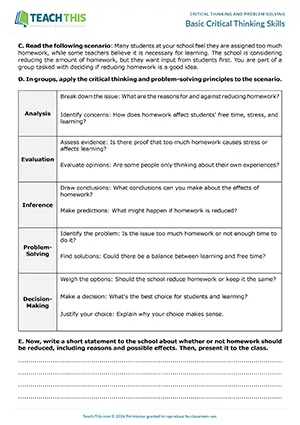
ESL Critical Thinking Worksheet - Reading and Writing Exercises: Writing a Paragraph - Speaking Activity: Presenting, Asking and Answering Questions - Group Work
Here is a useful critical thinking and problem-solving worksheet and activity to help students learn and apply basic critical thinking and problem-solving concepts...
My Ideal Partner

ESL Critical Thinking Activity - Speaking: Ranking, Expressing Opinions, Negotiating, Communicative Practice - Pair Work
In this interesting critical thinking activity, students prioritise and discuss the most important qualities of an ideal partner. First, students read a list of qualities that an ideal partner might have and...
Stress
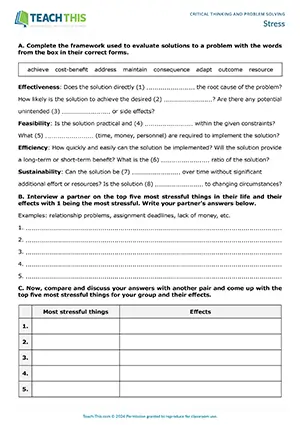
ESL Critical Thinking Activity - Vocabulary and Reading Exercise: Gap-fill - Speaking Activity: Discussion, Survey, Communicative Practice - Pair and Group Work
In this insightful critical thinking activity, students use a framework to look at the topic of stress and evaluate stress reduction and relaxation methods...
What's the Criterion?
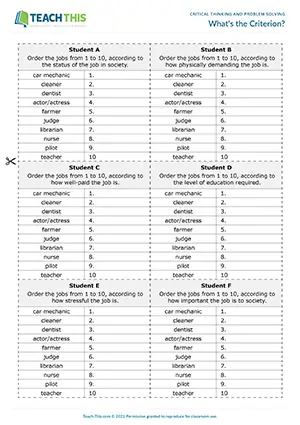
ESL Critical Thinking Game - Speaking: Ranking, Discussion, Guessing, Communicative Practice - Group Work
In this fun critical thinking game, students guess what criterion their classmates used to put a list of ten jobs in order. Working alone, students order jobs on their card, according to the given criterion with...
Your Views

ESL Critical Thinking Activity - Speaking: Discussion, Communicative Practice - Group Work
This intriguing critical thinking activity provides an opportunity for students to use their critical thinking skills to discuss a set of controversial questions. In groups of four, students read a set of...
Island Adventure
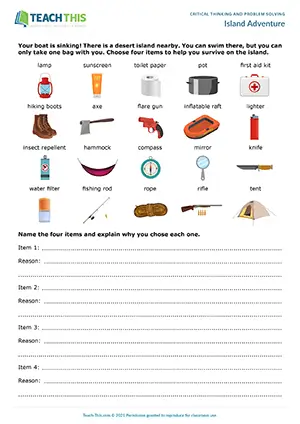
ESL Desert Island Survival Game - Reading, Writing, Listening and Speaking Activity: Writing Sentences, Preparing and Delivering a Presentation - Group Work
In this free desert island survival game, students use their critical thinking and problem-solving skills to survive being stranded on a desert island...
Survivor

ESL Problem Solving Activity - Speaking: Guided Discussion, Writing Sentences, Presenting, Role-Play, Communicative Practice - Group Work
In this communicative problem-solving activity, students use their critical thinking and problem-solving skills in order to survive an imaginary emergency...
Zero Sum Negotiations

ESL Zero Sum Negotiations Activity - Speaking: Negotiating, Discussion, Communicative Practice - Pair Work - Writing Exercise: Answering Questions
In this engaging critical thinking activity, students practice and reflect on zero-sum negotiations. Students imagine they have been given $100 that...
What Is Critical Thinking and Problem Solving?
Critical thinking is the ability to question assumptions, weigh evidence, and reason through a problem before drawing a conclusion. Problem solving is the structured process of identifying a challenge and working through possible solutions to reach the best one. Students who skip both skills tend to jump to the first available answer, and in academic writing or workplace discussions that makes their arguments easy to dismiss.
This page covers critical thinking and problem solving across B2 and C1 levels, with eight activities and games ranging from group scenario analysis to negotiation role-plays, including one free download.
When to Use Critical Thinking & Problem Solving Language
Challenging an Unsupported Claim: When a speaker or writer makes an assertion without evidence, critical thinking gives you the tools to question the reasoning behind it rather than accept it at face value, as a manager might ask 'What data supports that projection?' before approving a budget.
Choosing Between Competing Solutions: Problem solving comes into its own when there is no single obvious answer and you need to compare options against clear criteria, the way a team might weigh up 'Do we cut costs, reduce hours, or restructure the team?' before deciding on a course of action.
Presenting a Reasoned Recommendation: When you need to persuade others to act on your conclusion, pairing a clear problem statement with structured reasoning makes your case far more convincing, as in 'We identified three root causes and tested two solutions before recommending this one.'
3-Step Framework for Teaching Critical Thinking & Problem Solving
1. Build a Shared Framework: Start by giving students a set of core concepts and principles to match and define before applying them to a real scenario. The payoff comes when each group prepares a short statement that communicates their recommendation for addressing the issue and presents it to the class, who then vote on which solution would be most effective.
2. Apply a Scoring Framework to a Real Topic: Move students into applied evaluation by having them collect real data through a peer survey, then rate each solution against four named criteria: effectiveness, feasibility, efficiency, and sustainability. Scoring options against this framework pushes students beyond opinion and into structured, evidence-based reasoning.
3. Sharpen Analytical Thinking with a Guessing Challenge: Each student secretly ranks a list of ten jobs using a hidden criterion, then reads their order aloud while classmates analyze the pattern and try to identify the reasoning behind it. Students who guess the criterion correctly score a point, which keeps everyone engaged and thinking critically right to the end.
Common Mistakes with Critical Thinking & Problem Solving
Confusing Opinion with Evidence: Students often state a personal belief as if it were a reasoned conclusion, without providing supporting logic or evidence to back it up. Wrong: 'I think social media is bad, so companies should ban it.' Correct: 'Studies show social media reduces productivity by 13%, which suggests companies should limit its use during work hours.'
Ignoring the Other Side: Students often argue from only one perspective, failing to acknowledge counterarguments, which makes their reasoning appear one-sided and unconvincing. Wrong: 'Remote work is always better because employees are happier.' Correct: 'While remote work increases employee satisfaction, it can reduce collaboration, so a hybrid model may offer the best balance.'
Common Questions About Teaching Critical Thinking & Problem Solving
What is a fun game for practicing critical thinking and problem solving?
The free game Island Adventure puts students in a survival scenario where groups choose four items to help them survive on a desert island and plan how to use them. After presenting their plan to the class, each group rolls a dice combined with points the teacher awards. Groups need to score four or more to survive.
What is a good speaking activity for practicing critical thinking?
The activity Your Views gets students thinking critically by having them choose three controversial questions to discuss, brainstorm arguments for and against each one, then defend their conclusions to the class. Other groups challenge their reasoning and assumptions after each presentation, pushing everyone to support their views with evidence rather than just opinion.
What is a useful worksheet for teaching critical thinking and problem solving?
The worksheet Basic Critical Thinking Skills introduces key concepts and principles through sentence-completion exercises before moving into a group scenario. Students apply what they have learned by analyzing a real issue, preparing a recommendation, and presenting it to the class, who then vote on which solution would be most effective.
Become a Teach This Member
Get unlimited access to the full library, plus new resources added every week.
Unlimited Resource Access
Download from 3000+ worksheets, activities, and games.
Save 5+ Hours Weekly
Cut lesson prep time with ready-to-use resources, plus teacher notes and answer keys.
Trusted Professional Quality
Classroom-tested, editable resources created by experienced ESL professionals.
Fresh Content Weekly
Get 5 new resources added to the library each week.
Here's what our members are saying...


