
Present Perfect ESL Activities, Games & Worksheets
Are you sure?
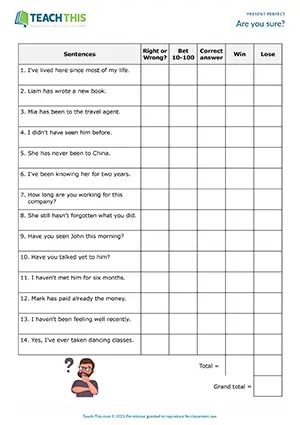
ESL Present Perfect Activity - Grammar: Error Correction, Betting
In this rewarding present perfect error correction activity, students review the correct use of the present perfect by finding errors in affirmative and negative sentences, and questions. First, students read the sentences and questions on the...
Finished or Unfinished?
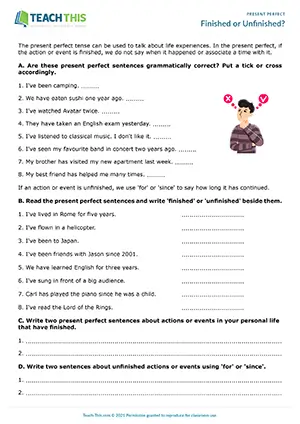
ESL Present Perfect Worksheet - Grammar: Categorising, Writing Sentences, Sentence Completion - Speaking Activity: Discussion, Communicative Practice - Pair Work
In this useful present perfect worksheet, students learn how to use the present perfect tense to talk about finished and unfinished actions or events and their...
How have you been?
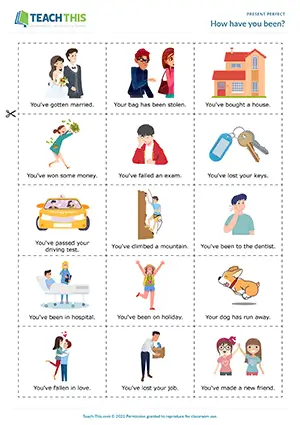
ESL Present Perfect Game - Grammar and Speaking: Asking and Answering Questions, Miming, Guessing, Forming Sentences - Group Work
In this free present perfect miming game, students guess present perfect sentences about recent events from mimes. Students take turns picking up a card...
Lie Detector
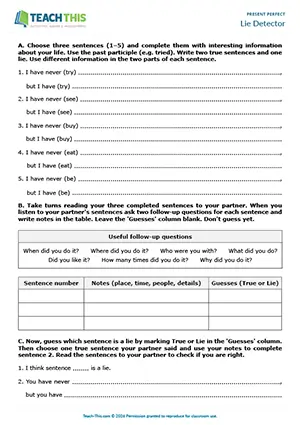
ESL Present Perfect Game - Grammar, Writing and Speaking: Sentence Completion, True or False, Asking and Answering Questions, Guessing - Pair Work
In this engaging present perfect game, students use 'never' to talk about life experiences and try to spot one lie by asking simple follow-up questions...
Life Experiences
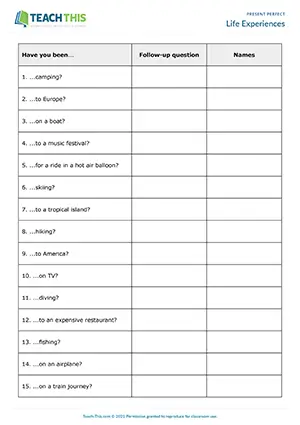
ESL Present Perfect with Been Activity - Grammar, Writing and Speaking: Forming, Asking and Answering Questions, Reporting Findings, Freer Practice
In this interesting present perfect speaking activity, students ask and answer questions about real-life experiences using 'Have you been...?', keep conversations...
Love Story
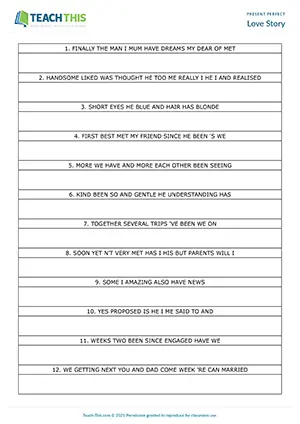
ESL Present Perfect Word Order Game - Grammar: Unscrambling, Identifying, Error Correction - Group Work
In this enjoyable present perfect game, students race to put words in the correct order to make present perfect sentences about a love story. This game helps students practice present perfect...
Time Expressions Game

ESL Present Perfect Game - Grammar and Speaking: Forming Sentences and Questions
In this fast-paced present perfect time expressions game, students race to make sentences and questions with time expressions that are associated with the present perfect tense. Invite one student from each team to come to...
How things have changed?

ESL Present Perfect Activity - Speaking: Categorising, Asking and Answering Questions, Forming Sentences, Discussion, Freer Practice - Pair and Group Work
In this intriguing present perfect speaking activity, students discuss how things have changed in the last ten years. First, students look at topics in a box and...
It's my Life
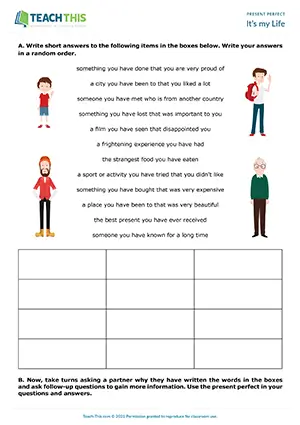
ESL Present Perfect Activity - Grammar and Speaking: Writing Short Answers, Asking and Answering Questions, Guided Discussion - Pair Work
In this handy present perfect speaking activity, students practice talking about their life experiences. First, students answer 12 questions on their worksheet...
Present Perfect Board Game

ESL Present Perfect Board Game - Grammar and Speaking: Impromptu Speech, Communicative Practice - Group Work
Here is an excellent present perfect board game to help students practice talking about various topics in the present perfect tense. In groups, students take turns rolling the dice and moving their counter...
Present Perfect Parley

ESL Present Perfect Activity - Vocabulary and Speaking: Gap-fill, Asking and Answering Questions, Controlled and Freer Practice - Group and Pair Work
In this enjoyable present perfect speaking activity, students complete, ask and answer present perfect conversation questions with ever, never, for, since, just, yet...
Present Perfect Overview
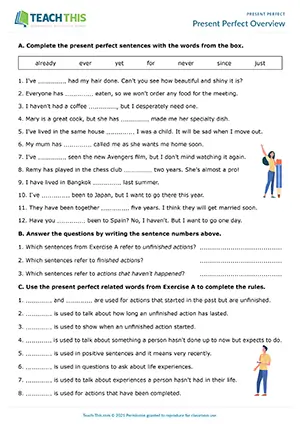
ESL Present Perfect Worksheet - Grammar Exercises: Gap-fill, Categorising, Writing Sentences - Speaking Activity: Asking and Answering Questions - Pair Work
In this productive present perfect worksheet, students revise the various uses of the present perfect tense and related vocabulary. First, students complete...
The Greatest Traveller
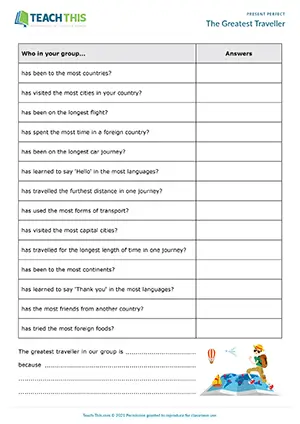
ESL Present Perfect Activity - Speaking and Grammar: Discussion, Asking and Answering Questions - Group Work
In this free present perfect speaking activity, students discuss travel questions in the present perfect to find out who is the most experienced traveller in their group. In groups, students review the items...
What have you done?
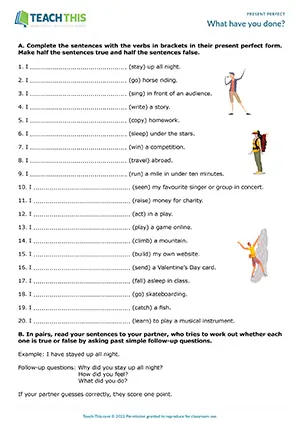
ESL Present Perfect Game - Grammar and Speaking: Sentence Completion, True or False, Asking Questions - Pair Work - Speaking Activity: Discussion - Group Work
In this creative present perfect activity, students write true and false sentences about what they have and haven't done in their lives and then play a guessing game...
Guess, Ask and Answer

ESL Present Perfect Game - Grammar and Speaking: Gap-fill, Asking and Answering Questions, Controlled and Freer Practice - Pair Work
In this insightful present perfect game, students guess missing words in present perfect conversation questions and then ask and answer the questions with...
Present Perfect Review

ESL Present Perfect Worksheet - Grammar Exercises: Gap-fill, Writing Sentences, Error Correction - Speaking Activity: Asking and Answering Questions - Pair Work
In this comprehensive present perfect review worksheet, students work through various exercises and texts to review different structures in the present...
Understanding the Present Perfect
The present perfect is the verb form that connects the past to the present, using 'have/has' plus a past participle to talk about experiences, recent events, and situations that started in the past and continue now. Students who confuse it with the past simple often say things like 'I have seen him yesterday,' which forces a time clash no English speaker would produce, because the present perfect never pairs with a finished time reference like 'yesterday.'
This page brings together 17 activities, games, and worksheets across A2, B1, and B2 levels, with resource types ranging from miming games and board games to error correction activities and speaking discussions, including two free downloads.
The table below shows the structure and an example sentence for each form of the present perfect tense.
| Form | Structure | Example |
|---|---|---|
| Affirmative | subject + have/has + past participle | 'She has worked here for ten years.' |
| Negative | subject + have/has + not + past participle | 'They haven't finished the report yet.' |
| Yes/No Question | Have/Has + subject + past participle? | 'Have you ever visited Japan?' |
| Short Answer (Yes) | Yes, + subject + have/has. | 'Yes, I have.' |
| Short Answer (No) | No, + subject + haven't/hasn't. | 'No, she hasn't.' |
| Wh- Question | Wh- word + have/has + subject + past participle? | 'How long have you lived in this city?' |
When to Use the Present Perfect
Introducing News Before Giving Detail: A speaker uses the present perfect to announce that something has happened before switching to the past simple to give the details, which is the natural pattern in English conversation and news reporting, as in 'Scientists have discovered a new species. They found it last month in the Amazon rainforest.'
Highlighting Achievements Without Pinning a Date: Writers use the present perfect in CVs, bios, and professional profiles when the fact that something happened matters more than when it happened, because pinning a date would actually weaken the statement, as in 'She has managed teams across three continents.'
Signaling Timing with 'Just,' 'Already,' and 'Yet': The adverbs 'just,' 'already,' and 'yet' work with the present perfect to tell a listener exactly where an event sits relative to the moment of speaking, which carries a different conversational weight each time, as in 'I've just emailed you the file' signals immediacy in a way that 'I emailed you the file' never quite does.
3-Step Framework for Teaching the Present Perfect
1. Sort Out the Time Expressions First: The present perfect trips students up most often because they reach for the wrong time expression. Start with a worksheet that asks students to sort a list of finished and unfinished time expressions into the correct category, then has them write true present perfect sentences about their own lives using unfinished time expressions. Locking in the time expressions before anything else saves a lot of backtracking later.
2. Add a Human Hook with a Miming Game: Once students have the time expressions sorted, bring the tense to life with a miming game built around real social language. One student draws a card, a group member asks 'How have you been?', and the student replies 'Pretty good' or 'Not too good' depending on whether the news on the card is good or bad, before miming the present perfect sentence for the group to guess. That natural conversation opener gives students a real-world frame for the tense straight away.
3. Push to Fluency Under Real Pressure: Finish with a board game where students land on a topic square and must speak about that topic in the present perfect for 30 seconds without stopping. Any grammar mistake or pause before the 30 seconds are up sends them back two squares, which makes accuracy and fluency feel genuinely connected rather than separate goals.
Common Mistakes with the Present Perfect
Past Simple for an Unfinished or Relevant Experience: Students often use the past simple when talking about a life experience that has no specific time attached, defaulting to a finished-tense form when the present perfect is the natural choice. Wrong: 'Did you ever try sushi?' Correct: 'Have you ever tried sushi?'
Wrong Auxiliary with Third Person Singular: Students often use 'have' instead of 'has' with he, she, or it, carrying over the first and second person form without adjusting for the third person singular. Wrong: 'She have worked here for five years.' Correct: 'She has worked here for five years.'
Common Questions About Teaching the Present Perfect
What is an interesting speaking activity for practicing the present perfect?
The free activity The Greatest Traveller gets students asking each other present perfect travel questions, such as 'How many countries have you been to?', and recording answers in a chart. When the discussion ends, students complete a short text explaining who is the greatest traveller in their group and share their findings with the class.
What is a useful present perfect worksheet?
The worksheet Present Perfect Overview takes students from form to communication in one lesson. They complete gap-fill exercises, write sentences using just, already, yet, for, since, and never, then form three 'ever' questions to ask a partner. The speaking stage gives every written sentence an immediate communicative purpose.
What is a fun present perfect game?
In the game Lie Detector, students complete present perfect sentences using 'never,' with two sentences true and one a lie. Their partner asks simple follow-up questions before guessing which sentence is false. Students then share one thing they learned about their partner with the class.
Become a Teach This Member
Get unlimited access to the full library, plus new resources added every week.
Unlimited Resource Access
Download from 3000+ worksheets, activities, and games.
Save 5+ Hours Weekly
Cut lesson prep time with ready-to-use resources, plus teacher notes and answer keys.
Trusted Professional Quality
Classroom-tested, editable resources created by experienced ESL professionals.
Fresh Content Weekly
Get 5 new resources added to the library each week.
Here's what our members are saying...


