
Future Continuous ESL Games, Activities & Worksheets
Day Tripper
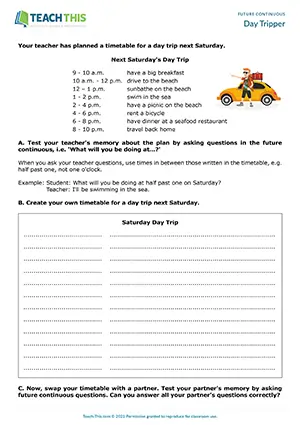
ESL Future Continuous Activity - Speaking: Writing a Schedule, Asking and Answering Questions, Freer Practice - Pair Work
In this fun future continuous speaking activity, students practice the future continuous by asking and answering 'What will you be doing at…?' questions about a day trip timetable, then creating and discussing...
Future Continuous Practice

ESL Future Continuous Worksheet - Grammar Exercises: Gap-fill, Sentence Completion - Speaking Game: Asking and Answering Questions - Pair Work
This free future continuous worksheethelps students to learn and practice how to form and use the future continuous to describe actions in progress at specific...
Paolo's Day
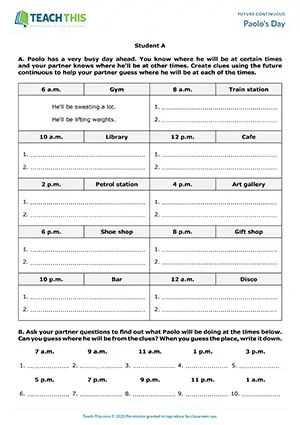
ESL Future Continuous Activity - Grammar and Speaking: Writing Sentences, Asking Questions, Information Gap, Guessing - Group and Pair Work
In this useful future continuous activity, students use the future continuous to write clues about what Paolo will be doing at certain times during the day and guess...
What Will I Be Doing?
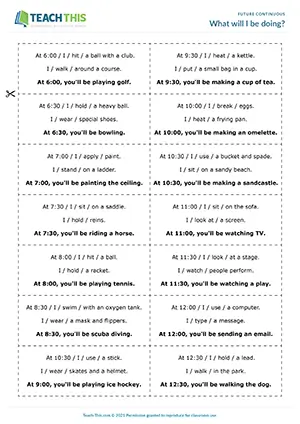
ESL Future Continuous Game - Grammar and Speaking: Forming Sentences, Guessing, Freer Practice - Group Work
In this engaging future continuous game, students listen to clues and guess what a partner will be doing at various times using the future continuous tense. In teams of two, students take turns picking...
An Intense Itinerary
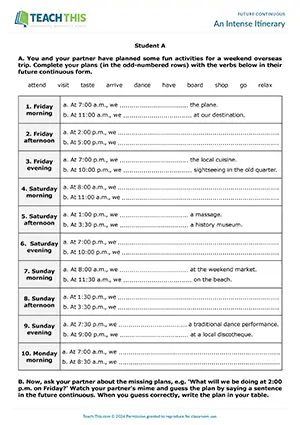
ESL Future Continuous Game - Grammar: Gap-fill, Asking Questions, Miming, Guessing - Pair Work
In this creative future continuous game, students partly complete an itinerary for a weekend overseas trip using the future continuous, then mime and guess the remaining plans to complete...
Future Continuous Fact Finders

ESL Future Continuous Board Game - Grammar and Speaking: Forming Sentences, True or False, Asking and Answering Questions, Guessing - Group Work
In this future continuous true or false board game, students practice future continuous questions, statements and time expressions. Students take turns rolling...
Future Continuous in Action

ESL Future Continuous Worksheet - Grammar Exercises: Gap-fill, Matching, Changing Word Forms, Writing Sentences
Here is a productive future continuous worksheet to help students practice the future continuous to describe activities in progress at specific future times in work and daily-life contexts. First, students...
Will I Be Asking Questions?

ESL Future Continuous Game - Grammar and Speaking: Asking and Answering Questions, Guessing - Pair Work
In this entertaining future continuous game, students guess what activities their partner has planned for them for next week by asking future continuous yes/no questions. Student A starts by asking future...
Understanding the Future Continuous
The future continuous is a verb form for describing an action that will be in progress at a specific moment in the future. It uses 'will be' followed by the -ing form of the verb, so 'I will be working at 9 a.m. tomorrow' tells the listener that the action is already underway at that future point, not just starting then. When students use simple 'will' instead, as in 'I will work at 9 a.m. tomorrow,' they lose that sense of ongoing progress and come across as making a bare statement of intent rather than describing something they are in the middle of doing.
This page covers the future continuous across B1 and B2 levels, with eight resources including speaking activities, worksheets, and games at both levels, and one resource available as a free PDF download.
This table shows the positive, negative, and question forms of the future continuous, using 'will be' plus the -ing form of the verb throughout.
| Form | Structure | Example |
|---|---|---|
| Positive statement | subject + will be + verb-ing | 'At noon, she will be presenting the report.' |
| Negative statement | subject + won't be + verb-ing | 'He won't be working this time tomorrow.' |
| Yes/No question | Will + subject + be + verb-ing? | 'Will you be joining us for dinner?' |
| Short answer (positive) | Yes, subject + will. | 'Yes, I will.' |
| Short answer (negative) | No, subject + won't. | 'No, she won't.' |
| Wh- question | Wh- word + will + subject + be + verb-ing? | 'What will you be doing at 8 p.m.?' |
| Negative question | Won't + subject + be + verb-ing? | 'Won't they be arriving by then?' |
When to Use the Future Continuous
Polite Enquiries About Plans: Speakers use the future continuous to ask about someone's schedule in a way that sounds less direct and more considerate than a simple yes/no question, making the enquiry feel less like a demand, as in 'Will you be using the car on Saturday?'
Describing Overlapping Future Actions: When two things will be happening at the same time in the future, the future continuous signals that both actions are in progress simultaneously, letting a speaker show the overlap clearly, as in 'While you're giving your talk, we'll be setting up the exhibition next door.'
Setting the Scene in Future Narratives: Writers and speakers use the future continuous to paint a background picture of what will already be underway when a key future event happens, giving a sense of atmosphere and timing, as in 'By the time you land, the sun will be setting over the city.'
3-Step Framework for Teaching the Future Continuous
1. Build the Form from the Ground Up: Open with a structured worksheet that walks students through the future continuous step by step, from gap-fills and sentence completion exercises through to a personal production task. The payoff comes at the end, when students write sentences predicting what their partner will be doing at a set of given times, then ask questions to check: every correct guess scores a point, so there is just enough competition to keep the language sharp.
2. Add a Guessing Challenge: Once students have the form, raise the stakes with a card-based guessing game built around two-clue prompts. One student reads two future continuous sentences from their card, such as 'I will be hitting a ball with a club' and 'I will be walking around a course,' and their partner has 30 seconds to produce the correct full future continuous sentence. This pushes students to process the form under light time pressure rather than just recognize it.
3. Open It Up With a True or False Challenge: Finish with a board game that adds a social dimension by asking students to decide whether a classmate is telling the truth. When a student lands on a square, they make a future continuous sentence using the prompt and time expression shown, such as 'At 7 p.m. today, I'll be doing my homework,' and the group asks follow-up questions like 'What homework will you be doing?' to decide whether the student is lying or telling the truth.
Common Mistakes with the Future Continuous
Omitting 'be' from the Structure: Students often drop 'be' and write 'will + verb-ing' directly, forgetting that the continuous aspect requires the auxiliary 'be' between 'will' and the -ing form. Wrong: 'This time tomorrow, I will working in the garden.' Correct: 'This time tomorrow, I will be working in the garden.'
Using the Base Form Instead of the -ing Form: Students often write 'will be + base form' rather than 'will be + verb-ing,' either by analogy with 'will + base form' or because they forget to add the -ing ending. Wrong: 'She will be present the report at noon.' Correct: 'She will be presenting the report at noon.'
Common Questions About Teaching the Future Continuous
What is an engaging speaking activity for practicing the future continuous?
The activity Day Tripper gives students a memory challenge that makes every question count. Students quiz the teacher about a day trip timetable using 'What will you be doing at half past one on Saturday?' then plan their own timetable, swap it with a partner, and test each other's memory using the future continuous.
What is a good worksheet for teaching the future continuous?
The worksheet Future Continuous in Action puts the tense into real work and daily-life contexts. Students complete sentences about workers' shifts and match them to jobs, work through a teacher's schedule, then write future continuous sentences describing a workday and read them to a partner, who tries to guess their job.
What is a fun game for practicing future continuous questions?
Students in the game Will I Be Asking Questions? ask yes/no questions such as 'Will I be eating something?' to guess a partner's planned activity for the week. A correct unprompted guess earns two points, while guessing correctly after a future continuous clue from their partner earns one point.
Become a Teach This Member
Get unlimited access to the full library, plus new resources added every week.
Unlimited Resource Access
Download from 3000+ worksheets, activities, and games.
Save 5+ Hours Weekly
Cut lesson prep time with ready-to-use resources, plus teacher notes and answer keys.
Trusted Professional Quality
Classroom-tested, editable resources created by experienced ESL professionals.
Fresh Content Weekly
Get 5 new resources added to the library each week.
Here's what our members are saying...


