
Be Going To & Present Continuous ESL Games, Activities & Worksheets
Ask and Find
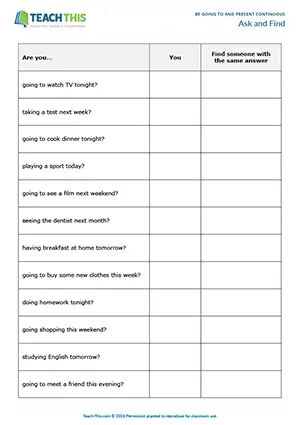
ESL Be Going To and Present Continuous Activity - Grammar and Speaking: Asking and Answering Questions, Controlled and Freer Practice
In this 'be going to' and present continuous speaking activity, students practice asking and answering yes/no questions about future plans and arrangements and...
Plans vs. Arrangements Game
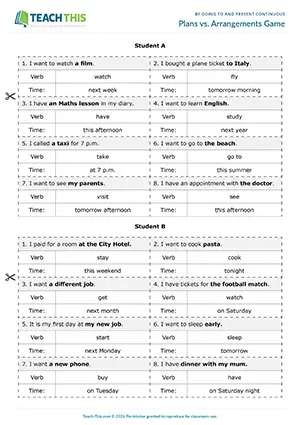
ESL Be Going To and Present Continuous Game - Grammar and Speaking: Forming Sentences from Prompts, Controlled Practice
In this 'be going to' and present continuous game, students practice using 'be going to' for plans and the present continuous for arrangements by making sentences about future events...
Ready for the Future
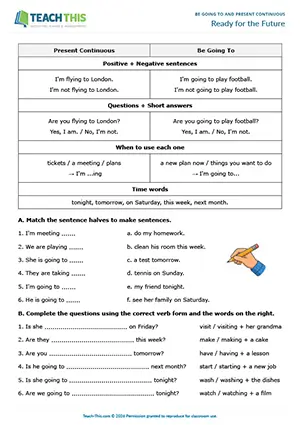
ESL Be Going To and Present Continuous Worksheet - Grammar and Writing Exercises: Matching, Question Completion, Gap-fill, Binary Choice, Writing Sentences
In this 'be going to' and present continuous worksheet, students practice using 'be going to' and the present continuous to talk about future plans and arrangements...
Fixed and Intended Future Plans
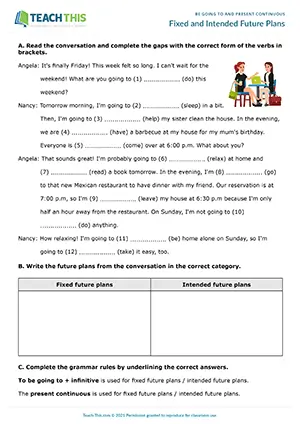
ESL Be Going To and Present Continuous Worksheet - Grammar Exercises: Gap-fill, Categorizing, Matching, Writing Sentences
In this comprehensive 'be going to' and present continuous worksheet, students practice using the present continuous for fixed future plans and 'be going to' for intended future plans...
Next Week

ESL Be Going To and Present Continuous Activity - Speaking: Asking and Answering Questions, Table Completion, Freer Practice
In this useful ‘be going to’ and present continuous activity, students plan a schedule for next week with leisure activities and then make and confirm arrangements with classmates using...
Who Wrote This Sentence?

ESL Be Going To and Present Continuous Game - Grammar and Speaking: Writing Sentences, Asking and Answering Questions, Freer Practice
This entertaining 'be going to' and present continuous game has students write true sentences about their future plans and definite arrangements, then...
Future Forms Face-Off
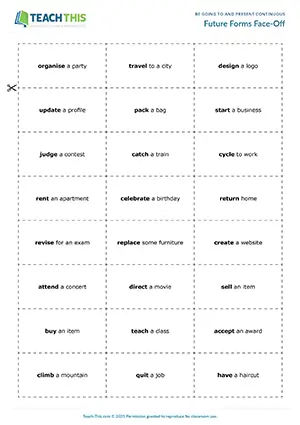
ESL Be Going To and Present Continuous Game - Grammar and Speaking: Forming Sentences, Impromptu Speech, Communicative Practice - Group Work
In this inventive 'be going to' and present continuous game, students practice talking about intentions, plans, and fixed future arrangements for different...
That Sounds Like a Plan
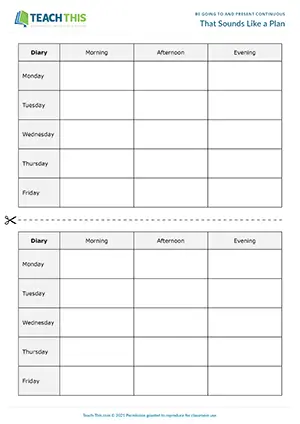
ESL Be Going To and Present Continuous Activity - Grammar and Speaking: Asking and Answering Questions, Giving Reasons, Communicative Practice - Group Work
This productive 'be going to' and present continuous activity helps students practice the difference between 'be going to' for future plans or intentions and...
The Explanation Game

ESL Be Going To and Present Continuous Board Game - Grammar: Forming Sentences - Group Work
In this free 'be going to' and present continuous board game, students talk about future plans and definite arrangements, explaining reasons with 'because' and results with 'so'. In groups, students...
The Long Weekend
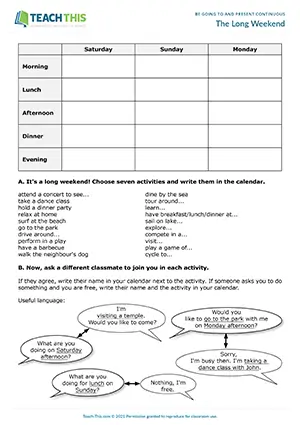
ESL Be Going To and Present Continuous Activity - Grammar and Speaking: Asking and Answering Questions, Writing Sentences, Communicative Practice
In this communicative 'be going to' and present continuous activity, students plan a long weekend by stating intentions and turning them into...
Your Future in 30 Seconds
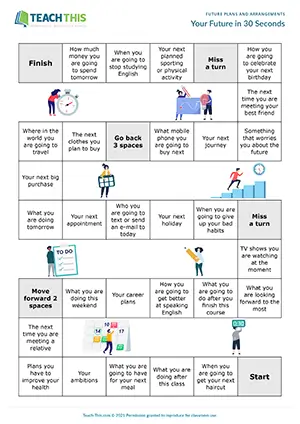
ESL Be Going To and Present Continuous Board Game - Grammar and Speaking: Impromptu Speech, Communicative Practice - Group Work
In this fun 'be going to' and present continuous board game, students talk about different future plans or arrangements for 30 seconds. Players take turns...
Understanding Be Going To and Present Continuous
'Be going to' commonly expresses an intention or a plan already decided on, while the present continuous can present a future event as an arrangement. Their uses overlap, so context and what the speaker wants to emphasise matter more than a rigid distinction between uncertain and certain plans.
This page has 11 resources across A1-A2, A2 and B1: five games, four activities and two worksheets. The Explanation Game is available as a free download.
The table compares the two forms when talking about the future.
| Feature | Be Going To | Present Continuous for the Future |
|---|---|---|
| Affirmative | subject + am/is/are + going to + base verb | subject + am/is/are + verb-ing |
| Negative | subject + am/is/are + not + going to + base verb | subject + am/is/are + not + verb-ing |
| Yes/no question | Am/Is/Are + subject + going to + base verb? | Am/Is/Are + subject + verb-ing? |
| Typical emphasis | An intention or a decision already made | A future event presented as arranged |
| Example | 'I'm going to visit my sister next week.' | 'I'm visiting my sister next week. We've agreed on Tuesday.' |
| Question example | 'What are you going to do tomorrow?' | 'Who are you meeting tomorrow?' |
| Short answer | 'Yes, I am.' / 'No, I'm not.' | 'Yes, I am.' / 'No, I'm not.' |
How to Use Be Going To and Present Continuous
Establish the situation before choosing a form: Ask whether the speaker is describing an intention or presenting something as arranged. 'I'm going to see a film' focuses on the plan; 'I'm seeing a film with Ana tonight' presents it as an arrangement. The second sentence does not mean that 'be going to' would be impossible in the same situation.
Make the future reference clear: With the present continuous, a phrase such as 'tomorrow' or an established future context distinguishes an arrangement from an action happening now. Both forms can occur with exact times, so a clock time alone does not determine the choice.
Use arrangements to explain availability: Students can decline an invitation by saying 'I can't come. I'm meeting my tutor.' They can also explain an intention with 'I'm going to study tonight.' Discuss what each response communicates without treating one as inherently more truthful or more certain.
3-Step Framework for Teaching Be Going To and Present Continuous
1. Interpret Plans in Context: For an A2 sequence, start with a conversation in which students complete verb forms and sort future plans into fixed and intended categories. Completing the grammar rules and writing a plan of their own connects the contextual clues with the forms they will need in conversation. Explain that the categories support this task rather than exhaust every possible use.
2. Turn Intentions into Arrangements: Students list eight leisure activities in a weekly schedule, then find classmates who can join them. They record a partner and an agreed time for each activity and state the arrangement using the present continuous. Reporting both plans and arrangements gives the form choices a practical purpose.
3. Ask Questions to Identify a Plan's Author: Students write true future sentences on cards and place them in a box. After taking a card, they ask classmates yes/no questions to discover who wrote it. Finding the author requires students to turn a statement into a question and interpret the reply, extending the scheduling work into less predictable exchanges.
Common Mistakes with Be Going To and Present Continuous
Omitting 'be' before 'going to': Match 'am', 'is' or 'are' to the subject before adding 'going to' and the base verb. Incorrect: 'She going to start a course.' Correct: 'She's going to start a course.'
Using the base verb in a present continuous arrangement: The present continuous requires the -ing form after 'be', even when the event is in the future. Incorrect: 'I'm meet Sam tomorrow.' Correct: 'I'm meeting Sam tomorrow.' Compare the different structure 'I'm going to meet Sam tomorrow.'
Common Questions About Teaching Be Going To and Present Continuous
What worksheet can I use for teaching be going to and the present continuous?
The worksheet Ready for the Future combines sentence matching, question completion and choices between future forms. Students use contextual items to select the matching sentence, then practice negative short answers and sentences. This gives teachers written practice in both constructing the forms and interpreting plans and arrangements.
What game can I use for practicing the difference between plans and arrangements?
Plans vs. Arrangements Game gives students clues and prompts for forming future sentences. Each player decides whether a clue describes a plan or an arrangement, makes a sentence and has a partner check it. Incorrect cards return to the pile, so students revisit their choices while working towards eight correct sentences.
What speaking activity can I use for practicing future plans and arrangements?
In the activity The Long Weekend, students list seven intended activities using 'be going to', then invite classmates to join them. Agreed activities become present continuous entries in their calendars. Students finish by reporting their arrangements, giving teachers a practical context for contrasting intentions with plans that have been organised with others.
Become a Teach This Member
Get unlimited access to the full library, plus new resources added every week.
Unlimited Resource Access
Download from 3000+ worksheets, activities, and games.
Save 5+ Hours Weekly
Cut lesson prep time with ready-to-use resources, plus teacher notes and answer keys.
Trusted Professional Quality
Classroom-tested, editable resources created by experienced ESL professionals.
Fresh Content Weekly
Get 5 new resources added to the library each week.
Here's what our members are saying...


