
Past Simple vs. Past Continuous ESL Activities, Games & Worksheets
Past Tense Exchange
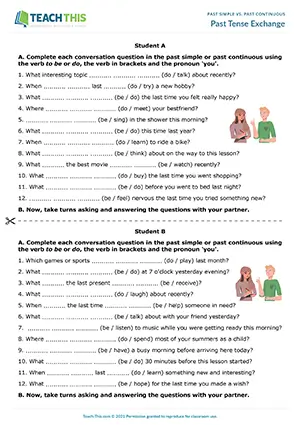
ESL Past Simple and Past Continuous Activity - Grammar and Speaking: Writing, Asking and Answering Questions - Group and Pair Work
In this past simple vs. past continuous speaking activity, students complete conversation questions and then interview a partner using the past simple...
Accidental Inventions
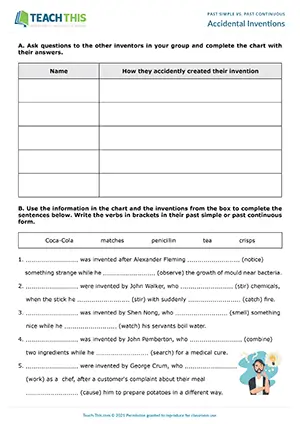
ESL Past Simple and Past Continuous Activity - Grammar and Speaking: Gap-fill, Asking and Answering Questions, Freer Practice - Group Work
In this engaging past simple and past continuous activity, students take on the role of famous inventors and discover how several inventions happened by accident...
Alibi
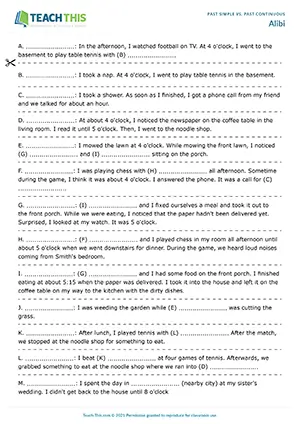
ESL Past Simple and Past Continuous Activity - Speaking: Role-Play, Asking and Answering Questions - Group Work
In this intriguing past simple and past continuous activity, students try to solve a murder by interviewing classmates about what they were doing between 4 and 5 p.m., listening for contradictions...
Past Simple or Past Continuous?
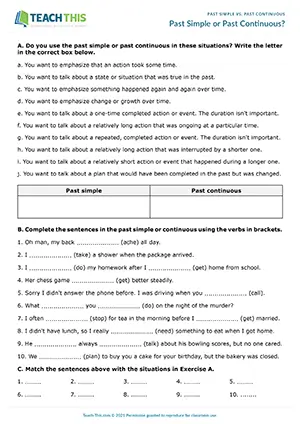
ESL Past Simple vs. Past Continuous Worksheet - Grammar Exercises: Categorising, Gap-fill, Matching, Writing Sentences
This free past simple or past continuous worksheet helps students practice how and when to use the past simple and the past continuous to describe...
What were you doing when...?
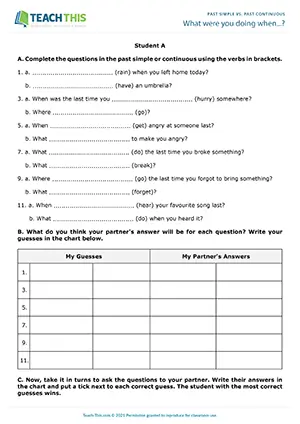
ESL Past Simple vs. Past Continuous Game - Grammar and Speaking: Gap-fill, Guessing, Asking and Answering Questions - Group and Pair Work
This fun past simple vs. past continuous game helps students practice forming, asking and answering questions with the past simple and past continuous. First...
When and While
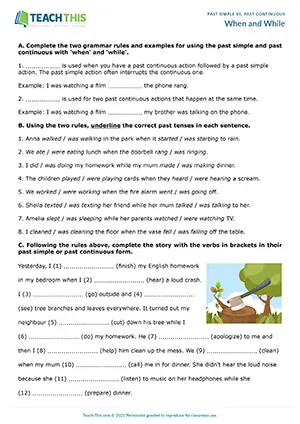
ESL When and While Worksheet - Grammar Exercises: Gap-fill, Binary Choice, Identifying, Sentence Completion
In this useful when and while worksheet, students practice three rules associated with using 'when' and 'while' with the past simple and past continuous. Students begin by completing two grammar rules...
A Tense Match
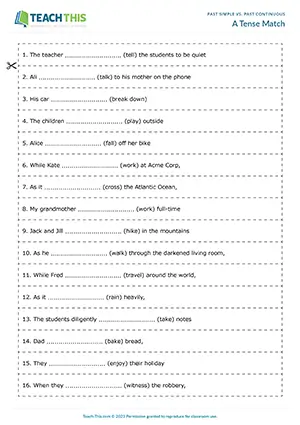
ESL Past Simple and Past Continuous Game - Grammar: Matching, Gap-fill - Pair Work
This enjoyable past simple and past continuous game helps students review sentences containing past simple and past continuous clauses. In pairs, students take turns turning over one sentence beginning card and one ending card...
Understanding the Past Simple vs. Past Continuous
The past simple describes a completed action or event that happened at a specific point in the past, as in 'She dropped her phone.' The past continuous describes an action that was already in progress at a particular past moment, as in 'She was walking to class,' and when students use the past simple where the past continuous is needed, they flatten the sense of duration and background, making it harder for readers to picture one event interrupting another.
This page covers past simple vs. past continuous across A2, B1, and B2 levels, with seven activities and worksheets ranging from grammar categorizing tasks and timeline exercises to a murder mystery role-play, with one activity available as a free download.
The table below contrasts the past simple and past continuous across their forms, main uses, and the time signals that most commonly appear with each tense.
| Aspect | Past Simple | Past Continuous |
|---|---|---|
| Form | subject + past verb (regular: add -ed; irregular: use learned form) | subject + was/were + base verb + -ing |
| Main Use | completed action or event at a specific point in the past | action in progress at a specific past moment |
| Setting the Scene | the new event that breaks into the story | the background situation already underway |
| With 'when' | the shorter, completed interrupting action | the longer action already in progress |
| With 'while' | the completed action in the other clause | the ongoing action ('while' signals past continuous) |
| Common Time Signals | yesterday, last week, in 2005, ago, at 6 p.m. | at that moment, all morning, while, when (+ past simple clause) |
| Single-clause Example | 'She dropped her keys.' | 'She was running to catch the bus.' |
| Combined Example | 'He knocked on the door...' | '...while we were eating dinner.' |
When to Use the Past Simple vs. Past Continuous
Setting the Scene in a Story: Writers use the past continuous to establish atmosphere and background before the main event arrives, giving the reader a sense of what the world looked like just before something changed, as in 'The rain was falling heavily and a dog was barking somewhere down the street when the phone rang.'
Giving a Reason or Explanation: When you want to explain why something happened by describing the circumstances that led up to it, the past continuous sets up that context naturally, as in 'She was not paying attention, so she missed the announcement.'
Two Actions Happening at the Same Time: When two people or things were doing different things simultaneously in the past, using the past continuous for both signals that they overlapped rather than happened one after the other, as in 'While he was presenting the report, his manager was checking her emails.'
3-Step Framework for Teaching the Past Simple vs. Past Continuous
1. Map the Meaning: Start with a worksheet that trains students to distinguish the two tenses by their meaning, not just their form. A well-designed approach asks students to read a set of situations and sort them into four categories (completed events, ongoing actions, repeated actions, and changes over time) before matching each situation to a visual timeline. Students then write their own sentences from those timelines using prompts and adding time adverbs, which forces them to connect the grammar rule to a concrete picture of what was happening.
2. When and While: Once students can sort the tenses by meaning, sharpen their understanding of the connectors that link the two tenses in a single sentence. A focused worksheet covers three rules for using 'when' and 'while' with the past simple and past continuous, then pushes students through a three-way discrimination task where they decide for each gap whether only 'when', only 'while', or both words could work. The worksheet closes by asking students to finish sentences with a second clause of their own, putting the full structure into production.
3. Murder Mystery: Round off the lesson with a role-play that makes both tenses essential for communication. Each student takes on the role of a murder suspect and receives a card showing their alibi for the time when Mr Smith was murdered between 4 and 5 p.m. on Saturday. Students mingle, share their alibis in the past simple and past continuous, and listen carefully for the one account that contradicts all the others, since the student with the inconsistent alibi is the murderer. The first student to identify the culprit wins.
Common Mistakes with the Past Simple vs. Past Continuous
Past Continuous for a Completed Action: Students often use the past continuous for a single, finished event that has no sense of ongoing duration, treating it as an alternative past form rather than a signal of something in progress. Wrong: 'I was arriving at the party at 8 p.m.' Correct: 'I arrived at the party at 8 p.m.'
Past Simple for Both Clauses in an Interrupted Action: Students often use the past simple for both the background action and the interrupting event in the same sentence, removing the sense that one was still going on when the other happened. Wrong: 'I cooked dinner when she called.' Correct: 'I was cooking dinner when she called.'
Common Questions About Teaching the Past Simple vs. Past Continuous
What is a fun game for practicing the past simple and past continuous?
A fun game for the past simple and past continuous gets students predicting before they ask anything. In the What were you doing when...? game, students write their guess for each question in a chart, ask the questions, then compare guesses to their partner's real answers, scoring a tick for each correct prediction. The student with the most ticks wins.
What is a good speaking activity for the past simple and past continuous?
In the Accidental Inventions activity, students play famous inventors and use the past simple and past continuous to explain how each invention happened by accident. Each student completes an inventor card with the correct verb forms, then interviews the other inventors, asking questions and noting the answers in a chart to piece together the full story of each invention.
What is an effective worksheet for teaching past simple and past continuous?
The free Past Simple or Past Continuous? worksheet builds from recognition to production across four uses of these two tenses. Students sort situations by tense, match each situation to a visual timeline, then write sentences from timeline prompts using time adverbs. The four uses covered are completed events, ongoing actions, repeated actions, and changes over time.
Become a Teach This Member
Get unlimited access to the full library, plus new resources added every week.
Unlimited Resource Access
Download from 3000+ worksheets, activities, and games.
Save 5+ Hours Weekly
Cut lesson prep time with ready-to-use resources, plus teacher notes and answer keys.
Trusted Professional Quality
Classroom-tested, editable resources created by experienced ESL professionals.
Fresh Content Weekly
Get 5 new resources added to the library each week.
Here's what our members are saying...


