
Passive Voice ESL Games, Activities & Worksheets
A Terrible Morning
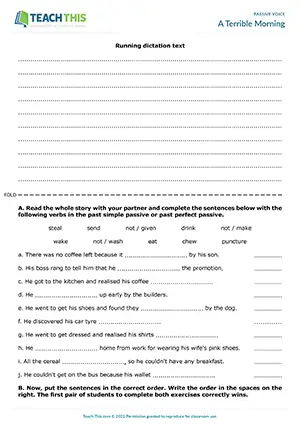
ESL Passive Voice Activity - Speaking: Running Dictation - Pair Work - Reading and Grammar Exercises: Gap-fill, Ordering
In this passive voice running dictation activity, students reconstruct a short story and then use the story to complete sentences with the past simple passive or the past perfect passive and order them...
Heads and Tails
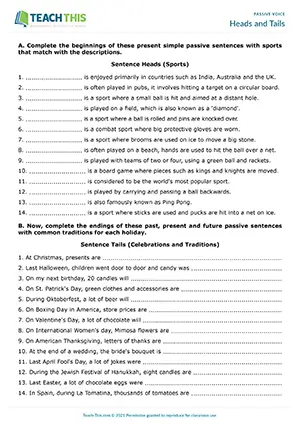
ESL Passive Voice Game - Grammar: Completing Sentences - Group Work
In this imaginative passive voice game, students practice the past, present and future passive by completing sentence beginnings and endings in teams. Teams begin by completing the beginnings of present simple passive sentences with...
Mixed Passive
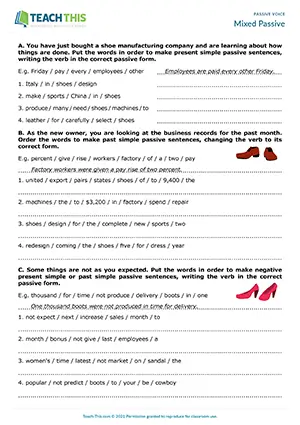
ESL Mixed Passive Voice Worksheet - Grammar and Writing Exercises: Writing Sentences and Questions - Speaking Activity - Pair Work
In this productive shoe-themed passive voice worksheet, students practice present simple, past simple, and future simple passive forms in statements, negatives...
Name Three
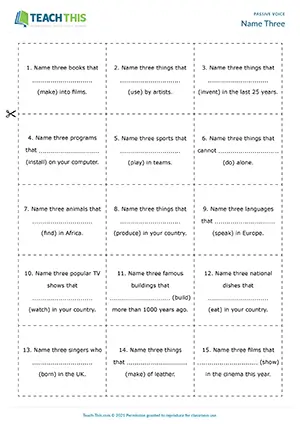
ESL Passive Voice Game - Grammar and Speaking: Gap-fill, Asking and Answering Questions - Group Work
In this free passive voice game, students practice forming, asking, and answering 'Name three' questions in the past and present passive. In groups, students take turns picking up a card and...
News Report Transformation
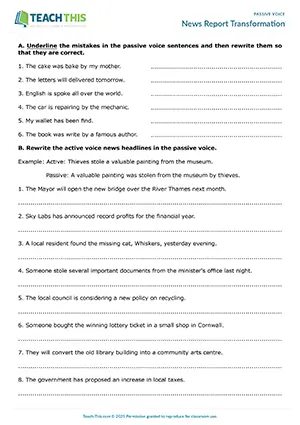
ESL Passive Voice Worksheet - Grammar and Writing Exercises: Error Correction, Rewriting Sentences - Speaking Activity: Presenting, Freer Practice - Pair Work
In this productive passive voice worksheet, students correct common passive voice errors, rewrite active news headlines and summaries in the passive, and...
Passive Question Time

ESL Passive Voice Activity - Speaking: Writing, Asking and Answering Questions, Freer Practice
In this passive voice 'Find Someone Who' activity, students ask and answer questions using the present perfect passive and past simple passive, then report their findings to the class. In pairs, students...
Passive Voice Fact Finder
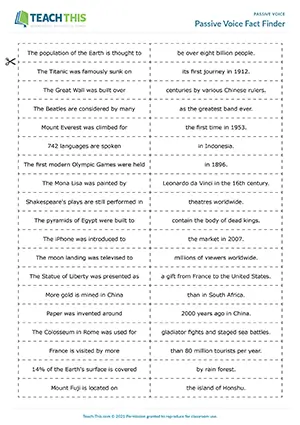
ESL Passive Voice Games - Grammar: Matching, Pelmanism, Forming Sentences - Group Work
In these two engaging passive voice games, students identify past and present passive sentences about facts and inventions. To begin, groups race to identify past and present passive sentences...
Guess the Noun
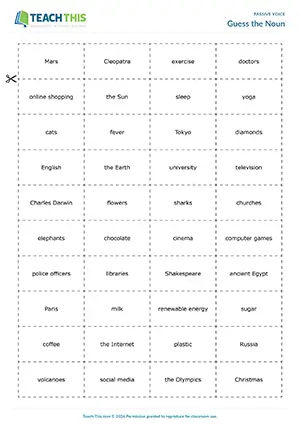
ESL Passive Voice Game - Grammar and Speaking: Describing, Forming Sentences, Guessing, Freer Practice - Group Work
In this engaging passive voice game, practice describing beliefs and opinions using 'it' + passive reporting verbs and guess target nouns. In groups, students take turns picking up a card and giving three...
Passive Battleships
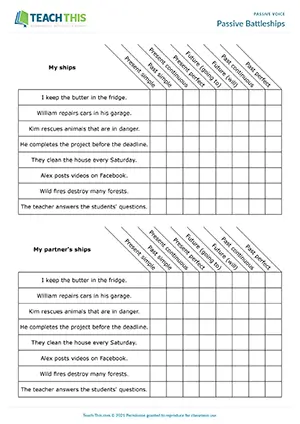
ESL Passive Voice Game - Grammar and Speaking: Forming Sentence - Pair Work
In this free passive voice game, students play Battleships using the past, present and future passive. First, students mark four ships on their grid. Students then play a game of battleships using the passive voice in eight tenses. The aim of the game...
Passive Infinitive Practice
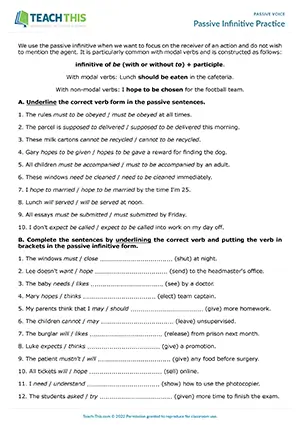
ESL Passive Voice Worksheet - Grammar Exercises: Binary Choice, Changing Word Form, Gap-fill, Reforming Sentences
Here is a useful passive infinitive worksheet to help students practice recognising and using the passive infinitive with modals and other verbs. First, students circle the correct verb forms in passive infinitive...
The Perfectly Passive Hotel
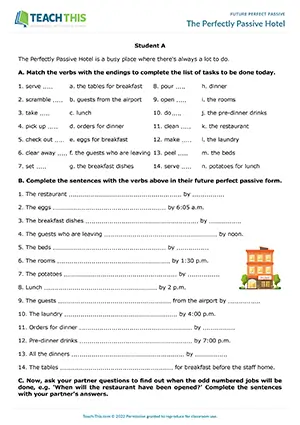
ESL Future Perfect Passive Activity - Grammar and Speaking: Matching, Gap-fill, Information Gap, Asking and Answering Questions, Controlled Practice - Pair Work
In this interesting future perfect passive activity, students use the future perfect passive to complete information about a hotel. First, in two groups...
Understanding the Passive Voice
The passive voice puts the receiver of an action in the subject position: 'The report was written by the team' instead of 'The team wrote the report.' Students who overuse the active voice in formal or academic writing often come across as too direct or blunt, while students who lean on the passive in everyday conversation can sound awkward and unnatural.
This page covers the passive voice at B1 and B2 levels, with eleven activities spanning running dictation, pelmanism games, sentence transformation worksheets, speaking activities, and information gap tasks, with two activities available as free downloads.
The table below shows how to form the passive voice across eight tenses by replacing the active verb with the correct form of 'be' plus the past participle.
| Tense | Active Structure | Passive Structure | Example Shift |
|---|---|---|---|
| Present Simple | subject + verb(s) | subject + is/are + past participle | 'The chef prepares the meals.' → 'The meals are prepared by the chef.' |
| Past Simple | subject + verb(ed/irregular) | subject + was/were + past participle | 'Someone stole the car.' → 'The car was stolen.' |
| Present Continuous | subject + is/are + verb(ing) | subject + is/are + being + past participle | 'They are building a new bridge.' → 'A new bridge is being built.' |
| Past Continuous | subject + was/were + verb(ing) | subject + was/were + being + past participle | 'Workers were repairing the road.' → 'The road was being repaired.' |
| Present Perfect | subject + has/have + past participle | subject + has/have + been + past participle | 'They have cancelled the meeting.' → 'The meeting has been cancelled.' |
| Future Simple (will) | subject + will + verb | subject + will + be + past participle | 'The company will announce the results.' → 'The results will be announced.' |
| Future Perfect | subject + will + have + past participle | subject + will + have + been + past participle | 'They will have finished the project.' → 'The project will have been finished.' |
| Passive Infinitive | modal + base verb | modal + be + past participle | 'You must submit the report.' → 'The report must be submitted.' |
When to Use the Passive Voice
Distancing from Responsibility: Writers and speakers use the passive when they want to report an outcome without directly assigning blame or naming the person responsible, which is common in formal correspondence and official statements, as in 'Mistakes were made during the review process.'
Describing Processes: In scientific writing, technical manuals, and recipes, the passive removes the need to name a doer when the action itself is what matters, making instructions cleaner and more objective, as in 'The mixture is heated to 100 degrees and then filtered.'
News Headlines: Journalists use a short passive structure in headlines to put the newsworthy event first without naming the actor, saving space and keeping the focus on what happened, as in 'Three suspects arrested after city center robbery.'
3-Step Framework for Teaching the Passive Voice
1. Build the Form Through Physical Recall: A running dictation is a surprisingly effective way to get passive forms into students' heads before any formal analysis begins. One partner runs to a text posted outside the classroom, reads as much as they can, then races back to dictate it while their partner writes it down. After both partners reconstruct the full story, they work through gap-fill and ordering exercises that require them to produce the past simple passive and the past perfect passive forms they have just encountered in context.
2. Cement Recognition Through Creative Mismatching: A card-matching game built around facts and inventions gives students repeated exposure to passive sentences without the repetitiveness of drills. Students race to match sentence halves correctly, then flip the cards face-down for a memory game. The real twist comes when two cards do not match: the student still has to produce a grammatically correct passive sentence using that sentence beginning, even if the result is completely absurd. Because the sentences do not have to be factually accurate, the pressure drops and the fun goes up, which is exactly when students stop overthinking the form.
3. Push Into Complex Forms With a Real Information Gap: Once students control the core tenses, a genuine information gap gives them a real communicative reason to use the future perfect passive. Working in pairs, students ask each other questions about tasks to be completed at a hotel, such as 'When will the restaurant have been opened?', and fill in the answers as they go. Because neither partner has the full picture, the language stays purposeful rather than purely mechanical, and students get authentic practice in a tense that can otherwise feel remote and difficult to connect to real use.
Common Mistakes with the Passive Voice
Wrong Form of 'Be': Students often use the base form of 'be' instead of matching it to the correct tense, producing errors like 'the letter be written' instead of choosing was or were. Wrong: 'The letter be written yesterday.' Correct: 'The letter was written yesterday.'
Base Form Instead of Past Participle: Students often write the base form of the main verb instead of the past participle, particularly with irregular verbs, which is one of the most common passive voice errors at B1 level. Wrong: 'The bridge was build in 1900.' Correct: 'The bridge was built in 1900.'
Common Questions About Teaching the Passive Voice
What is a good speaking game for practicing passive voice questions?
The game Name Three gives students practice forming, asking, and answering passive questions. Students pick up a card, complete the gap with the past or present passive form of a bracketed verb to make a question like 'Name three books that were made into films,' and then race classmates to answer. It is available as a free download.
What is a useful worksheet for teaching passive voice at the intermediate level?
A passive voice worksheet that moves from error correction into real writing works well for B1 students. The worksheet News Report Transformation takes students through identifying mistakes in passive sentences and rewriting them correctly, then rewriting active news headlines and summaries in the passive, and finishing with students writing and presenting their own short passive voice news report.
How can I get upper-intermediate students to practice passive voice across different tenses?
The game Passive Battleships is a free download that covers the passive voice across eight tenses. Students choose a square, state the passive tense and prompt number, for example 'Past simple, prompt 3,' and form a sentence in that passive form. A correct sentence earns a hit; an incorrect one is an invalid shot.
Become a Teach This Member
Get unlimited access to the full library, plus new resources added every week.
Unlimited Resource Access
Download from 3000+ worksheets, activities, and games.
Save 5+ Hours Weekly
Cut lesson prep time with ready-to-use resources, plus teacher notes and answer keys.
Trusted Professional Quality
Classroom-tested, editable resources created by experienced ESL professionals.
Fresh Content Weekly
Get 5 new resources added to the library each week.
Here's what our members are saying...


