
First Conditional ESL Games, Worksheets & Activities
Christmas Conditionals
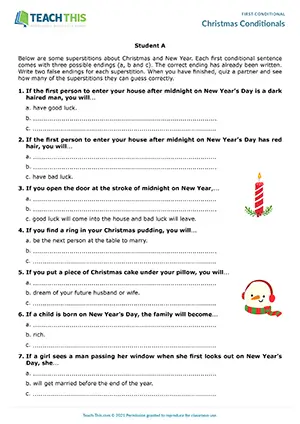
ESL First Conditional Activity - Grammar: Sentence Completion, Guessing - Group and Pair Work
This festive first conditional activity combines the topic of Christmas and New Year superstitions with the first conditional. The worksheets contain Christmas and New Year superstitions written as first...
First Conditional Advice
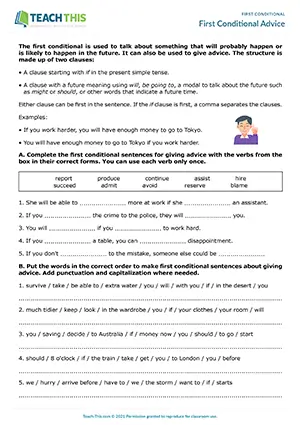
ESL First Conditional Worksheet - Grammar, Reading and Writing Exercises: Gap-fill, Identifying, Writing a Paragraph
In this free first conditional worksheet, students practice giving advice using the first conditional with 'will' and other modal verbs. Students start by completing first conditional sentences about giving advice...
First Conditional Card Game
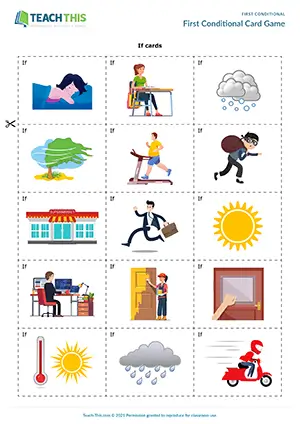
ESL First Conditional Game - Grammar and Speaking: Forming Sentences from Picture Prompts, Freer Practice - Group Work
In this engaging first conditional game, students practice making first conditional sentences by matching picture prompts for if-clauses to suitable result cards. The first student turns over the top...
First Conditional Chain
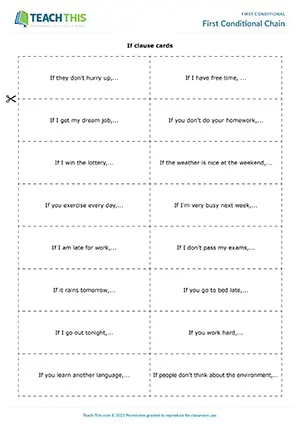
ESL First Conditional Activity - Grammar and Writing: Sentence Completion - Group Work
In this imaginative first conditional activity, students practice forming and linking first conditional sentences by collaboratively creating sentence chains. First, students write their name and an if-clause at the top of the worksheet, e.g. 'If they don't...
First Conditional Dominoes
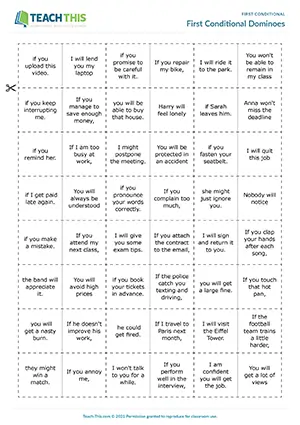
ESL First Conditional Game - Grammar: Matching - Group Work
This rewarding first conditional game helps learners review and reinforce first conditional sentence structures by matching clause halves to build complete sentences. The first player tries to make a first conditional sentence by placing a...
First Conditional Focus
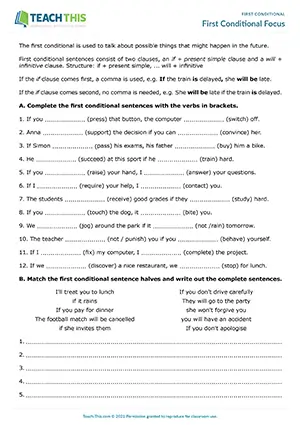
ESL First Conditional Worksheet - Grammar Exercises: Gap-fill, Sentence Completion, Writing Sentences - Speaking Activity: Asking and Answering Questions - Pair Work
This insightful first conditional worksheet helps to teach students how to form and use the first conditional to talk about real future possibilities. First, students...
First Conditional Story
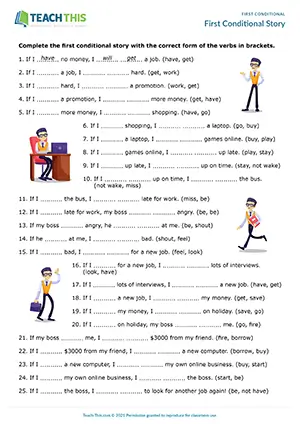
ESL First Conditional Worksheet - Grammar Exercise: Gap-fill
This useful first conditional worksheet helps to introduce students to first conditional verb forms and structure. Working alone, students complete first conditional sentences in a story with the correct form of the verbs in brackets. When the students have...
Five-in-a-Row
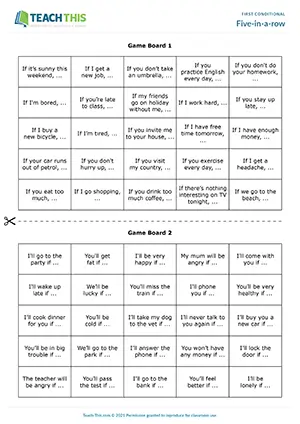
ESL First Conditional Game - Speaking: Completing Sentences, Freer Practice - Pair Work
In this fun first conditional game, students complete if-clauses or result clauses to build first conditional sentences. In pairs, students take turns choosing an if-clause square and making a first conditional...
If and When
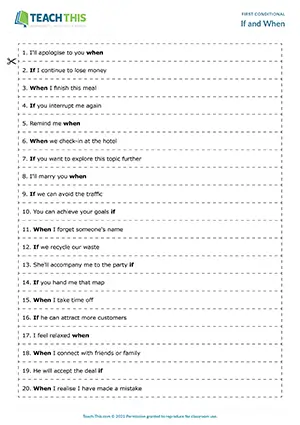
ESL First Conditional Game - Grammar: Sentence Completion - Group Work
In this creative first conditional game, students race to complete first conditional sentences and future time clauses with 'when'. Give each team an incomplete sentence strip. Teams then race to complete the first sentence, making sure...
What Did I Write?
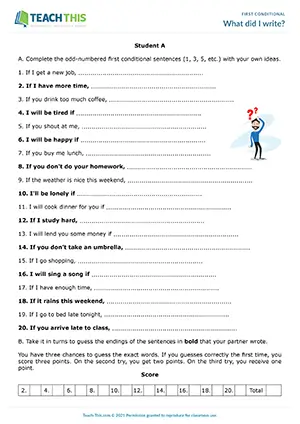
ESL First Conditional Game - Grammar: Sentence Completion, Guessing, Freer Practice - Pair Work
In this interesting first conditional game, students complete sentence starters with their own ideas and then try to guess the endings their partner wrote, reinforcing both if-clauses and result clauses in the...
What Will Happen?
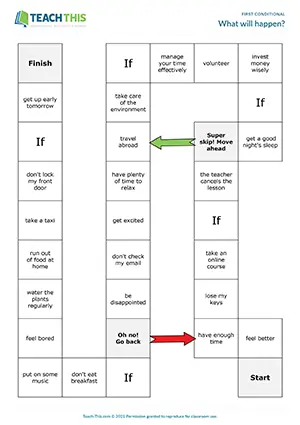
ESL First Conditional Board Game - Grammar and Speaking: Forming Sentences, Freer Practice - Group Work
In this free first conditional board game, students practice making first conditional sentences from prompts. In groups, students take turns rolling the dice and moving their counters along the board...
First Conditional Practice
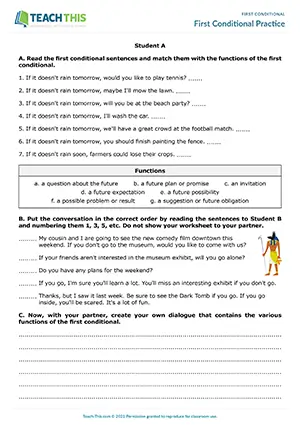
ESL First Conditional Activity - Grammar: Matching, Ordering, Writing a Dialogue, Role-Play - Pair Work
In this enjoyable first conditional activity, students identify different ways of using the first conditional and practice using them in two conversations. First, students read first conditional sentences and...
If...
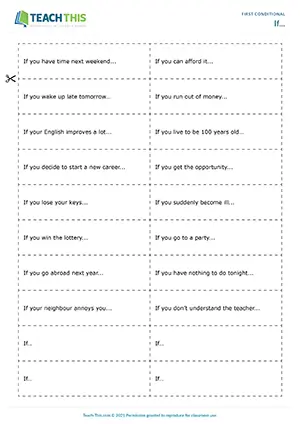
ESL First Conditional Game - Grammar and Speaking: Forming and Answering Questions, Freer Practice - Group Work
In this rewarding first conditional game, students practice asking first conditional questions and responding with phrases of probability. Begin by writing probability phrases on the board...
Understanding the First Conditional
The first conditional is a sentence structure using the pattern 'if + present simple, will + infinitive' to talk about real or likely situations in the future and their probable outcomes, as in 'If you study tonight, you will pass the test.' When students confuse the first conditional with the second conditional, they signal the wrong degree of likelihood: writing 'If I studied harder, I would pass' tells a reader the speaker sees success as unlikely or imaginary, which can completely misrepresent someone's intentions or plans.
This page covers the first conditional across B1 and B2 levels, with 14 activities including gap-fill worksheets, dominoes, board games, card games, and speaking activities, with two activities available as free downloads.
This table maps the main structural patterns of the first conditional, showing how the if-clause and result clause can vary in form while the core present-simple logic in the if-clause stays the same.
| Pattern | If-Clause Form | Result Clause Form | Example |
|---|---|---|---|
| Standard positive | If + present simple | will + infinitive | 'If it rains, we will stay inside.' |
| Negative if-clause | If + present simple negative | will + infinitive | 'If you don't hurry, you will miss the bus.' |
| Unless (negative alternative) | Unless + present simple | will + infinitive | 'Unless you call, she will worry.' |
| Modal variation: may/might | If + present simple | may/might + infinitive | 'If the weather improves, we might go hiking.' |
| Modal variation: can | If + present simple | can + infinitive | 'If you finish early, you can leave.' |
| Imperative result | If + present simple | imperative | 'If you feel unwell, call the doctor.' |
| Question form | If + present simple | will + subject + infinitive | 'What will you do if the train is late?' |
When to Use the First Conditional
Giving Warnings: A speaker uses the first conditional to alert someone to a real negative consequence they can still avoid, making the warning feel urgent and actionable rather than theoretical, as in 'If you don't back up your files, you will lose everything.'
Making Offers and Deals: The first conditional lets a speaker attach a genuine commitment to a specific condition, making clear the offer stands only if the condition is met, as in 'If you finish the report today, I'll take the team out for lunch.'
Stating Conditions in Agreements: Written instructions and formal agreements use the first conditional to spell out exactly what will happen when a condition is or is not met, keeping expectations clear for both parties, as in 'If payment is not received within 30 days, a late fee will apply.'
3-Step Framework for Teaching the First Conditional
1. Lock In the Form: Start by having students work through a gap-fill story where every blank requires the correct verb form for a first conditional sentence. Students score one point for each correct answer, so there is a light competitive edge that keeps them focused. Checking answers by eliciting each completed sentence aloud from a different student gives you a chance to hear the structure in production before you move to anything more open.
2. Build the Structure Through Matching: Once students can form sentences accurately, move them into a matching game using dominoes, where each player places a piece down either before or after the domino already on the table. Every time a player makes a match, they read the complete sentence aloud to the group to confirm it is correct, which builds in an accuracy check without any extra teacher effort.
3. Push Into Freer Production: Finish with a picture-prompt card game that asks students to move from recognition to open sentence-building. One student turns over an 'If' card featuring a picture and produces the if-clause, for example 'If you stay up late,...' while the rest of the group scans their result cards to find an appropriate match to complete the sentence. Whoever holds the matching result card wins both cards, giving students a clear, motivating reason to produce accurate and logical sentences.
Common Mistakes with the First Conditional
Using 'will' in the If-Clause: Students often place 'will' in both clauses, treating the if-clause as a future statement rather than a present-simple condition, because the situation refers to something in the future. Wrong: 'If it will rain tomorrow, we will cancel the trip.' Correct: 'If it rains tomorrow, we will cancel the trip.'
Present Simple in the Result Clause: Students often write the result clause in present simple instead of using 'will + infinitive,' either overgeneralizing from zero conditional patterns or following the logic of their first language. Wrong: 'If you study hard, you pass the exam.' Correct: 'If you study hard, you will pass the exam.'
Common Questions About Teaching the First Conditional
What is a fun speaking game for practicing the first conditional?
Built around a spoken chain of first conditional sentences, the game Conditional Chain Game keeps production sharp and competitive. The teacher says an if-clause, the first student adds a result clause, and the next student turns that result clause into a new if-clause. Students who cannot respond within the time limit are out, and the last student remaining wins.
What is a useful first conditional worksheet for practicing giving advice?
The worksheet First Conditional Advice gives students a real-world purpose for using the structure accurately. Students practice giving advice using the first conditional with 'will' and other modals, working through gap-fills and sentence unscrambling before reading an email to an advice columnist, then writing their own reply. This worksheet is available as a free download.
How can I get students to ask and answer first conditional questions?
The game If... puts question formation and probability language to work together. Students pick up if-clause cards and ask first conditional questions, while partners respond using probability phrases such as 'I doubt if,' 'will probably,' or 'will definitely.' Both the question and the answer earn a point if grammatically correct, so accuracy matters throughout.
Become a Teach This Member
Get unlimited access to the full library, plus new resources added every week.
Unlimited Resource Access
Download from 3000+ worksheets, activities, and games.
Save 5+ Hours Weekly
Cut lesson prep time with ready-to-use resources, plus teacher notes and answer keys.
Trusted Professional Quality
Classroom-tested, editable resources created by experienced ESL professionals.
Fresh Content Weekly
Get 5 new resources added to the library each week.
Here's what our members are saying...


