
Future Tenses ESL Games, Activities & Worksheets
Change your Mind

ESL Going To and Will Activity - Grammar and Speaking: Asking and Answering Questions, Controlled and Freer Practice
In this free 'be going to' and 'will' activity, students ask 'be going to' questions to confirm plans for tomorrow and change their minds by making spontaneous decisions with 'will'. First, students hold...
Future Sentences

ESL Future Expressions Games - Grammar and Speaking: Pelmanism, Forming Sentences - Group Work
In these two future expressions games, students practice making sentences about the future with 'would like to', 'want to', 'hope to' and 'be going to'. First, students play a pelmanism game where they...
Going to or Will?
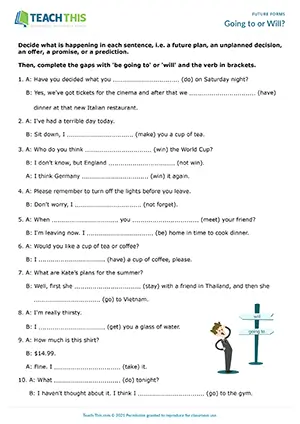
ESL Be Going To or Will Worksheet - Grammar Exercise: Gap-fill
In this useful 'be going to' or 'will' worksheet, students identify the function of each sentence and then fill in the gaps with the correct future form, using 'be going to' for plans and 'will' for offers, promises, spontaneous decisions, and...
Plans and Predictions
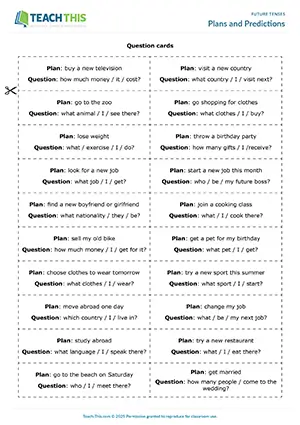
ESL Be Going To or Will Game - Grammar and Speaking: Forming Sentences, Asking and Answering Questions, Freer Practice - Pair Work
In this rewarding 'be going to' and 'will' game, students practice using 'be going to' for future plans and 'will' for predictions by forming sentences, asking questions...
The Future You
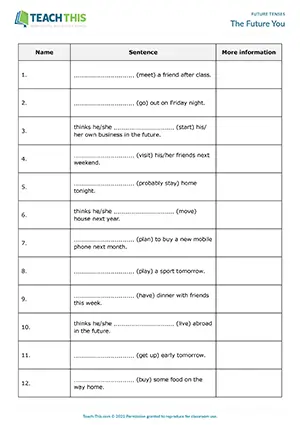
ESL Future Tenses Activity - Grammar and Speaking: Gap-fill, Forming, Asking and Answering Questions
Here is an engaging future tenses speaking activity to help students practice the future forms: will, be going to and the present continuous. Students begin by completing sentences with 'will', 'be going...
Tomorrow, Next Week, and Beyond!

ESL Future Tenses Activity - Vocabulary and Speaking: Gap-fill, Asking and Answering Questions - Group and Pair Work
In this useful future tenses speaking activity, students complete, ask and answer conversation questions using 'will', 'be going to' and the present continuous. First, in two groups, students...
A Week in My Country
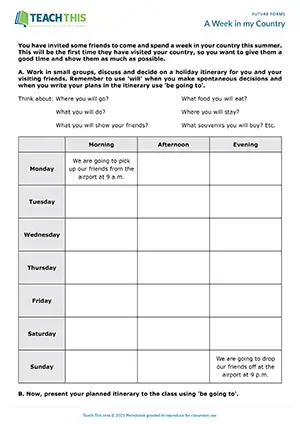
ESL Will and Going To Activity - Speaking: Discussing and Planning a Schedule, Presenting, Freer Practice - Group Work
In this enjoyable 'will' and 'be going to' activity, students use 'will' to make on-the-spot decisions while planning a week-long holiday itinerary, and then use 'be going to' to write up and present the ...
Cards of the Future

ESL Future Tenses Game - Grammar and Speaking Game: Matching, Asking and Answering Questions - Group Work
In this imaginative future tenses game, students practice asking and answering questions about the future using 'will', 'be going to', and the present continuous. In groups, students take turns...
Dialogue Disarray
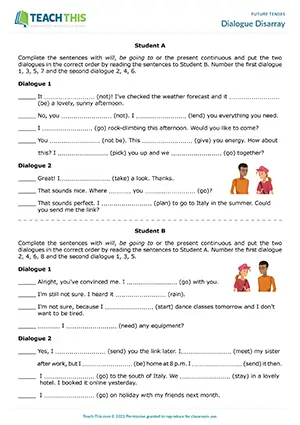
ESL Future Tenses Activity - Grammar and Speaking: Gap-fill, Ordering, Role-Play, Controlled Practice - Pair Work
In this challenging future tenses activity, students use 'will', 'be going to', and the present continuous to complete missing verbs in two dialogues and put the dialogues in a logical order. The students'...
Dice of Prediction

ESL Future Tenses Board Game - Grammar and Speaking: Forming Sentences - Group Work
In this free future tenses board game, students practice making predictions using the future simple with 'will', the future perfect, the future continuous, future time expressions, 'will probably' and...
Future Tenses Board Game

ESL Future Tenses Board Game - Grammar and Speaking: Impromptu Speech, Communicative Practice - Group Work
Here is a free future forms board game to help students talk about the future using the present continuous, 'be going to', 'will', 'won't' and 'would like to'. Students take turns rolling the dice and moving...
New Year's Resolutions
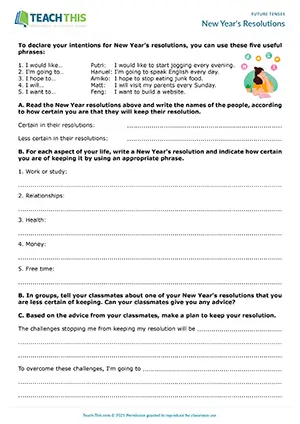
ESL Future Intentions Worksheet - Grammar and Writing Exercises: Rating, Writing Sentences - Speaking Activity: Discussion - Group Work
In this creative New Year's resolutions worksheet, students use five common future forms to express intentions with different levels of certainty and use...
Questions of the Future

ESL Future Forms Game - Grammar: Writing Sentences, Guessing
In this intriguing future forms game, students practice future forms by anonymously completing a short questionnaire about their plans and predictions, then listening to classmates’ responses and guessing who wrote each set of answers...
Race to the Top
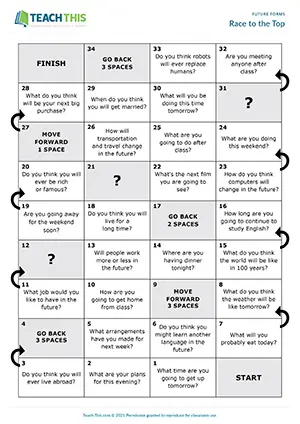
ESL Future Tenses Board Game - Grammar Game: Answering Questions, Forming Questions and Sentences - Group Work
This fun future forms board game helps students practice future forms by asking and answering questions, forming full sentences, and discussing plans in small groups. Players take turns rolling the...
Will or Be Going To?
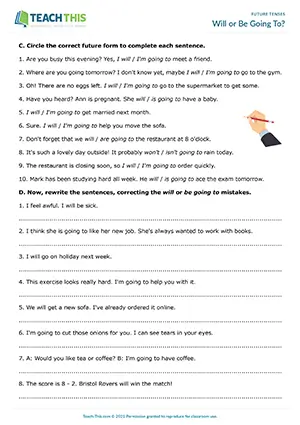
ESL Will or Be Going To Worksheet - Grammar Exercises: Gap-fill, Matching, Writing Sentences, Binary Choice, Error Correction, Rewriting Sentences
This comprehensive 'will' or 'be going to' worksheet helps students practice or review the differences between these two future forms. First, students...
Future Tenses Grammar Gamble

ESL Future Tenses Game - Grammar: Gap-fill, Betting
In this mixed future tenses game, students complete sentences that refer to the future and to future-in-the-past forms, then bet points on their answers. First, students complete sentences with verbs from a box in their correct future forms...
I'm about to win!

ESL Future Expressions Game - Grammar: Sentence Completion - Group Work
In this future expressions with 'be' game, students complete sentences by combining verbs from a word bank with be + due to, about to, just about to, or to. The aim of the game is for players to get four squares in a row whilst trying to...
What Does the Future Hold?
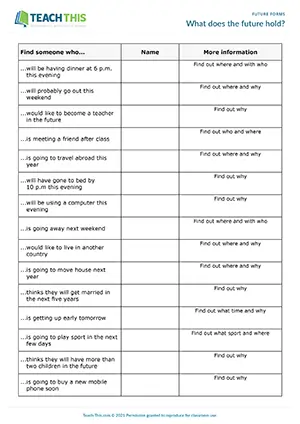
ESL Future Tenses Activity - Grammar and Speaking: Forming, Asking and Answering Questions, Controlled and Freer Practice
This future forms speaking activity helps students review future forms and their functions. The activity covers 'will' for predictions, 'be going to' for plans and intentions, present...
Focusing on the Future

ESL Future Tenses Game - Vocabulary and Speaking: Discussions - Pair Work
In this rewarding future expressions game, students discuss a range of personal and global questions while deliberately using advanced future expressions in their answers to gain pointsIn pairs, one student picks up a question card, reads it aloud...
Understanding Future Tenses
Future tenses in English fall into three main categories that students encounter early: 'will' for predictions and spontaneous decisions, as in 'It will rain tomorrow'; 'be going to' for plans and intentions, as in 'I'm going to visit my parents'; and the present continuous for fixed arrangements, as in 'I'm meeting Sam at 6.' When students use only 'will' for every future meaning, their English sounds imprecise: saying 'I will meet my friend tonight' instead of 'I'm meeting my friend tonight' signals a vague intention rather than a confirmed plan, which can leave a listener uncertain about whether the event is actually happening.
This page covers future tenses across four levels from A2 to C1 with 20 activities ranging from card games and board games to dialogue reconstruction and discussion tasks, totaling around 560 minutes of practice, with two activities available as free downloads.
English uses five main future forms, each with a distinct structure and communicative function, from pre-intermediate through to advanced level.
| Form | Structure | Main Use | Example |
|---|---|---|---|
| will (future simple) | subject + will + base verb | predictions, spontaneous decisions, offers, promises | 'I think it will snow tonight.' |
| be going to | subject + am/is/are + going to + base verb | plans, intentions, evidence-based predictions | 'We are going to visit Rome next month.' |
| Present Continuous | subject + am/is/are + verb-ing | fixed arrangements with a specific time or place | 'I am meeting the team at 9 a.m. on Monday.' |
| Future Continuous | subject + will be + verb-ing | actions in progress at a specific future moment | 'This time tomorrow I will be flying to Tokyo.' |
| Future Perfect | subject + will have + past participle | actions completed before a specific future point | 'By Friday she will have finished the report.' |
When to Use Future Tenses
Signaling a Confirmed Arrangement: When a speaker wants to show that a future event is already fixed and scheduled rather than merely intended, the present continuous signals that commitment clearly, as in 'I can't come on Saturday. I'm having lunch with my parents.'
Predicting Based on Visible Evidence Right Now: When a speaker can see clear evidence that something is about to happen, 'be going to' links that present evidence directly to the future outcome in a way that 'will' does not, as in 'Look at those clouds. It's going to rain.'
Describing an Action in Progress at a Future Moment: When a writer or speaker wants to place the reader inside a future moment and show that an action will already be underway at that point, the future continuous creates that sense of ongoing activity, as in 'At this time next week, we will be sitting on the beach.'
3-Step Framework for Teaching Future Tenses
1. Contrast the Two Core Forms Through a Mingle Activity: The biggest challenge for beginners is understanding when to use 'be going to' versus 'will', and a mingle activity that forces them to switch between the two in real time is the fastest way to make the difference stick. Students hold a card with a plan prompt visible only to themselves and circulate, answering questions like 'Are you going to go to the gym tomorrow?' by changing their mind and choosing one of two 'will' responses, such as 'No, I think I'll play tennis.' Because students repeat the same question with different partners and make a different decision each time, they get a high volume of practice in a short window.
2. Embed All Three Forms in a Real Dialogue Context: Once students can switch between 'will' and 'be going to' in isolation, give them the challenge of using all three main future forms inside a real conversation. A dialogue reconstruction activity works well here: Student A selects the most suitable future form for their sentence and reads it aloud, and Student B listens, finds a suitable reply, completes it with the correct future form, and reads it back, with both students numbering the exchanges to build the dialogue in order. Working through two complete conversations this way helps students see how future forms function differently within the same natural exchange.
3. Push Advanced Students to Use Future Expressions Under Conversational Pressure: At higher levels, students need to go beyond the three core forms and deploy a wider range of future expressions accurately in free speech. A discussion card game creates the right conditions: pairs discuss a question card for two minutes while deliberately weaving a target expression into the conversation naturally, for example working 'be about to' into an answer by saying 'I'm about to graduate from school, so I think in the next five years I'll get a job.' Every successful use of the target expression, confirmed by the partner, scores a point, which keeps precision in focus without interrupting the flow of conversation.
Common Mistakes with Future Tenses
Using 'Will' for a Pre-Arranged Plan: Students often use 'will' for events that are already booked or confirmed, when 'be going to' or the present continuous is the more natural choice, because they have not yet learned that 'will' signals a newly formed rather than a pre-existing decision. Wrong: 'I will have dinner with my family on Sunday. It's all arranged.' Correct: 'I'm having dinner with my family on Sunday. It's all arranged.'
Using 'Be Going To' for a Spontaneous Decision: Students often use 'be going to' in response to a sudden situation, when 'will' is the natural choice for a decision made on the spot rather than something planned in advance. Wrong: 'It's hot in here. I am going to open the window.' Correct: 'It's hot in here. I'll open the window.'
Common Questions About Teaching Future Tenses
What is a fun board game for practicing future tenses?
Available as a free download, the board game Future Tenses Board Game puts all the main future forms into play at once. Students roll the dice, move along the board, and talk about the topic on their square for 30 seconds using an appropriate future form. Making a grammar mistake or stopping early sends the player back two squares.
What is a good worksheet for teaching the difference between 'will' and 'be going to'?
The worksheet Will or Be Going To? targets the difference between these two future forms across a sequence of exercises. Students complete statements, questions, and responses with the correct form and match them together, rewrite sentences in the negative, underline the correct future form in context, and finish by correcting 'will' or 'be going to' mistakes.
How can I get students to practice 'be going to' and 'will' in the same activity?
Switching between the two forms in every exchange is exactly what the game Plans and Predictions demands. One student forms a 'be going to' plan and asks a matching 'will' question; their partner finds a logical answer card and makes a 'will' prediction, winning the question card for a correct match. The student with the most cards wins.
Become a Teach This Member
Get unlimited access to the full library, plus new resources added every week.
Unlimited Resource Access
Download from 3000+ worksheets, activities, and games.
Save 5+ Hours Weekly
Cut lesson prep time with ready-to-use resources, plus teacher notes and answer keys.
Trusted Professional Quality
Classroom-tested, editable resources created by experienced ESL professionals.
Fresh Content Weekly
Get 5 new resources added to the library each week.
Here's what our members are saying...


