
Possessive Adjectives, Pronouns & Nouns ESL Games, Worksheets & Activities
His, Her or Their?
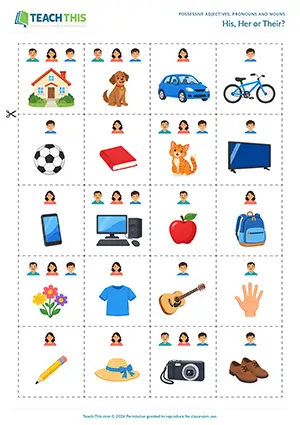
ESL Possessive Adjective Games - Vocabulary, Grammar and Speaking: Matching, Forming Sentences
In this engaging set of possessive adjective games, students practice talking about who owns different objects using his, her and their. In groups, students take turns turning over a picture card and a...
My Things, Your Things
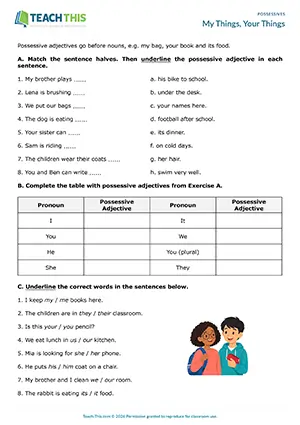
ESL Possessive Adjectives Worksheet - Grammar Exercises: Matching, Labelling, Underlining, Gap-fill, Unscrambling, Correcting
This comprehensive possessive adjectives worksheet helps students identify and use possessive adjectives in sentences about everyday things. First...
Possessive Adjectives Connect Four
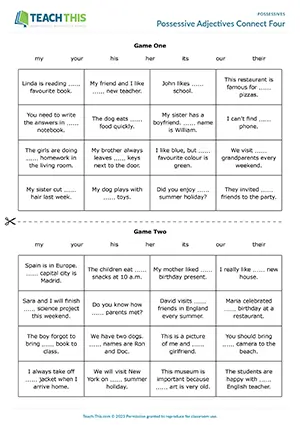
ESL Possessive Adjectives Game - Grammar: Gap-fill
In this rewarding possessive adjectives game, students play Connect Four by completing sentences with my, your, his, her, its, our and their. In groups, two students play and a third student checks their answers. The two players choose 'X' or 'O'...
What's your favourite...?

ESL Possessive Adjectives Game - Speaking and Writing Activity: Writing Short Answers, Asking and Answering Questions, Writing Sentences
In this fun possessive adjectives game, students play a true or false guessing game about favourites to practice the possessive adjectives: my, your, his...
Who Owns What?
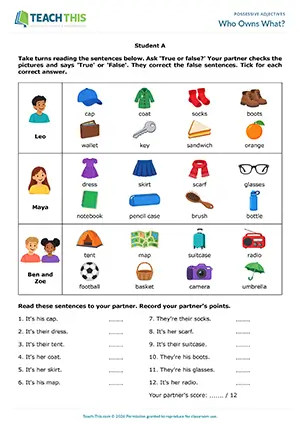
ESL Possessive Adjectives Game - Grammar and Speaking: True or False, Correcting Sentences
In this free possessive adjectives game, students use pictures to identify who owns different objects and correct statements with 'his', 'her' and 'their'. In pairs, students take turns reading sentences...
Accurate Apostrophes

ESL Apostrophe Games - Grammar and Speaking: Matching, Forming Sentences, Freer Practice
In these two entertaining apostrophe games, students make nouns possessive by adding an apostrophe or apostrophe+s. Each student stands up with an apostrophe card and an apostrophe+s card...
Happy Families
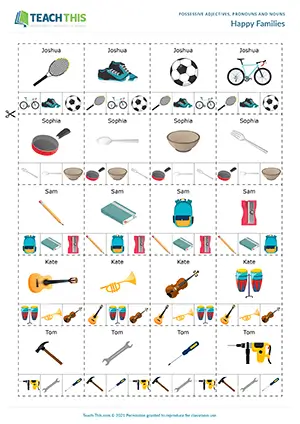
ESL Possessive Nouns Game - Grammar and Speaking: Asking and Answering Questions, Freer Practice
In this productive possessive nouns game, students play a Happy Families card game to practice possessive nouns. Each card contains a picture of an object and the name of the person who the item...
Possessive Adjectives and Pronouns
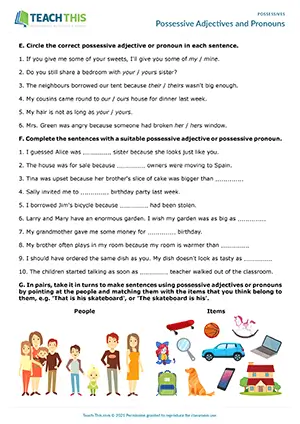
ESL Possessive Adjectives and Pronouns Worksheet - Vocabulary and Grammar Exercises: Binary Choice, Gap-fill - Speaking Activity: Forming Sentences
This useful possessives worksheet helps students learn and practice possessive adjectives and pronouns. Students begin by completing a table with...
Possessive Nouns and Pronouns
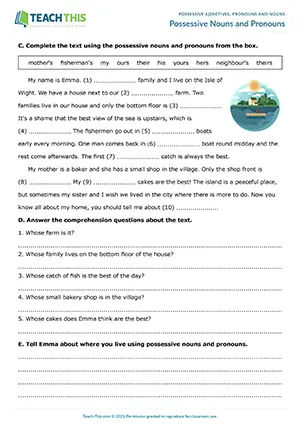
ESL Possessive Nouns and Pronouns Worksheet - Grammar Exercises: Rewriting, Gap-fill, Answering Comprehension Questions, Writing Sentences
In this insightful possessives worksheet, students practice possessive nouns and possessive pronouns. Students begin by writing the correct...
Possessive Pronoun Race

ESL Possessive Pronouns Game - Grammar: Matching, Sentence Completion
In this fast-paced possessive pronouns game, students race to complete sentences with possessive pronouns. Students take it in turns to pick up a sentence card and read it to the other two students. The students listen to the sentence and then race...
Possessive Pronouns
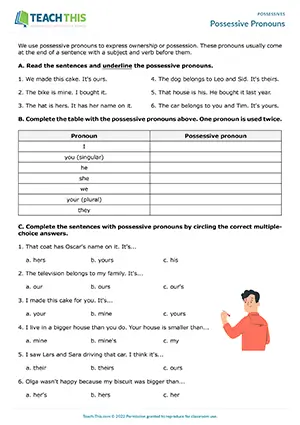
ESL Possessive Pronouns Worksheet - Grammar Exercises: Identifying, Multiple Choice, Table and Sentence Completion, Rewriting Sentences, Unscrambling
In this free possessive pronouns worksheet, students practice the possessive pronouns: mine, yours, his, hers, ours, yours, theirs. First, students read...
Whose is it?
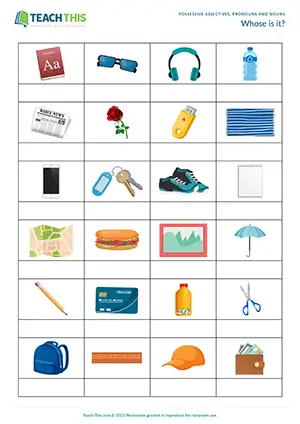
ESL Possessive Pronouns Game - Speaking: Labelling, Forming Sentences
In this enjoyable possessive pronouns speaking activity, students play a memory game to practice possessive pronouns. Give each student a picture of an object and each pair a picture to share. The students then play a memory game where...
Correct it
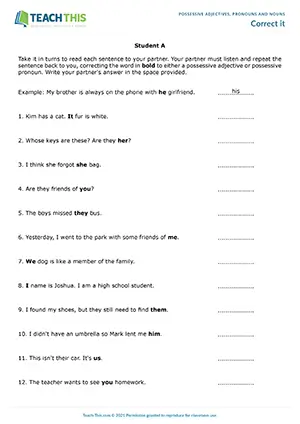
ESL Possessive Adjectives and Pronouns Game - Grammar: Error Correction
In this handy possessive adjectives and pronouns error correction game, students correct sentences by changing subject pronouns to possessive adjectives or object pronouns to possessive pronouns. The sentences on the worksheet contain errors...
Who does this belong to?

ESL Possessives Activity - Speaking: Reading, Listening, Summarising, Matching
In this creative possessives speaking activity, students practice language for talking about possessions. Students take it in turns to read the text on their biography card to the other group members who listen and summarise the important facts on their...
Understanding Possessive Adjectives, Pronouns and Nouns
Possessive adjectives, pronouns and nouns show ownership or relationships, as in 'my bag', 'mine' and 'Sarah's sister'. Choosing the right form helps students make clear who or what they mean without unnecessarily repeating a noun.
This page covers possessive adjectives, pronouns and nouns from beginner (A1) to intermediate (B1), with 14 resources comprising games, worksheets and a speaking activity, including two free downloads.
Possessive adjectives come before a noun, while possessive pronouns stand in place of a possessive phrase. To form possessive nouns, add 's to singular nouns and irregular plurals such as 'children', and add an apostrophe after regular plurals ending in s: 'the child's bag', 'the children's bags' and 'the students' bags'.
| Subject Pronoun | Possessive Adjective | Possessive Pronoun | Example Sentences |
|---|---|---|---|
| I | my | mine | 'That is my bag. The bag is mine.' |
| you | your | yours | 'That is your coat. The coat is yours.' |
| he | his | his | 'That is his phone. The phone is his.' |
| she | her | hers | 'Those are her keys. The keys are hers.' |
| it | its | Not normally used independently | 'The cat hurt its paw.' |
| we | our | ours | 'This is our table. The table is ours.' |
| they | their | theirs | 'That is their car. The car is theirs.' |
How to Use Possessive Adjectives, Pronouns and Nouns
Choose the form according to the owner: The possessive adjective identifies the owner, not the number of objects. Compare 'her book' and 'her books' with 'their book' and 'their books'.
Decide whether to include the noun: Use 'This is my umbrella' when naming the object and 'This is mine' when the object is already clear. In a question and answer, the viewpoint changes: 'Is this your umbrella?' 'Yes, it's mine.'
Make the owner explicit when needed: Use a possessive noun if a pronoun would leave the owner unclear. 'This is Maya's notebook' identifies the person directly; 'This is her notebook' relies on the listener knowing who 'her' refers to.
3-Step Framework for Teaching Possessive Adjectives, Pronouns and Nouns
For learners moving from elementary to pre-intermediate work, introduce these stages across lessons as needed. Establish possessive adjectives before contrasting them with pronouns and adding possessive noun forms.
1. Connect People with Possessive Adjectives: Begin with sentence halves that students match before underlining the possessive adjective in each completed sentence. Follow with a reference table and picture-based corrections about people's belongings. This links the owner to the correct form before students express ownership in another way.
2. Contrast Adjectives and Pronouns: Use a worksheet in which students complete a table, choose words to complete grammar rules and fill sentence gaps with possessive adjectives or pronouns. They then point to pictured people and items and make sentences such as 'That is his skateboard' and 'The skateboard is his'. This prepares students to choose a form according to whether they include the noun.
3. Name the Owner with a Possessive Noun: Add practice with singular and plural owners through a team game. Players listen to a noun and race to select an apostrophe or apostrophe+s card, then try to make a sentence with the possessive noun for an extra point. Follow up by asking learners to compare naming an owner with using an adjective or pronoun, bringing the three forms together.
Common Mistakes with Possessive Adjectives, Pronouns and Nouns
Using a possessive adjective without its noun: When the possessive form stands alone, use a possessive pronoun. Incorrect: 'That bag is her.' Correct: 'That bag is hers.' Alternatively, include the noun: 'That is her bag.'
Confusing its with it's: 'Its' shows possession without an apostrophe. 'It's' is a contraction of 'it is' or 'it has', so check whether either full form fits the sentence. Incorrect: 'The cat hurt it's paw.' Correct: 'The cat hurt its paw.'
Common Questions About Teaching Possessive Adjectives, Pronouns and Nouns
What is a free worksheet for teaching possessive pronouns?
The free worksheet Possessive Pronouns introduces the forms through identification and a reference table before moving to sentence practice. Students choose and supply possessive pronouns, rewrite sentences to include them and reorder words while adding a suitable pronoun. This gives teachers a progression from recognising forms to using them.
What is a fun game for practicing possessive nouns?
The game Happy Families gives students a reason to repeat possessive nouns as they collect matching cards. They ask classmates for named people's belongings, such as 'Joshua's tennis racket', and exchange an unwanted card when successful. Collecting a set of four wins the round, giving the questions a clear purpose.
What speaking activity can I use for practicing possessives?
In the speaking activity Who does this belong to?, students listen to biographies and summarise key facts. They then match objects to the people described, explaining their choices with possessive nouns and 'belongs to'. Comparing the clues gives students a reason to discuss ownership and justify their answers.
Become a Teach This Member
Get unlimited access to the full library, plus new resources added every week.
Unlimited Resource Access
Download from 3000+ worksheets, activities, and games.
Save 5+ Hours Weekly
Cut lesson prep time with ready-to-use resources, plus teacher notes and answer keys.
Trusted Professional Quality
Classroom-tested, editable resources created by experienced ESL professionals.
Fresh Content Weekly
Get 5 new resources added to the library each week.
Here's what our members are saying...


