
Travel ESL Activities, Role-Plays & Games
How long does it take?
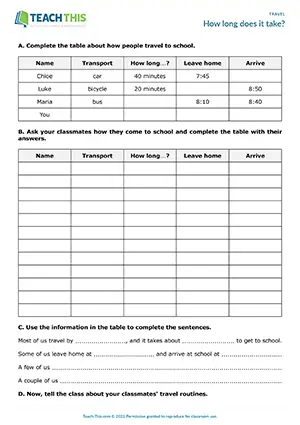
ESL Travel Routines Activity - Speaking: Table Completion, Asking and Answering Questions, Sentence Completion
In this insightful travel routines activity, students practice asking and answering questions about how they travel to school. First, students complete a table about how three people travel to...
London to Paris
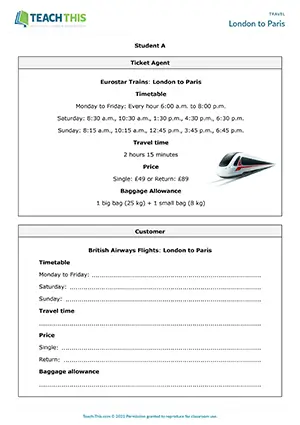
ESL Travel Information Role-Play - Speaking Activity: Asking and Answering Questions, Communicative Practice - Pair Work
In this free travel information role-play, students practice asking and answering questions about train and flight schedules, prices, and baggage allowances between London and Paris. First...
Making and Cancelling Hotel Bookings
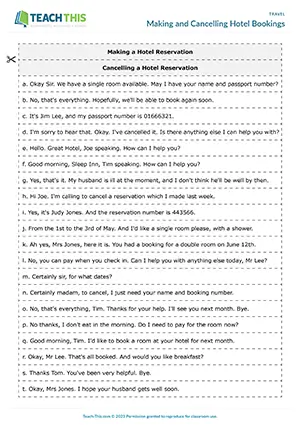
ESL Hotel Reservations Activity - Reading, Vocabulary and Speaking Activity: Ordering, Binary Choice, Gap-fill, Role-Play - Pair Work
Here is a productive hotel reservations activity to help students practice phrases for making and cancelling hotel reservations by phone. First, in pairs, students arrange sentence strips to form two dialogues...
Travel Mix Up
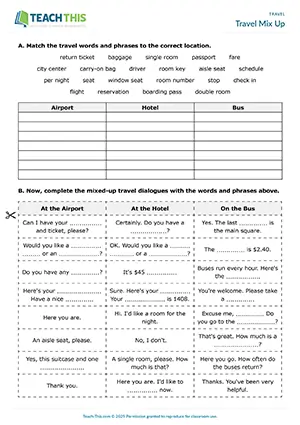
ESL Travel Vocabulary Activity - Vocabulary: Matching, Gap-fill, Ordering, Role-Play - Pair Work
Here is an engaging travel vocabulary activity to help students practice vocabulary and phrases for travel situations at the airport, hotel, and bus. First, students match travel words and phrases to...
Passport to Conversation
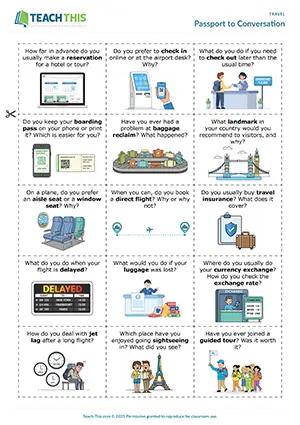
ESL Travel Conversation Activity - Speaking: Asking and Answering Questions, Guided Discussion, Freer Practice - Group Work
Here is an insightful travel conversation questions activity that helps students practice travel vocabulary and talk about travel experiences. In groups, students take turns picking up a card and asking the...
Travel Dominoes
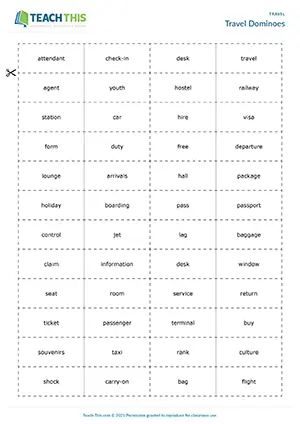
ESL Travel Collocations Game - Vocabulary and Speaking: Matching, Forming Sentences, Controlled and Freer Practice - Group Work
In this enjoyable travel collocations game, students play dominoes by matching words together to form travel collocations and using them in sentences. The first...
What Is Travel Language?
Travel language helps learners ask for information, discuss journeys, book accommodation, handle transport situations, and talk about travel experiences. When learners use the wrong phrase or miss key details like prices, schedules, or baggage allowances, conversations at stations, airports, and hotels can break down.
This page covers travel from Elementary (A1-A2) to Intermediate (B1), with six resources including speaking activities, role-plays, conversation tasks, and games, plus one free download.
This quick reference table maps common travel language by situation, speaker, and example phrase.
| Situation | Speaker | Example Phrase |
|---|---|---|
| Asking about transport | Traveler | 'How do you get to school?' |
| Asking travel time | Traveler | 'How long does it take?' |
| Asking about a schedule | Customer | 'What time does the train leave?' |
| Asking about price | Customer | 'How much is a return ticket?' |
| Asking about baggage | Passenger | 'What is the baggage allowance?' |
| Making a hotel booking | Guest | 'I'd like to book a room.' |
| Canceling a hotel booking | Guest | 'I'd like to cancel my reservation.' |
| Finding airport services | Passenger | 'Where is the check-in desk?' |
| Sharing a travel experience | Traveler | 'The best trip I ever took was to Japan.' |
How to Use Travel Language
Choose the Right Setting: Use travel phrases by matching them to the place where the exchange happens, so learners choose airport, hotel, bus, or train language correctly, as in 'Where is the departure gate?'
Ask Before Choosing: Use travel language to compare options before making a decision about tickets, routes, rooms, or times, as in 'Is there a cheaper train in the afternoon?'
Confirm Key Details: Use travel language to check important information before a trip, especially dates, times, prices, names, and rules, as in 'Can I confirm the booking is for two nights?'
3-Step Framework for Teaching Travel Language
1. Start with Real Travel Routines: Begin with the journeys learners already make so travel language has an immediate purpose. A class survey where students ask classmates questions and complete a table with their answers turns transport phrases into useful personal information.
2. Move into Service Encounters: Build confidence with travel exchanges where learners need to make or change arrangements. A hotel phone context gives clear roles, with learners taking turns to be the hotel receptionist and the guest.
3. Expand into Travel Conversation: Once learners can handle basic information exchanges, give them space to share opinions and experiences. Conversation cards let students pick up a card, ask the travel question on it, and discuss the topic with the group.
Common Mistakes with Travel Language
Wrong Phrase for Walking: Students often say 'by foot' when English uses 'on foot' for walking. Wrong: 'I go to school by foot.' Correct: 'I go to school on foot.'
Wrong Preposition After Arrive: Students often use 'to' after arrive when English usually needs 'at' for specific places. Wrong: 'We arrived to the airport at six.' Correct: 'We arrived at the airport at six.'
Common Questions About Teaching Travel Language
What is a useful travel role-play for ESL students?
The free role-play London to Paris puts one student in the role of a ticket agent and the other as a customer. Students ask and answer questions about train and flight schedules, prices, and baggage allowances, then switch roles and repeat the activity using air travel information instead.
What is a good activity for teaching travel vocabulary?
Travel Mix Up moves students through three locations in one activity. They match travel words and phrases to the airport, the hotel, and the bus, then use the words to complete three mixed-up dialogues and arrange the sentences in order before role-playing all three conversations with a partner.
What is a fun game for practicing travel collocations?
In the game Travel Dominoes, students take turns matching domino cards to form travel collocations such as 'check-in desk.' Each correct collocation scores one point and a meaningful sentence scores an extra point. The first player to get rid of all their dominoes wins an additional three points.
Become a Teach This Member
Get unlimited access to the full library, plus new resources added every week.
Unlimited Resource Access
Download from 3000+ worksheets, activities, and games.
Save 5+ Hours Weekly
Cut lesson prep time with ready-to-use resources, plus teacher notes and answer keys.
Trusted Professional Quality
Classroom-tested, editable resources created by experienced ESL professionals.
Fresh Content Weekly
Get 5 new resources added to the library each week.
Here's what our members are saying...


