
Shopping ESL Role-Plays, Activities, Worksheets & Games
At the Shops
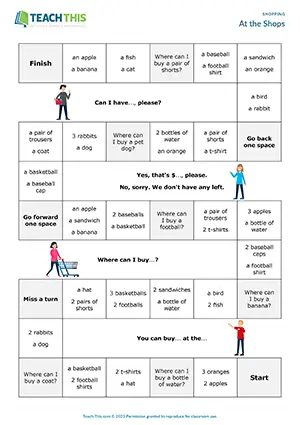
ESL Shopping Board Game - Vocabulary and Speaking: Asking and Answering Questions, Controlled Practice - Group Work
In this imaginative shopping board game, students practice asking for items in a shop, giving prices and saying where to buy particular items. In groups, players take turns rolling the dice and moving...
At the Clothes Shop
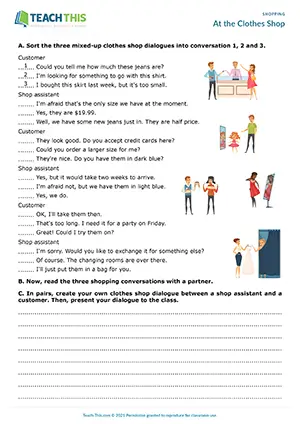
ESL Clothes Shopping Activity - Vocabulary and Speaking: Categorising, Ordering, Role-Play, Creating and Presenting a Dialogue - Pair Work
In this free clothes shopping activity, students categorise and order clothes shop conversations and role-play a clothes shopping dialogue. First...
Bargain Hunters
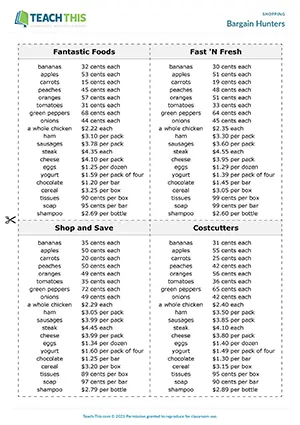
ESL Shopping Role-Play - Speaking Activity: Asking and Answering Questions, Communicative Practice - Group Work
Here is a communicative shopping role-play to help students practice asking and saying how much things cost in a shop. Four students take on the role of shop assistants and four students are shoppers...
Can I help you?
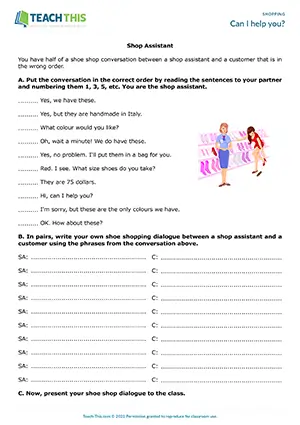
ESL Shoe Shop Role-Play - Speaking Activity: Ordering, Creating and Presenting a Dialogue, Controlled and Freer Practice - Pair Work
In this free shoe shop role-play activity, students put a shoe shop conversation in order and role-play a shoe shopping dialogue. In pairs, one student takes...
Let's Go Shopping
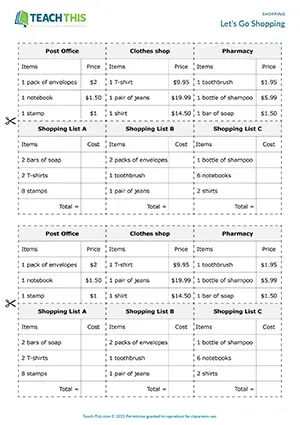
ESL Shopping Role-Play - Speaking Activity: Asking and Answering Questions, Communicative Practice - Group Work
In this communicative shopping role-play, students take on the roles of shop assistants and customers and practice phrases for buying and selling items in a shop. In groups, three students take on the...
Shopping Around
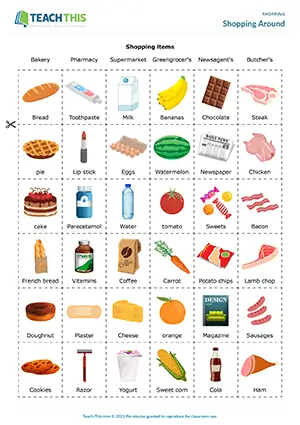
ESL Shopping Game - Speaking: Role-Play, Communicative Practice - Group Work
In this fun shopping role-play game, students act as customers and shop assistants and practice buying and selling items in a shop. In groups, students stand a card up on their table to show the name of their shop, e.g. bakery. The aim of the game...
Shopping Dominoes
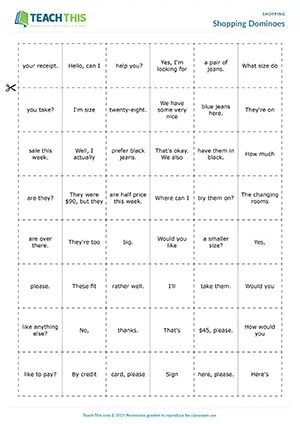
ESL Clothes Shopping Game - Vocabulary: Matching, Ordering - Group Work
In this enjoyable clothes shopping game, students build a clothes shop conversation between a shop assistant and a customer by matching sentence halves together. First, students find the 'Hello, can I...' domino and place it face-up on the table...
Shopping Role-Plays
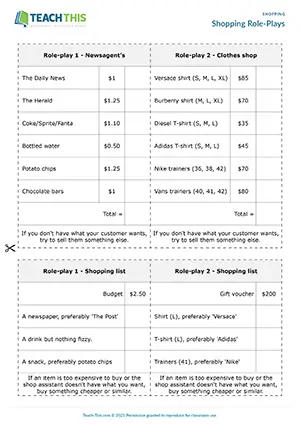
ESL Shopping Role-Plays - Speaking Activity: Asking and Answering Questions, Communicative Practice - Pair Work
In these two communicative shopping role-plays, students practice phrases for buying and selling items in a newsagent and a clothes shop. In pairs, one student plays a newsagent shop assistant, and the...
Containers
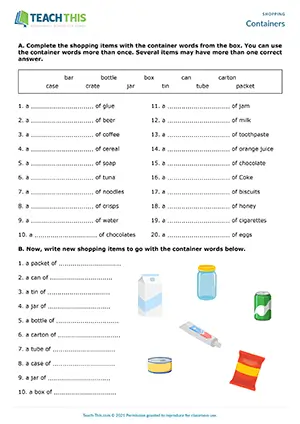
ESL Containers Worksheet - Vocabulary Exercises: Matching, Gap-fill
This handy containers worksheet helps students practice container words for everyday shopping items. First, students complete shopping items with container words from a box. Students can use the container words more than...
End of Season Sale
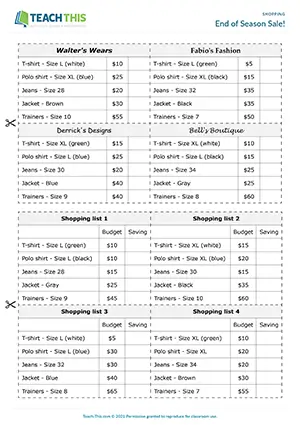
ESL Clothes Shop Role-Play - Speaking Activity: Asking and Answering Questions, Communicative Practice - Group Work
In this communicative clothes shopping role-play, students practice phrases for buying and selling items in a clothes shop. The aim of the activity is for the shop assistants to sell all the items on their card and for...
It's a Bargain!
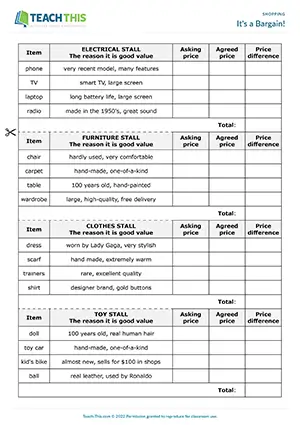
ESL Bargaining Activities - Reading and Vocabulary Exercises: Ordering, Matching - Speaking Activity: Role-Play, Negotiating, Communicative Practice - Group Work
In this engaging bargaining language activity, students learn vocabulary and phrases related to bargaining and take part in a market role-play where they practice...
Shopping Conversation Questions
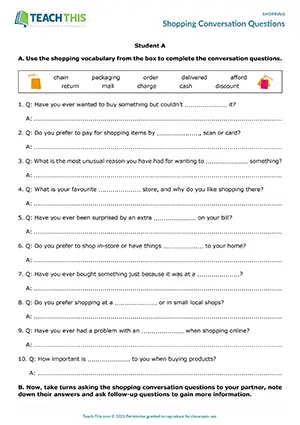
ESL Shopping Vocabulary Activity - Speaking: Gap-fill, Asking and Answering Questions - Group and Pair Work
In this free shopping vocabulary activity, students practice vocabulary related to shopping by forming, asking and answering shopping conversation questions. First, in two groups, students use...
Shopping Vocabulary Quiz
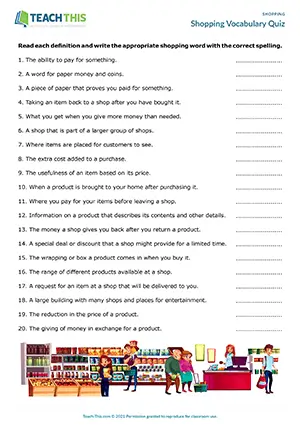
ESL Shopping Vocabulary Game - Vocabulary: Quiz, Writing Answers
In this useful shopping vocabulary game, students take part in a quiz where they read definitions and write down the appropriate shopping vocabulary. Working alone, students read definitions and write the appropriate shopping words in the...
Shops and What They Sell
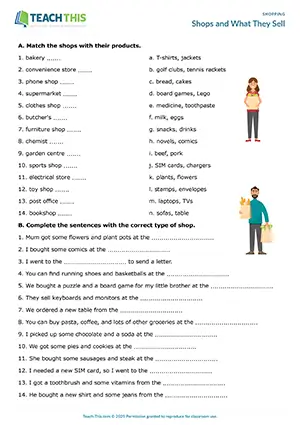
ESL Shopping Vocabulary Worksheet - Vocabulary Exercises: Matching, Gap-fill, Sentence Completion, Writing Sentences, Guessing
In this insightful shopping vocabulary worksheet, students learn about different types of shops and the products they sell. First, students match shops...
Specific Shoppers
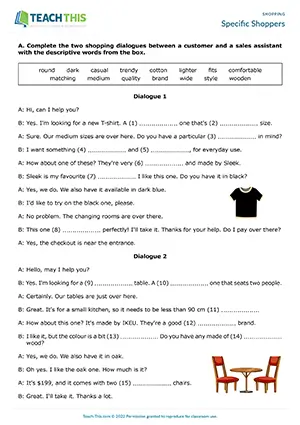
ESL Shopping Vocabulary Worksheet - Vocabulary Exercises: Gap-fill, Unscrambling, Writing a Dialogue - Speaking Activity: Role-Play - Pair Work
Here is a comprehensive shopping worksheet to help students practice vocabulary and phrases for describing product requirements in a shop. First, students...
Shopping Crossword
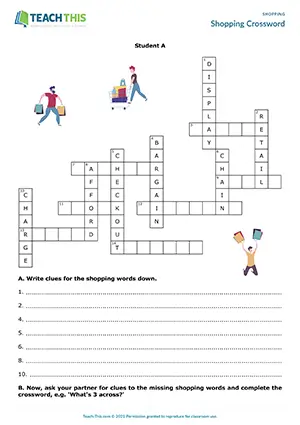
ESL Shopping Crossword - Vocabulary and Speaking Activity: Writing and Giving Clues, Defining, Guessing - Group and Pair Work
In this shopping vocabulary crossword activity, students complete a crossword by defining and guessing shopping-related words. In two groups, students invent and write down clues for the...
Shopping for Clothes
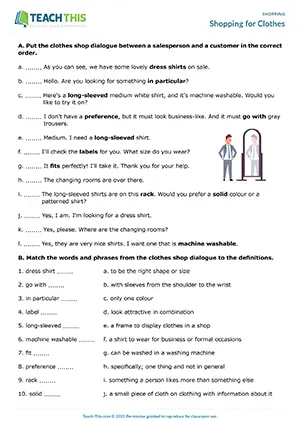
ESL Clothes Shopping Worksheet - Vocabulary Exercises: Ordering, Matching, Gap-fill, Identifying, Writing a Dialogue - Speaking Activity: Role-Play - Pair Work
Here is a productive clothes shopping worksheet to help students practice vocabulary and phrases that are commonly used when shopping for...
Shopping Phrasal Verbs
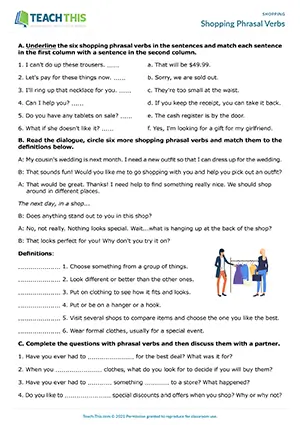
ESL Shopping Phrasal Verbs Worksheet - Vocabulary Exercises: Identifying, Matching, Gap-fill, Writing Sentences - Speaking Activity - Pair Work
In this useful shopping phrasal verbs worksheet, students learn and practice phrasal verbs related to shopping. First, students underline shopping...
Shopping Situations
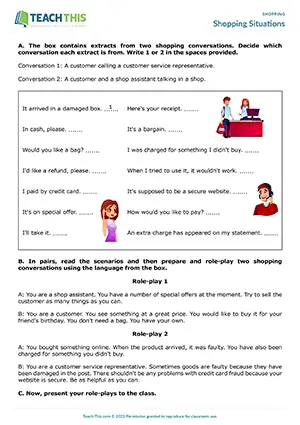
ESL Shopping Role-Plays - Speaking Activity: Categorising, Communicative Practice - Pair Work
In this communicative shopping role-play activity, students match shopping phrases to two situations and then use the language in role-plays. First, students read extracts from two shopping conversations...
What Is Shopping Language?
Shopping language is the set of phrases and expressions used to buy and sell goods in English. It covers both sides of the counter, giving learners the words a customer needs to ask for items, check prices, and handle returns, as well as the phrases a shop assistant uses to greet, assist, and close a sale. Without this language, even simple transactions can stall, leading to misunderstandings over prices, sizes, or stock availability.
This page offers 19 shopping activities, worksheets, and games for levels A1–A2 to B2, including three free downloads.
The table below maps the most common shopping interactions to the speaker and a sample phrase.
| Interaction | Speaker | Example Phrase |
|---|---|---|
| Greeting a customer | Shop assistant | 'Can I help you?' |
| Asking for an item | Customer | 'Have you got this in a size 10?' |
| Asking the price | Customer | 'How much is this?' |
| Stating the price | Shop assistant | 'That's $14.99, please.' |
| Asking for a discount | Customer | 'Is there any chance of a discount?' |
| Handling a return | Customer | 'I'd like to return this. I have the receipt.' |
| Offering an alternative | Shop assistant | 'We don't have that in stock, but we do have...' |
| Closing a sale | Shop assistant | 'How would you like to pay?' |
When to Use Shopping Language
In a physical store: Shopping language helps customers navigate a transaction from the moment they walk in to the moment they leave. Learners need phrases for attracting a shop assistant's attention, describing what they want in terms of size, colour, or material, and responding politely when an item is unavailable, such as 'Do you have this in blue?' or 'Could you check in the back?'
When shopping by phone or online: The language shifts slightly because learners cannot rely on gesture or pointing. They need precise vocabulary to describe items, confirm order details, and ask about delivery or availability, including phrases for spelling out names, repeating numbers, and confirming addresses, such as 'Could you repeat the order reference?' or 'When will it be delivered?'
During returns and exchanges: Learners often know how to buy something but struggle to explain a problem or state a preference for a refund or exchange. Teaching this closes a practical gap, giving learners the language to say 'I'd like to exchange this for a different size' or 'It was faulty when I opened it.'
3-Step Framework for Teaching Shopping Language
1. Anchor vocabulary with a core phrases board game: Start with a controlled board game where students roll the dice, land on squares containing shopping items, and practice asking for those items using the language printed on the board. The board constrains the language so that every student produces the same core structures, making errors easy to spot and correct before moving to freer practice.
2. Build confidence with a whole-class role-play race: Move to a whole-class shopping game where groups act as both shop assistants and customers and race to be the first to buy all the items on their shopping list. The competitive element creates genuine communicative pressure without the stakes of a real transaction, pushing learners to use shopping phrases fluently and accurately under mild time pressure.
3. Push fluency with negotiation language: Finish with a market role-play where students learn vocabulary and phrases for negotiating prices. Sellers try to justify their asking price while customers attempt to negotiate a discount, giving every learner practice in both positions and moving students beyond transactional phrases into the language of persuasion and compromise.
Common Mistakes with Shopping Language
Unnatural price questions: Students often translate directly from their first language and produce questions that sound formal and stilted in a real shop. Wrong: 'What is the price of this?' Correct: 'How much is this?'
Blunt discount requests: Students often ask for a discount too directly, which can sound rude to a native speaker even when no offense is intended. Wrong: 'Give me a discount.' Correct: 'Is there any chance of a discount?'
Common Questions About Teaching Shopping Language
What is a good activity for practicing shopping vocabulary?
The activity Shopping Conversation Questions is a free resource where learners discuss real shopping situations, building vocabulary naturally through conversation rather than memorizing a list. The questions cover a range of topics from comparing prices to describing purchases, making it easy to slot into the end of a lesson.
What is a useful worksheet for teaching clothes shopping language?
Clothes shopping language falls into two very different voices: the shop assistant's and the customer's. The worksheet Shopping for Clothes guides students through both, with students studying phrases for each role, practicing conversations, and then producing their own dialogue in a role-play that draws on language from both sides of the counter.
What is a fun game for practicing shopping phrases?
In the game Shopping Dominoes, learners match dominoes by connecting shopping phrases and responses. The game moves quickly, so learners get repeated exposure to key phrases under mild time pressure, reinforcing natural language patterns without the activity feeling like a drill. Every turn requires reading and producing language in context.
Become a Teach This Member
Get unlimited access to the full library, plus new resources added every week.
Unlimited Resource Access
Download from 3000+ worksheets, activities, and games.
Save 5+ Hours Weekly
Cut lesson prep time with ready-to-use resources, plus teacher notes and answer keys.
Trusted Professional Quality
Classroom-tested, editable resources created by experienced ESL professionals.
Fresh Content Weekly
Get 5 new resources added to the library each week.
Here's what our members are saying...


