
Imperatives ESL Worksheets, Games & Activities
Classroom Instructions
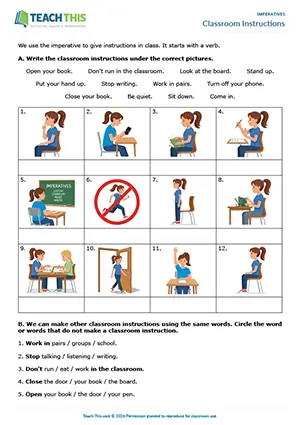
ESL Classroom Imperatives Worksheet - Grammar Exercises: Matching, Identifying, Ordering, Gap-fill
This useful classroom imperatives worksheet helps students learn and practice imperatives related to common classroom instructions. First, students write classroom instructions under the correct pictures...
Treasure Map
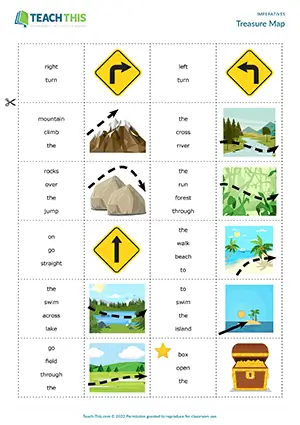
ESL Imperatives Activity - Speaking: Unscrambling, Matching, Controlled Practice - Pair Work
In this free imperatives speaking activity, students make a treasure map by giving each other instructions using imperatives. In pairs, students take turns picking up a word card without showing it to their...
Imperative Dominoes
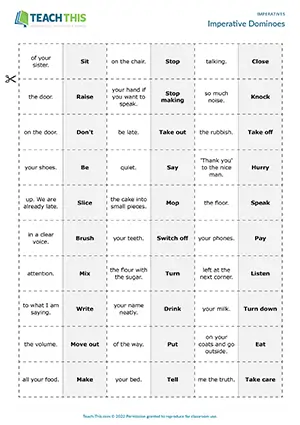
ESL Imperatives Game - Grammar: Matching - Group Work
In this engaging imperatives game, students play dominoes by matching base verbs with objects and complements to make complete imperative sentences. In groups, the first player tries to make an imperative by placing one of their dominoes...
Imperative Mood
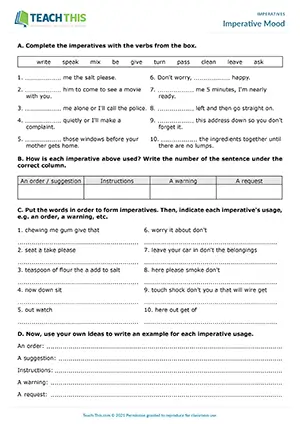
ESL Imperative Mood Worksheet - Grammar Exercises: Gap-fill, Categorising, Unscrambling, Writing Sentences
This productive imperatives worksheet helps students practice using the imperative mood to give orders and instructions, make suggestions, issue warnings, and make polite requests. Students start by...
Introduction to Imperatives
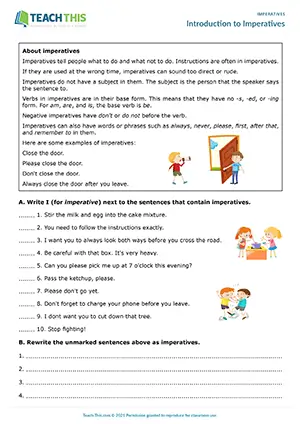
ESL Imperatives Worksheet - Grammar Exercises: Labelling, Writing and Rewriting Sentences, Gap-fill, Identifying
This free imperatives worksheet helps students to learn and practice affirmative and negative imperatives for instructions, requests, warnings, and orders. First, students read through an introduction...
Let's Practice Imperatives
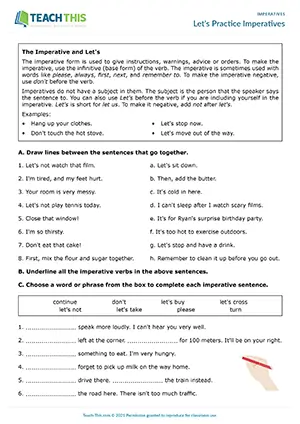
ESL Imperatives Worksheet - Grammar and Writing Exercises: Matching, Gap-fill, Writing Sentences, Sentence Completion
This comprehensive worksheet helps students practice the imperative form, including using 'let's' to give instructions, advice, warnings and suggestions that include the speaker. First, students match...
Silent Crossword
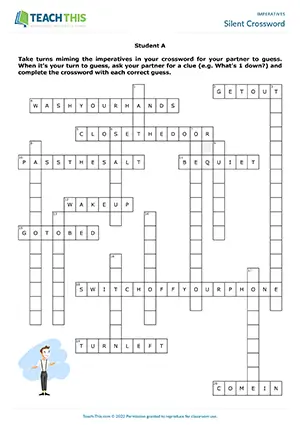
ESL Imperatives Activity - Vocabulary: Miming, Guessing
In this amusing imperatives activity, students mime common imperatives to a partner to help them complete a crossword. In pairs, students take turns asking their partner for a clue to one of their missing imperatives. Their partner indicates the number of...
Imperative Push-ups and Stretches
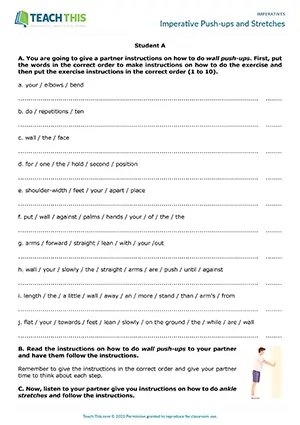
ESL Imperatives Activity - Reading and Listening: Unscrambling, Ordering, Following Instructions - Group and Pair Work
In this inventive imperatives activity, students unscramble and sequence exercise instructions, then take turns giving the steps to a partner, who follows the instructions. In two groups, students put...
Who Would Say That?
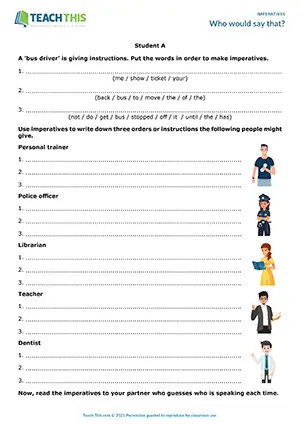
ESL Imperatives Game - Grammar: Unscrambling, Writing Sentences, Guessing, Freer Practice - Pair Work
In this fun imperatives game, students write orders and instructions that certain people would say and read them to a partner who guesses who would say them. First, students put words in the correct order...
Understanding Imperatives
Imperatives are commands formed by starting a sentence directly with the base verb and leaving out the subject, as in 'Sit down' or 'Don't touch that.' When students add a subject pronoun or use the wrong verb form, their commands sound unnatural and come across as confusing, as when a student writes 'You sit down' instead of simply 'Sit down.'
This page covers imperatives across Elementary, Pre-intermediate, and Intermediate levels (A1 to B1), with nine activities including worksheets, a dominoes matching game, a miming crossword, and a speaking guessing game, and includes two activities available as free downloads.
The table below maps the main structural forms of imperatives with their typical uses and a clear example of each.
| Form | Structure | Example | Use |
|---|---|---|---|
| Affirmative Imperative | base verb (+ object/complement) | 'Close the window.' | instructions, orders, requests |
| Negative Imperative | don't + base verb | 'Don't be late.' | prohibitions, negative instructions, warnings |
| Let's (Inclusive Imperative) | let's + base verb | 'Let's take a break.' | suggestions that include the speaker |
| Emphatic Affirmative | do + base verb | 'Do come in.' | urging or encouraging someone politely |
| Negative Inclusive | let's not + base verb | 'Let's not waste time.' | suggesting the group avoids a particular action |
When to Use Imperatives
Written Instructions: Writers use imperatives to guide readers step-by-step through a process because the form is direct, efficient, and leaves no room for confusion about what the reader should do next, as in 'Add the flour and stir until smooth.'
Urgent Warnings: Speakers choose imperatives when a listener needs to act immediately and there is no time to soften the message, as in 'Watch out for the step.'
Polite Requests: Adding 'please' to an imperative lets a speaker stay direct while still sounding considerate, which makes it a natural choice in service and hospitality settings, as in 'Please take a seat and we will be with you shortly.'
3-Step Framework for Teaching Imperatives
1. Connect Form to Function with Familiar Language: Start by giving students imperatives they already hear every day in class. Have them match and sequence familiar classroom commands, then role-play a scenario where one student reads out a classroom situation and the other responds by saying the correct instruction and writing it down. This gets students producing real imperatives before any grammar explanation arrives.
2. Build Confidence Through Spoken Production: Move students into a speaking task that pushes them to produce imperatives out loud under a simple constraint. Give pairs a set of word cards they pick up one at a time, then each student says the words in the correct order to form a command such as 'Climb the mountain' while their partner listens and finds the matching picture. The pressure of sequencing words aloud keeps the focus on verb-first structure naturally.
3. Push Into Freer, Context-Rich Practice: Once students can form imperatives accurately, challenge them to think about who gives them and why. Ask students to write three commands a specific person such as a coach or doctor would give, then read them aloud while their partner guesses the speaker by saying 'I think a ... would say these things.' This moves practice from sentences on a page into real communicative reasoning.
Common Mistakes with Imperatives
Adding 'To' Before the Base Verb: Students often treat the imperative like an infinitive and add 'to' before the verb, producing a form that no native speaker would use. Wrong: 'Please to sit down.' Correct: 'Please sit down.'
Forming Negatives Without 'Don't': Students often place 'not' directly before the verb when making a negative imperative, leaving out 'don't' and producing a non-grammatical structure. Wrong: 'Not run in the hallway.' Correct: 'Don't run in the hallway.'
Common Questions About Teaching Imperatives
What is a creative imperatives activity for practicing listening and following instructions?
Students get a genuinely physical task in the activity Imperative Push-ups and Stretches. Working in two groups, they unscramble exercise instructions and put the steps in order, then pair up with someone from the other group and take turns reading their instructions aloud while their partner follows each step.
What is a good worksheet for teaching the different uses of imperatives?
The worksheet Imperative Mood builds from controlled practice toward original production. Students complete imperatives with verbs from a box, then sort the sentences by function, choosing between orders, warnings, suggestions, instructions, and requests. They finish by writing their own example for each usage type.
What is a free worksheet for teaching imperatives?
Solid starting-point material for students meeting imperatives for the first time, the free worksheet Introduction to Imperatives opens with a short grammar introduction, then asks learners to identify imperatives in a sentence set and rewrite non-imperative sentences as imperatives. The final task gives a situation and a verb in brackets to prompt an appropriate imperative.
Become a Teach This Member
Get unlimited access to the full library, plus new resources added every week.
Unlimited Resource Access
Download from 3000+ worksheets, activities, and games.
Save 5+ Hours Weekly
Cut lesson prep time with ready-to-use resources, plus teacher notes and answer keys.
Trusted Professional Quality
Classroom-tested, editable resources created by experienced ESL professionals.
Fresh Content Weekly
Get 5 new resources added to the library each week.
Here's what our members are saying...


