
Present Simple vs. Present Continuous ESL Activities, Worksheets & Games
Find Someone Who...
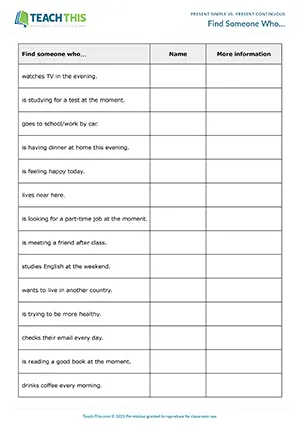
ESL Present Simple vs. Present Continuous Activity - Grammar and Speaking: Asking and Answering Questions
This useful present simple and present continuous speaking activity helps to illustrate to students how the present simple and present continuous tense are different and how to ask and answer questions using each tense. First, students...
Greetings from Italy!
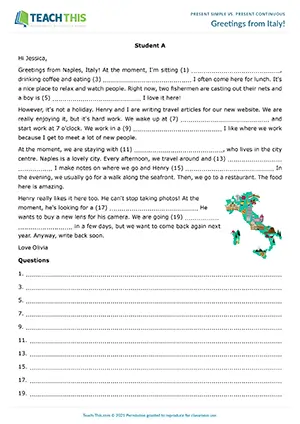
ESL Present Simple vs. Present Continuous Activity - Grammar and Speaking: Information Gap, Writing, Asking and Answering Questions - Pair Work
In this fun present simple and present continuous information gap activity, students write and then ask questions in order to complete missing information in an email. First, in two groups...
Question Time

ESL Present Simple and Present Continuous Activity - Grammar, Writing and Speaking: Writing, Asking and Answering Questions, Freer Practice - Pair Work
In this free present simple vs. present continuous activity, students write questions on various topics using both tenses and then ask and answer the questions with a partner. In pairs, students look at...
Time for a Review

ESL Present Simple vs. Present Continuous Worksheet - Grammar Exercises: Matching, Identifying, Writing Sentences, Error Correction, Gap-fill
In this comprehensive present simple vs. present continuous worksheet, students revise the use of these two tenses. Students start by using phrases to...
Which tense?
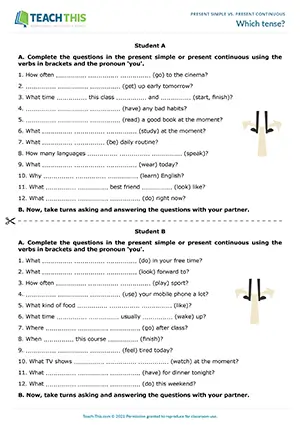
ESL Present Simple vs. Present Continuous Activity - Grammar and Speaking: Writing, Asking and Answering Questions - Pair Work
This engaging present simple vs. present continuous speaking activity helps students practice forming, asking and answering conversation questions in the present simple and present continuous tense...
An Interview with Elon Musk

ESL Present Simple and Present Continuous Activity - Grammar and Speaking: Role-Play, Asking and Answering Questions - Pair Work
In this creative present simple vs. present continuous speaking activity, students take part in a business interview to practice asking and answering questions in the present simple and present continuous...
An Unusual Monday
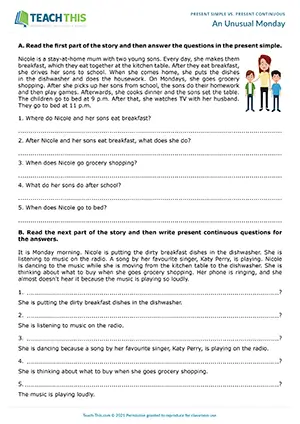
ESL Present Simple vs. Present Continuous Worksheet - Grammar and Reading Exercises: Answering and Writing Questions, Gap-Fill, Changing Word Forms
Here is a story-based present simple vs. present continuous worksheet to help students practice the present simple and present continuous. Students...
Create a Company

ESL Present Simple vs. Present Continuous Activity - Grammar and Speaking: Gap-fill, Discussion, Writing Sentences, Presenting, Communicative Practice - Group Work
In this imaginative present simple and present continuous activity, students create a company by completing and answering questions in the present simple...
Guess the Sentence

ESL Present Simple vs. Present Continuous Game - Grammar and Speaking: Forming Sentences, Guessing - Group Work
In this free present simple and present continuous game, students describe present simple or present continuous sentences for other students to guess. In groups, students take turns picking up a card...
Understanding the Present Simple vs. Present Continuous
The present simple describes habits, routines, and facts that are generally or always true: 'She works in a school.' The present continuous describes actions happening right now or temporary situations around the present time: 'She's working from home this week.'
When students confuse the two tenses, they describe temporary situations as permanent facts or frame ongoing actions as settled routines, which changes the meaning of what they are trying to say and can mislead the listener or reader entirely.
This page covers present simple vs. present continuous across Pre-intermediate (A2) and Intermediate (B1) levels, with nine resources including grammar worksheets, speaking activities, and a group game, with two available as free downloads.
The present simple and present continuous serve different communicative purposes, and each tense pairs with its own set of time signals that help writers and speakers choose the correct form.
| Tense | Main Uses | Typical Time Signals | Example |
|---|---|---|---|
| Present Simple | Habits and routines | always, usually, often, sometimes, never, every day, on Mondays | 'I walk to work every day.' |
| Present Simple | Permanent states and facts | generally, in general, as a rule | 'She loves jazz music.' |
| Present Simple | General truths | (no specific time signal needed) | 'Water freezes at zero degrees.' |
| Present Continuous | Actions happening right now | now, right now, at the moment, currently, still | 'He is talking on the phone.' |
| Present Continuous | Temporary situations around the present | this week, this month, these days, for now | 'I'm staying with my sister this week.' |
| Present Continuous | Changing or developing trends | nowadays, more and more, increasingly | 'Prices are rising quickly.' |
| Present Continuous | Fixed future arrangements | tonight, tomorrow, next week, on Friday | 'We're meeting the client tomorrow.' |
When to Use the Present Simple vs. Present Continuous
Describing What Is Happening Right Now: Speakers reach for the present continuous when they want to narrate or comment on something unfolding in the immediate moment, making it the natural choice in live commentary or during phone calls, as in 'I'm standing outside the stadium and the crowd is going wild.'
Contrasting What Is Usual with What Is Different: Writers and speakers use both tenses together when they want to highlight that something temporary is different from the normal pattern, as in 'I usually take the train, but this week I'm driving because of the strike.'
Talking About Long-Term Change or Trends: The present continuous describes situations that are gradually shifting over time, making it the tense of choice in journalism and business commentary when a trend is still developing, as in 'More companies are allowing employees to work remotely.'
3-Step Framework for Teaching the Present Simple vs. Present Continuous
1. Anchor the Rules Through Time Expressions: The fastest way to help students choose between the two tenses is to connect each one to its typical time signals. Start with a task where students sort time expressions into two groups: those that belong with the present simple, such as 'every day' and 'usually', and those that signal the present continuous, such as 'right now' and 'at the moment.' Follow this with a gap-fill where students choose the correct tense based on the time expression in each sentence. This gives students a practical decision-making tool they can apply immediately in speaking and writing.
2. Practice Both Tenses Together in Conversation: Move students into a speaking task where they switch between the two tenses within a single activity. Prepare two sets of conversation questions, one group completing them in the present simple and the other in the present continuous using verbs in brackets. Students then pair up across the two groups and take turns asking and answering each question, responding in whichever tense the question uses. The cross-group pairing means students hear and produce both tenses back to back, which reinforces the contrast naturally.
3. Push for Fluency Through Role-Play: At intermediate level, a role-play pushes students to use both tenses accurately under communicative pressure. One student takes on the role of a journalist and the other takes on the role of a public figure, with the journalist's task being to find out about the person's work routine, current projects, plans, and goals. The structure of the interview naturally calls for the present simple when discussing routines and the present continuous when discussing temporary or ongoing work, which forces students to make conscious tense choices throughout.
Common Mistakes with the Present Simple vs. Present Continuous
Using the Present Continuous with Stative Verbs: Students often use the present continuous with verbs that describe states of mind or perception, such as know, want, and understand, because these feel like ongoing mental activities rather than fixed states. Wrong: 'I am knowing the answer.' Correct: 'I know the answer.'
Omitting the Auxiliary 'Be': Students often form the present continuous by putting the verb directly into the -ing form without the auxiliary 'be', producing an incomplete sentence rather than a correctly tensed one. Wrong: 'She working in the garden now.' Correct: 'She is working in the garden now.'
Common Questions About Teaching the Present Simple vs. Present Continuous
What is a fun present simple and present continuous game?
The game Guess the Sentence, available as a free download, gives students practice producing both tenses in a describe-and-guess format. Students pick up a card and describe the sentence using present simple or present continuous sentences, but cannot say the sentence or clusters of words within it. The first student to guess correctly wins the card.
What is a useful present simple vs. present continuous worksheet?
The worksheet An Unusual Monday is a story-based resource that keeps students reading and producing both tenses throughout. Students begin by reading the first part of a story and answering questions in the present simple, then read the next part and write present continuous questions for a set of answers. A gap-fill and sentence unscrambling exercise complete the worksheet.
What is an engaging present simple and present continuous speaking activity?
Students build confidence with both tenses through writing and speaking in the activity Question Time, available as a free download. In pairs, they write one present simple and one present continuous question for each card prompt, then take turns asking and answering the questions with a partner. Afterwards, students share what they found out with the class.
Become a Teach This Member
Get unlimited access to the full library, plus new resources added every week.
Unlimited Resource Access
Download from 3000+ worksheets, activities, and games.
Save 5+ Hours Weekly
Cut lesson prep time with ready-to-use resources, plus teacher notes and answer keys.
Trusted Professional Quality
Classroom-tested, editable resources created by experienced ESL professionals.
Fresh Content Weekly
Get 5 new resources added to the library each week.
Here's what our members are saying...


