
Holidays ESL Activities, Games, Role-Plays & Worksheets
The Hotel Information Exchange

ESL Hotel Information Activity - Speaking: Information Gap, Asking and Answering Questions, Communicative Practice - Pair Work
In this communicative hotel information activity, students ask and answer questions about the location of hotel facilities, opening and closing times, and the...
Holiday Habits
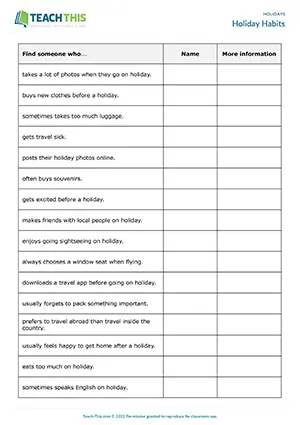
ESL Holiday Habits Activity - Speaking: Asking and Answering Questions
In this engaging holiday habits speaking activity, students find out about one another's holiday habits by asking and answering present simple questions. Students go around the class asking each other present simple yes/no questions from the...
Holiday Plans

ESL Holiday Plans Activity - Speaking: Information Gap, Asking and Answering Questions - Pair Work
Here is a free holiday plans information gap activity to help teach students how to ask and answer questions about future holiday arrangements. In pairs, students complete missing information about...
Holiday Question Time

ESL Holiday Conversation Questions Activity - Speaking: Gap-fill, Asking and Answering Questions, Freer Practice - Pair Work
In this insightful holiday conversation questions speaking activity, students complete questions about holidays with question words and then use the questions to interview a partner. First...
Holiday Conversation Questions
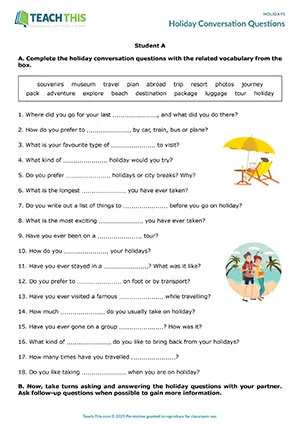
ESL Holiday Conversation Questions Activity - Vocabulary and Speaking: Gap-fill, Asking and Answering Questions - Group and Pair Work
In this talking about holidays activity, students complete holiday conversation questions with related vocabulary and then ask and answer the questions with a partner...
Holiday Postcards
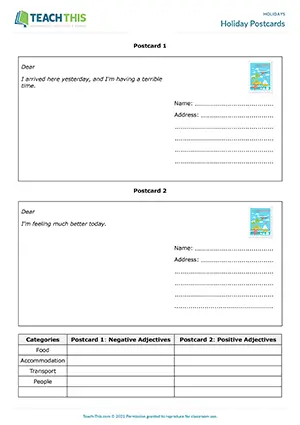
ESL Holiday Experiences Activity - Writing: Writing Sentences
In this creative holiday postcards activity, students write postcards describing positive and negative holiday experiences. Students begin by writing down positive and negative adjectives to describe different aspects of a holiday. For example, if...
Holiday Vocabulary
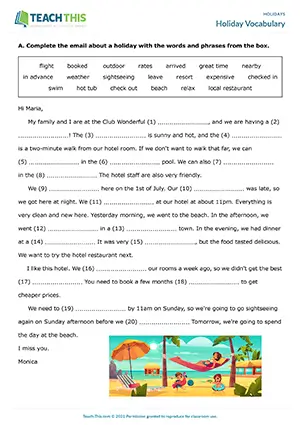
ESL Holidays Worksheet - Vocabulary Exercises: Gap-fill, Matching, Unscrambling, Writing Answers - Speaking Activity: Role-Play, Discussion - Pair Work
In this free holiday vocabulary worksheet, students learn and practice words and questions related to holidays. Students begin by completing an email about...
Hotel Requests Game
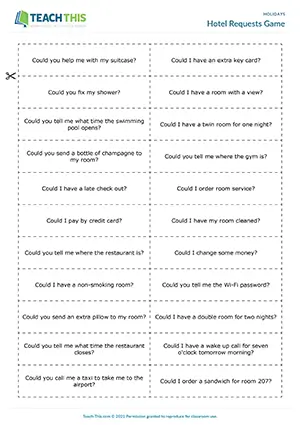
ESL Hotel Requests Game - Speaking: Miming, Forming Questions, Freer Practice - Group Work
In this amusing hotel requests game, students mime and guess hotel requests. Students imagine that they are at a hotel reception in a country where they can't speak the language and that they have to mime...
Itinerary Inquiries
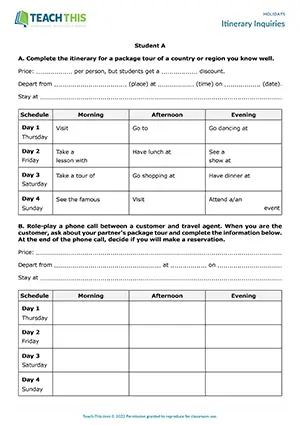
ESL Tour Itineraries Activity - Reading and Speaking: Ordering, Role-Play, Asking and Answering Questions, Communicative Practice - Pair Work
In this communicative tour itinerary role-play activity, students practice inquiring about the itinerary of a package tour. First, in pairs, students arrange sentence...
Jill and Jack's Mexican Holiday
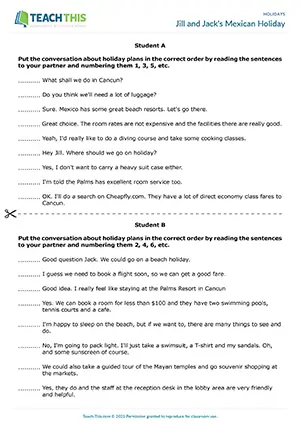
ESL Holiday Plans Activity - Reading, Writing and Speaking: Ordering a Dialogue, Matching, Writing and Presenting a Dialogue, Role-Play, Freer Practice - Pair Work
In this useful holiday plans activity, students learn holiday vocabulary and practice language for planning a holiday. First, in pairs, students put a conversation...
Making and Confirming a Booking
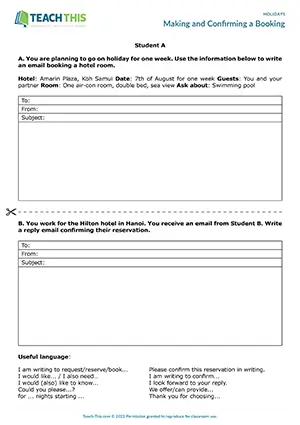
ESL Booking a Hotel Activity - Reading and Writing: Ordering a Text, Writing Emails, Freer Practice - Pair Work
In this productive hotel bookings activity, students practice writing emails to book and confirm hotel rooms. First, in pairs, students arrange sentence strips in the correct order to reveal two emails. One is a...
Holiday Bingo
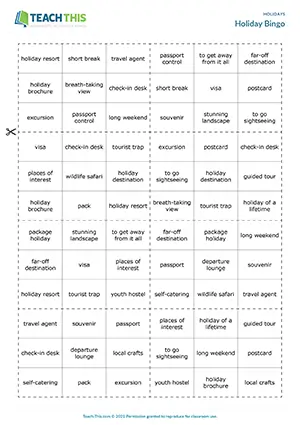
ESL Holiday Vocabulary Game - Vocabulary: Matching - Group Work
In this enjoyable holiday vocabulary game, students play bingo by listening to definitions and matching them to holiday words and phrases on bingo cards. In groups, the bingo caller reads out definitions of holiday words and phrases. If a student...
Holiday Taboo

ESL Holiday Vocabulary Game - Vocabulary: Describing, Guessing - Group Work
In this fun holiday vocabulary game, students describe and guess holiday words. In groups, students take turns picking up a card and describing the holiday vocabulary in bold on the card to the group without saying the words on the card. The...
Trip to Thailand

ESL Travel Agency Role-Play - Speaking Activity: Gap-fill, Asking and Answering Questions, Communicative Practice - Pair Work
In this communicative travel agency activity, students practice and role-play a travel agency conversation about booking a holiday where they discuss flights...
Weekend Tour Competition
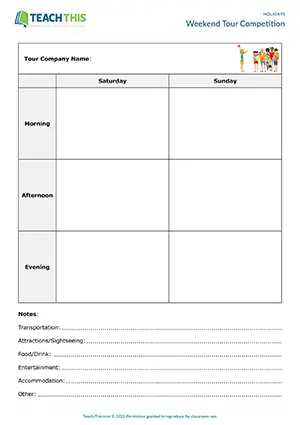
ESL Planning a Tour Activity - Speaking: Planning and Presenting an Itinerary - Group Work
In this imaginative tour program activity, students compete to see who can provide the best weekend tour of their local city for a group of international tourists. In groups, students take on the role of...
Using Holiday Language
Holiday language covers the vocabulary and phrases students need to talk about travel plans, describe holiday experiences, make bookings, and handle practical situations such as checking into a hotel or inquiring about a tour. Students who lack this language find themselves unable to manage even basic holiday transactions in English, from asking for room requirements at a hotel reception to understanding what is included in a package tour.
This page covers holidays from A1 to B2 level, with 15 activities, games, role-plays, and worksheets, including two free downloads.
The table below maps common real-world situations in which holiday language is used, with example phrases for each.
| Situation | Speaker/Role | Example Phrase |
|---|---|---|
| Asking about future holiday plans | Friend, colleague, or classmate | 'Where are you going on holiday this year?' |
| Describing a past holiday experience | Returning traveller | 'We stayed in a small guesthouse near the beach, and the food was amazing.' |
| Making a hotel room booking | Guest or customer | 'I'd like to book a double room for three nights from the 14th of July, please.' |
| Asking for hotel facilities or information | Hotel guest | 'Could you tell me what time breakfast is served?' |
| Making a request at a hotel | Guest | 'Could you help me with my suitcase, please?' |
| Inquiring about a tour or itinerary | Customer | 'What does the tour include, and how long does it last?' |
| Describing holiday preferences | Any speaker | 'I prefer city breaks to beach holidays because I love exploring local markets.' |
When to Use Holiday Language
Making or changing a travel booking: When you book a hotel, flight, or tour by phone or in writing, you need polite, precise language that covers all the practical details clearly, as in 'I'd like to book a double room for two nights from the 20th of August. Do you have anything available?'
Handling requests and problems at a hotel: When something goes wrong during a stay or you need help from hotel staff, polite request language matters because an abrupt or unclear request can cause confusion or come across as rude, as in 'Excuse me, the air conditioning in my room doesn't seem to be working. Could someone take a look?'
Talking about past holidays in conversation: When someone asks how your holiday was, a flat 'It was good' closes the conversation, while a brief narrative with some descriptive detail keeps it going naturally, as in 'We spent a week in Lisbon. The weather was perfect and we found this incredible little restaurant in the old town.'
3-Step Framework for Teaching Holiday Language
1. Build Vocabulary Before Students Speak: Start by building a solid vocabulary foundation through a sequence that moves from reading to production. Students work through a holiday-themed email, completing it with words and phrases from a box, then match vocabulary from the email to definitions, and unscramble words to form holiday questions before answering them using the email's content. The sequence finishes with students role-playing a conversation from those questions and then using the same questions to ask their partner about their own last holiday, so every word they learned gets tested in real use.
2. Consolidate Request Language Through a Game: Shift gears with a game that makes production physical and competitive. Students imagine they are at a hotel reception in a country where they cannot speak the language, so they must mime requests to the receptionist. The student miming points and nods at classmates who provide accurate guesses until someone says the exact request on the card, for example 'Could you help me with my suitcase?' That moment of recognition, when the precise phrase finally lands, pushes students to think carefully about both meaning and wording.
3. Put All the Language to Work in a High-Stakes Task: Close with an extended output task that requires students to deploy the full range of holiday language under pressure. Groups take on the role of a tour company, think of a tour company name, and compete to provide the best weekend tour of their local city for a group of five international tourists, with a limitless budget and a lucrative business contract on the line. Groups plan a full itinerary, present it to the class, and face questions from the audience, which gives students a genuine reason to produce detailed, accurate holiday language from start to finish.
Common Mistakes with Holiday Language
Confusing 'travel', 'trip', and 'journey': Students often use 'travel' as a countable noun to describe a single holiday or outing, not realising that 'travel' is uncountable and that 'trip' or 'journey' is needed depending on the context. Wrong: 'We had a very nice travel to Spain.' Correct: 'We had a very nice trip to Spain.'
Using 'make' instead of 'take' with holiday activities: Students often use 'make' instead of 'take' with common holiday collocations, confusing the two verbs because their equivalent in many languages uses a single verb for both. Wrong: 'We made a lot of photos and made a tour of the old city.' Correct: 'We took a lot of photos and took a tour of the old city.'
Common Questions About Holiday Language
What is a good speaking activity for practicing holiday plans?
The free activity Holiday Plans gives students an information gap where they complete missing details about four people's holiday plans by asking and answering questions using 'be going to' and the present continuous. They then use the same questions to ask their partner about their own real plans, moving from controlled practice into genuine conversation.
What is a fun game for practicing holiday vocabulary?
The game Holiday Taboo challenges students to describe holiday vocabulary without saying the forbidden words on the card. Students pick up a card and describe the holiday word in bold by talking around it, and the first classmate to guess correctly wins the card. The player with the most cards at the end wins.
What is a useful activity for practicing holiday experiences?
The activity Holiday Postcards has students brainstorm positive and negative adjectives for different aspects of a holiday, then write two postcards to a partner: one describing a terrible holiday, the other describing a perfect one. Students swap and peer-correct each other's work, which gives them immediate feedback on their descriptive language.
Become a Teach This Member
Get unlimited access to the full library, plus new resources added every week.
Unlimited Resource Access
Download from 3000+ worksheets, activities, and games.
Save 5+ Hours Weekly
Cut lesson prep time with ready-to-use resources, plus teacher notes and answer keys.
Trusted Professional Quality
Classroom-tested, editable resources created by experienced ESL professionals.
Fresh Content Weekly
Get 5 new resources added to the library each week.
Here's what our members are saying...


