Classroom Snap and Match

Elementary (A1-A2) 25 minutes
ESL classroom vocabulary games preview with snap, matching, pelmanism and sentence formation for Elementary A1-A2

ESL Classroom Vocabulary Games - Vocabulary and Speaking: Snap, Matching, Pelmanism, Forming Sentences - Pair Work

Here are two free classroom object games to help students practice vocabulary related to the classroom. Students begin by playing a game of snap. In pairs, students turn over a card from their pile at the...

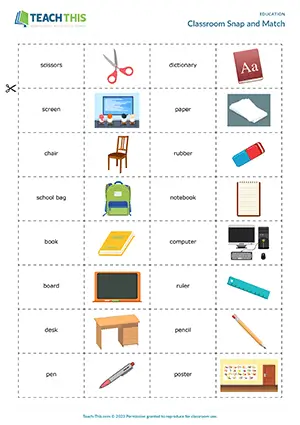
ESL Classroom Vocabulary Games - Vocabulary and Speaking: Snap, Matching, Pelmanism, Forming Sentences - Pair Work Here are two free classroom object games to help students practice vocabulary related to the classroom. Students begin by playing a game of snap. In pairs, students turn over a card from their pile at the same time. If the classroom object word card and picture card match, the first student to say 'Snap' scores a point. Students then pick up their own cards, shuffle them, and play again. If a student says 'Snap' when the cards don't match, the other student scores a point, and the game continues. The first student to get ten points wins the game. After that, students move on to play a pelmanism game. Students take turns turning over one classroom object word card and one picture card. If the word matches with the picture, the student scores one point and keeps the two cards. For an extra point, the student then tries to make a sentence with the classroom object word. If the student successfully makes a sentence, they have another turn. If the cards don't match, the student turns them back over. The student with the most points at the end of the game wins.

Learning Lingo

Elementary (A1-A2) 30 minutes
ESL education vocabulary games preview with dominoes, matching, describing and guessing for Elementary A1-A2

ESL Education Vocabulary Games - Vocabulary: Matching, Describing, Guessing - Group Work

These two engaging school vocabulary games help students practice words related to education and the classroom. First, in groups of four, students play a game of dominoes by completing sentences with...

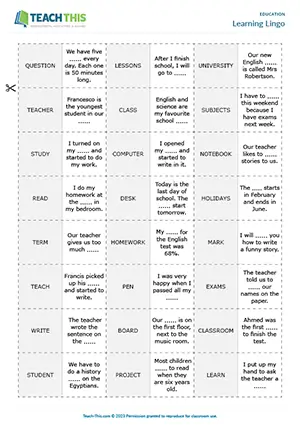
ESL Education Vocabulary Games - Vocabulary: Matching, Describing, Guessing - Group Work These two engaging school vocabulary games help students practice words related to education and the classroom. First, in groups of four, students play a game of dominoes by completing sentences with education vocabulary. The first player tries to complete a sentence with an education word by placing a domino down either before or after the domino on the table. If the word matches the sentence, the player reads the complete sentence to the group to show the match is correct. The next player then tries to put down one of their dominoes at either end of the domino chain, and so on. The first player to get rid of all their dominoes wins the game. Next, students play a describing and guessing game with the vocabulary. In teams of two, students take turns picking up a card and describing the education word in the grey square to their partner, who has 30 seconds to guess and say the word. If the student successfully guesses the word, the team wins and keeps the card. If not, the other team has one chance to guess the word, keeping the card if they are successful. The team with the most cards at the end of the game wins.

School Vocabulary Quest

Elementary (A1-A2) 30 minutes
ESL school vocabulary games preview with matching, gap-fill, creating sentences and group activities for Elementary A1-A2

ESL School Vocabulary Games - Vocabulary and Speaking: Matching, Gap-fill, Creating Sentences, Freer Practice - Group Work

Here are two entertaining educational vocabulary games to help students practice common words related to learning and school. First, students play a matching game. In groups, students take turns...

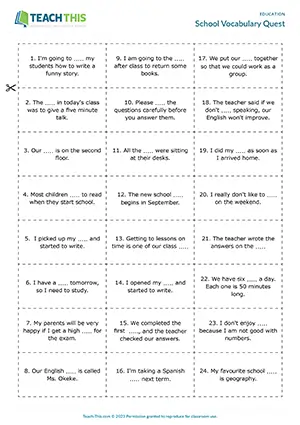
ESL School Vocabulary Games - Vocabulary and Speaking: Matching, Gap-fill, Creating Sentences, Freer Practice - Group Work Here are two entertaining educational vocabulary games to help students practice common words related to learning and school. First, students play a matching game. In groups, students take turns picking up a sentence card, reading it aloud, and then placing it face-up on the table. All the students then race to find an educational word card on the table to complete the sentence. When a student finds the right card, they pick it up and read the complete sentence aloud. If the other students agree the word matches the sentence, the student wins and keeps the cards. If not, the student puts down the word card and is out of the round. The student with the most pairs of cards at the end of the game wins. Next, students play a sentence race game using the word cards. Students take turns turning over a word card so it's visible to everyone. Students then race to put up their hands and say a sentence using the education-related word. If a student makes a suitable sentence, they win and keep the card. The student with the most cards at the end of the game wins.

What are they learning?

Elementary (A1-A2) 25 minutes
ESL education vocabulary activity preview with information gap, question practice and group work for Elementary A1-A2

ESL Education Vocabulary Activity - Vocabulary, Reading and Speaking: Information Gap, Asking and Answering Questions - Group and Pair Work

In this enjoyable education information gap activity, students practice vocabulary related to school subjects. First, in two groups, students use education...

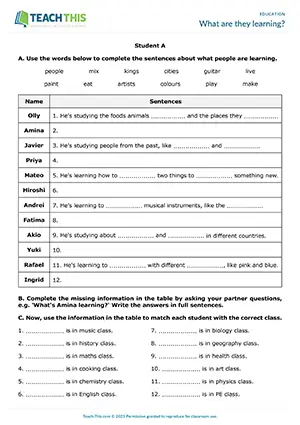
ESL Education Vocabulary Activity - Vocabulary, Reading and Speaking: Information Gap, Asking and Answering Questions, Controlled Practice - Group and Pair Work In this enjoyable education information gap activity, students practice vocabulary related to school subjects. First, in two groups, students use education vocabulary to complete sentences about what people are learning. Next, students pair up with someone from the other group and take turns asking their partner what people are learning in order to complete missing sentences on their worksheet, e.g. 'What's Amina learning?' Students write their partner's responses in sentence form. After that, pairs race to complete sentences by writing the correct person's name next to the corresponding class they are in. The first pair to complete all their sentences correctly wins.

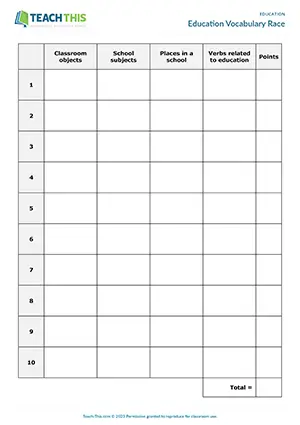
Education Vocabulary Race

Pre-intermediate (A2) 30 minutes
ESL education game preview with brainstorming, categorising, sentence formation and pair work for Pre-intermediate A2

ESL Education Game - Vocabulary: Brainstorming, Categorising, Forming Sentences - Pair Work

In this productive educational vocabulary game, students brainstorm and write down words related to school and education and create sentences using the vocabulary. In teams, students have 30...

ESL Education Game - Vocabulary: Brainstorming, Categorising, Forming Sentences - Pair Work In this productive educational vocabulary game, students brainstorm and write down words related to school and education and create sentences using the vocabulary. In teams, students have 30 seconds to complete rows with words that fit four education-related categories. When the time limit has been reached, teams take it in turns to give their answers, spelling the words as they go. Teams score one point for each appropriate and correctly spelt word. However, if another team has written the same word in that round, neither team scores a point for that word. After the points have been awarded, each team has one chance to score bonus points by creating a sentence with the four words they have written. If a team only manage to include one word in their sentence, they score one point. If they manage to include two words, they score two points, and so on. This process is repeated until all ten rows have been completed. The team with the most points at the end of the game wins.

Language for Learning

Pre-intermediate (A2) 30 minutes
ESL education worksheet preview with matching, binary choice, categorising, gap-fill and speaking for Pre-intermediate A2

ESL Education Worksheet - Vocabulary Exercises: Matching, Binary Choice, Categorising, Gap-fill - Speaking Activity: Asking and Answering Questions - Pair Work

This free educational vocabulary worksheet helps students learn and practice words related to learning, school subjects and education. First, students...

ESL Education Worksheet - Vocabulary Exercises: Matching, Binary Choice, Categorising, Gap-fill - Speaking Activity: Asking and Answering Questions - Pair Work This free educational vocabulary worksheet helps students learn and practice words related to learning, school subjects and education. First, students match classroom object words with pictures. Students then underline the correct words or phrases to complete sentences about school subjects. After that, students rank the school subjects in order of importance, from one to eight and compare their rankings with a partner, explaining their choices. Next, students identify the odd word out in each set. Following that, students match different types of schoolwork to their definitions. Students then categorise each type of schoolwork according to the verb it is used with. Finally, students use words from a box to complete questions about education and then ask and answer the questions with a partner.

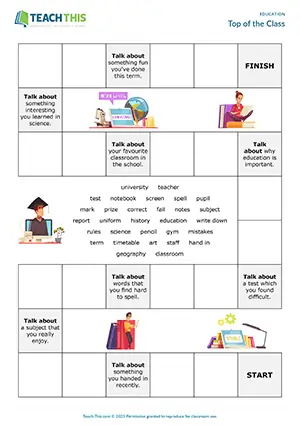
Top of the Class

Pre-intermediate (A2) 25 minutes
ESL education board game preview with gap-fill, impromptu speech and freer practice for Pre-intermediate A2

ESL Education Board Game - Vocabulary and Speaking: Gap-fill, Impromptu Speech, Freer Practice - Group Work

Here is a fun educational vocabulary board game to help students practice words related to education and study. In groups, students take turns picking up a card and reading the sentence to the other...

ESL Education Board Game - Vocabulary and Speaking: Gap-fill, Impromptu Speech, Freer Practice - Group Work Here is a fun educational vocabulary board game to help students practice words related to education and study. In groups, students take turns picking up a card and reading the sentence to the other students using the word 'blank' for the missing word, e.g. 'My favourite BLANK is English because I like languages.' The other students listen to the sentence and race to choose a word from the game board and say it aloud to complete the sentence, e.g. subject. The first student to say the correct word shown on the card rolls the dice and moves their counter along the board. If a student gives an incorrect answer, they are out and cannot answer again unless the other students each give a wrong answer. If a student lands on a square beginning with 'Talk about...', they talk about that topic for 20 seconds to remain on the square. If they are unsuccessful, they move back one space. The first student to reach the finish wins the game. As a variation, students take turns trying to complete a sentence with a word from the board rather than racing each other.

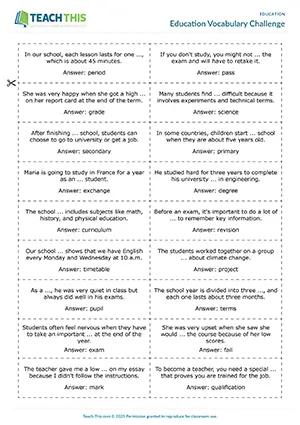
Education Vocabulary Challenge

Intermediate (B1) 25 minutes
ESL education games preview with gap-fill, matching, sentence formation and group work for Intermediate B1

ESL Education Games - Vocabulary and Speaking: Gap-fill, Matching, Forming Sentences - Group Work

These two fast-paced education vocabulary games help students practice common words related to education. First, students play a game where they match education words to sentences. Students take...

ESL Education Games - Vocabulary and Speaking: Gap-fill, Matching, Forming Sentences from Prompts - Group Work These two fast-paced education vocabulary games help students practice common words related to education. First, students play a game where they match education words to sentences. Students take turns picking up a sentence card and reading it to the group using the word 'blank' for the missing word. The other students listen and then race to find the word card on the table that correctly completes the sentence. The first student to place their hand on the correct word card and say the sentence wins the pair of cards. The student with the most pairs of cards at the end of the game wins. Students then move on to play a game in which they race to form sentences that use the education words in context. Students take turns turning over a word card for everyone to see. All the students then race to think of a sentence that uses the education word in context. The first student to put their hand on the card and say a grammatically correct and suitable sentence wins and keeps the card. If a student puts their hand on the card and delays their answer or forms an incorrect sentence, they are out of the round. The student with the most word cards at the end of the game wins.

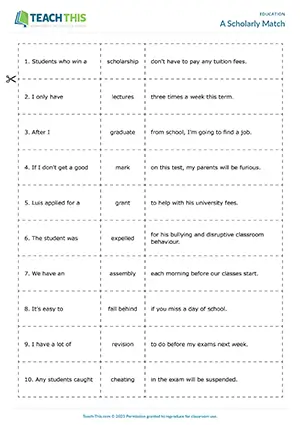
A Scholarly Match

Upper-intermediate (B2) 20 minutes
ESL education activity preview with matching, forming sentences and pair work for Upper-intermediate B2

ESL Education Activity - Vocabulary: Matching, Forming Sentences - Pair Work

In this useful education vocabulary activity, students race to form sentences related to education. First, in pairs, students arrange sentence beginning cards, education vocabulary cards, and ending cards face-up on the table in three sets...

ESL Education Activity - Vocabulary: Matching, Forming Sentences - Pair Work In this useful education vocabulary activity, students race to form sentences related to education. First, in pairs, students arrange sentence beginning cards, education vocabulary cards, and ending cards face-up on the table in three sets. Next, students race to arrange the sentence beginning cards in numerical order and match each one with a suitable education word card and an ending card. The first pair to complete all their educational sentences correctly wins. Afterwards, review the correct answers with the class.

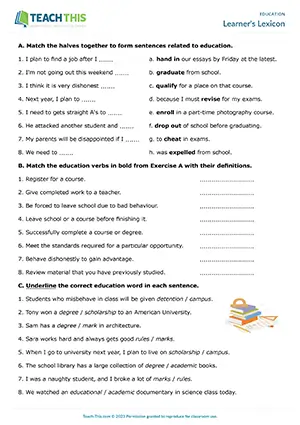
Learner's Lexicon

Upper-intermediate (B2) 30 minutes
ESL education worksheet preview with matching, multiple choice, gap-fill and communicative practice for Upper-intermediate B2

ESL Education Worksheet - Vocabulary Exercises: Matching, Multiple Choice, Gap-fill - Speaking Activity: Discussion, Freer and Communicative Practice - Pair Work

This handy educational vocabulary worksheet helps students practice verbs, nouns and adjectives related to education. First, students match halves together to...

ESL Education Worksheet - Vocabulary Exercises: Matching, Multiple Choice, Gap-fill - Speaking Activity: Guided Discussion, Freer and Communicative Practice - Pair Work This handy educational vocabulary worksheet helps students practice verbs, nouns and adjectives related to education. First, students match halves together to form sentences related to education. Students then match education verbs from Exercise A with their definitions. Next, students underline the correct education word in each sentence. Students then move on to complete statements by choosing the correct words from the multiple-choice options. After that, students pair up with a classmate and discuss whether or not they agree with each statement. Students then complete education conversation questions with verbs from a box in their correct form. Lastly, students discuss the questions with their partner.

Using Education Vocabulary

Education vocabulary includes words and phrases for classroom objects, school subjects, schoolwork and learning experiences. Knowing how these words work together helps students explain what they study, ask about tasks and discuss their education.

This page has ten resources across A1-A2, A2, B1 and B2, including matching games, information gap activities, worksheets and a board game, with two free downloads.

The table connects education words and phrases with their meanings and everyday uses.

Word or phraseMeaning or useExample
school subject An area of knowledge studied at school 'My favourite subject is science.'
classroom object An item used in a classroom 'Can I borrow your ruler?'
do homework Complete work set for study outside lessons 'I do my homework after dinner.'
hand in an assignment Give a completed piece of work to a teacher 'We need to hand in our assignments on Friday.'
revise for an exam Study material again to prepare for an exam 'She is revising for her history exam.'
pass an exam Achieve the result needed to succeed in an exam 'He passed his maths exam.'

When to Use Education Vocabulary

Explain school routines: Combine subject names with times and activities so listeners can follow a timetable or study routine, as in 'We have science on Tuesdays, and we do experiments in the laboratory.'

Clarify classroom tasks: Use specific words for the work, materials and deadline when checking instructions. A question such as 'Do we need to hand in the assignment today?' helps establish exactly what is expected.

Compare learning experiences: Add reasons and examples when discussing subjects or study habits, as in 'I prefer studying with a partner because we can explain difficult words to each other.'

3-Step Framework for Teaching Education Vocabulary

This sequence suits elementary to pre-intermediate classes, moving from recognising concrete words to using education vocabulary in sentences.

1. Connect Words with Objects: Begin with classroom picture and word cards. Students turn over cards together and say 'Snap' when the word and picture match. Follow with memory matching and an extra point for a sentence using the matched word, introducing sentence use after recognition.

2. Choose Words from Context: Move to sentence cards with missing education words. Students race to find the matching word card and read the completed sentence aloud. Then turn over word cards and have students create their own sentences, reducing the support provided by the original sentence.

3. Retrieve and Combine Vocabulary: Give students timed rounds to brainstorm words in education-related categories. After checking their answers and spelling, have them try to combine their chosen words in a sentence for bonus points. This extends the earlier sentence practice by asking students to retrieve and connect several words themselves.

Mistakes to Avoid with Education Vocabulary

Confusing study and learn: Use 'study for' when describing preparation for an exam. 'Learn' focuses on gaining knowledge or a skill, as in 'learn new words'. Incorrect: 'I learned for the exam all evening.' Correct: 'I studied for the exam all evening.'

Making homework countable: 'Homework' is uncountable, so it does not take 'a' or a plural ending. Use 'some homework' or 'a homework assignment' when needed. Incorrect: 'Our teacher gave us three homeworks.' Correct: 'Our teacher gave us three homework assignments.'

Common Questions About Teaching Education Vocabulary

What is a fun game for practicing education vocabulary?

The games Learning Lingo help students connect education words with meaning. Students first complete sentences by matching dominoes and read each completed sentence aloud. They then describe education words for a partner to guess within 30 seconds, giving students practice both recognising vocabulary in context and explaining what words mean.

What is a useful worksheet for teaching education vocabulary?

The free worksheet Language for Learning combines education vocabulary exercises with discussion. Students match classroom objects to pictures, choose words to complete sentences about school subjects, and compare subject rankings. They also match types of schoolwork to definitions and group them by verb before completing and discussing questions about education.

What is a good speaking activity for practicing school subjects?

The activity What are they learning? gives students a reason to ask and answer questions about school subjects. Students complete sentences about what people are learning, then exchange missing information with a partner. They write the responses as sentences before racing to match people with the correct classes.

Become a Teach This Member

Get unlimited access to the full library, plus new resources added every week.

Unlimited Resource Access

Download from 3000+ worksheets, activities, and games.

Save 5+ Hours Weekly

Cut lesson prep time with ready-to-use resources, plus teacher notes and answer keys.

Trusted Professional Quality

Classroom-tested, editable resources created by experienced ESL professionals.

Fresh Content Weekly

Get 5 new resources added to the library each week.

Join Now Just $29.99 quarterly