
Discussion Skills EAP Worksheets & Activities
Rapid-Fire Discussions
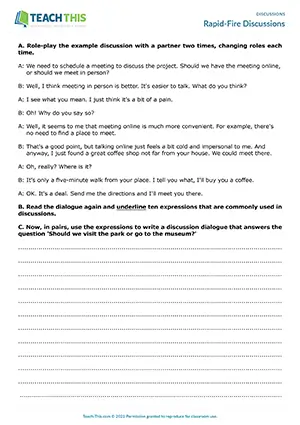
EAP Discussion Skills Activity - Vocabulary and Speaking: Identifying, Preparing and Delivering a Dialogue, Discussion, Communicative Practice - Pair Work
In this free discussion skills speaking activity, students practice discussion expressions and then take part in rapid-fire discussions where they answer questions...
Discussion Phrases
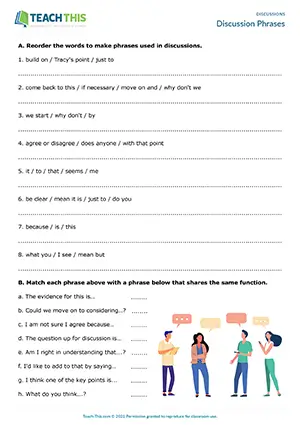
EAP Discussion Phrases Worksheet - Vocabulary Exercises: Matching, Gap-fill - Speaking Activity: Discussion, Communicative Practice
In this discussion phrases worksheet, students learn and practice phrases that are commonly used in discussions and their functions. First, students...
Interaction Techniques

EAP Discussion Skills Worksheet - Reading and Vocabulary Exercises: Matching, Gap-fill - Speaking Activity: Discussion, Communicative Practice
In this interaction techniques worksheet, students learn and practice three effective discussion interaction techniques and their associated language...
Leading a Discussion

EAP Leading Discussions Worksheet - Vocabulary Exercises: Categorising, Writing Sentences - Speaking Activity: Discussion, Communicative Practice - Group Work
In this comprehensive leading discussions worksheet, students learn and practice the responsibilities of and language for leading a discussion. First, students...
Phrases for Disagreeing
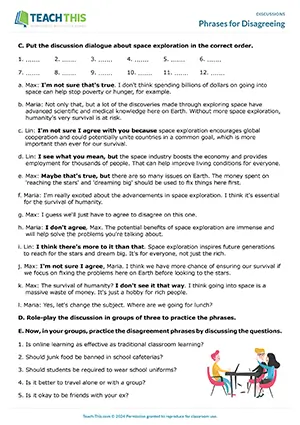
EAP Discussion Skills Worksheet - Vocabulary and Reading Exercises: Gap-fill - Speaking Activity: Discussion, Communicative Practice - Group Work
In this expressing disagreement worksheet, students practice eight phrases for disagreeing in a discussion. Students begin by ordering words...
Reciprocal Speech

EAP Discussion Skills Worksheet - Reading and Vocabulary Exercises: Matching, Writing Sentences - Speaking Activites: Asking and Answering Questions, Discussion
In this informative reciprocal speech worksheet, students learn and practice discussion interaction patterns and hesitation expressions. First, students...
The Discussion Director

EAP Discussion Skills Game - Vocabulary and Speaking: Categorising, Matching, Discussion, Role-Play, Communicative Practice - Group Work
In this communicative discussion skills game, students practice phrases for facilitating discussions and put them into practice in role-plays. First, students...
Voicing and Responding to Opinions

EAP Discussion Skills Worksheet - Reading and Vocabulary Exercises: Matching, Table Completion, Preparing Notes - Speaking Activity: Discussion, Freer Practice
In this useful expressing opinions worksheet, students learn and practice expressing and responding to opinions in a discussion. First, students read an excerpt...
Understanding Academic Discussion Skills
Academic discussion skills combine the language and interaction techniques needed to express a view, respond to others and help a conversation develop. Choosing an appropriate phrase matters, but so does recognising when to ask for clarification, extend an answer or invite another contribution.
This page contains eight resources across B1 and B2, including worksheets on discussion phrases, interaction techniques, leadership and responding to opinions, alongside a discussion game and one free speaking activity.
The table connects discussion functions with example language that students can adapt to the situation.
| Function | Purpose | Example language |
|---|---|---|
| State a position | Make your view clear without presenting it as an established fact | 'My view is that we should consider both options.' |
| Extend an answer | Give a partner material for a follow-up question | 'Yes, I would choose that option because it offers more flexibility.' |
| Clarify meaning | Check your interpretation before agreeing or disagreeing | 'Do you mean that it would be cheaper for everyone?' |
| Disagree with a reason | Explain a difference in viewpoint | 'I see your point, but I would give more weight to the cost.' |
| Gain thinking time | Signal that you are considering a response | 'Let me think about that for a moment.' |
| Invite a response | Open the discussion to another perspective | 'How do you see the situation?' |
How to Develop Academic Discussion Skills
Choose phrases by purpose: Ask students what they want their next contribution to achieve before selecting an expression. A phrase for challenging a claim will not serve the same purpose as one for checking what the speaker means.
Connect language practice with listening: Have students briefly identify their partner's point before responding. This helps them choose a relevant contribution instead of using a memorised expression simply because it is their turn.
Make feedback specific: Focus on one interaction goal at a time, such as extending answers or inviting responses. After speaking, ask students to identify an exchange where the technique helped and one they could handle differently next time.
3-Step Framework for Teaching Discussion Skills
For B2 learners, use this progression across suitable lessons to move from recognising discussion functions to responding to another viewpoint and managing an exchange.
1. Connect expressions with their functions: Students reorder words into discussion phrases, match expressions with the same function and complete gaps in a discussion. They then use the phrases in a group discussion. Focus feedback on whether each expression fits the speaker's purpose, preparing students to make deliberate language choices.
2. Prepare a position and a response: Students examine a seminar discussion, group expressions by function and add alternatives. They then prepare arguments for or against social media use, together with a response to the opposing position, before discussing with a partner from the other group. This extends phrase selection into anticipating and responding to another view.
3. Take responsibility for the exchange: Students evaluate discussion dos and don'ts, examine six leadership responsibilities and add suitable phrases. In groups of three, they take turns leading discussions on three topics. Ask them to draw on their earlier response practice while helping others contribute, then reflect on how their language choices supported the discussion.
Common Mistakes with Academic Discussion Skills
Using agree as an adjective: Agree is a verb, so it does not need am when expressing a present opinion. Incorrect: 'I am agree with your point.' Correct: 'I agree with your point.'
Rejecting a view without explaining the difference: A polite disagreement phrase alone gives the group little to examine. Add a reason or a specific concern so the other speaker can respond. Limited response: 'I'm afraid I disagree.' Developed response: 'I'm afraid I disagree because the proposal does not address the cost of training.'
Common Questions About Teaching Discussion Skills
What worksheet helps teach students to keep a discussion going?
The worksheet Reciprocal Speech introduces an ask, answer and add pattern through a model interaction. Students connect answers with additional comments and follow-up questions, then practice hesitation expressions. Discussing four questions brings these elements together, helping students move beyond brief replies and give their partner something to respond to.
What game helps students practice group discussions?
The game The Discussion Director gives students practice facilitating discussions while a classmate follows a role card. After each round, the group judges how the facilitator handled the situation, such as a disruption or uneven participation. Rotating roles lets everyone practice choosing phrases and responding to challenges in the conversation.
What free activity helps students practice reaching agreement?
The activity Rapid-Fire Discussions starts with a model dialogue in which students identify discussion expressions. Pairs use those expressions to write their own dialogue before discussing choices between two options under a time limit. Working towards an agreement gives students a reason to explain preferences and respond to their partner.
Become a Teach This Member
Get unlimited access to the full library, plus new resources added every week.
Unlimited Resource Access
Download from 3000+ worksheets, activities, and games.
Save 5+ Hours Weekly
Cut lesson prep time with ready-to-use resources, plus teacher notes and answer keys.
Trusted Professional Quality
Classroom-tested, editable resources created by experienced ESL professionals.
Fresh Content Weekly
Get 5 new resources added to the library each week.
Here's what our members are saying...


