
Adverbs of Time Worksheets, ESL Activities & Games
Mime Time
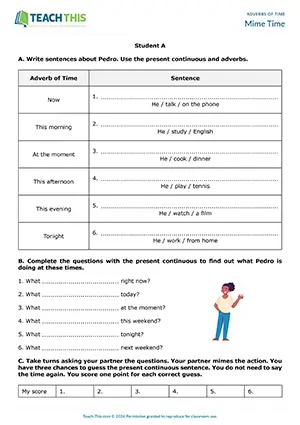
ESL Adverbs of Time Game - Grammar, Writing and Speaking: Writing Sentences, Asking and Answering Questions, Miming, Guessing - Group and Pair Work
In this enjoyable adverbs of time game, students practice using adverbs of time with the present continuous by writing sentences, asking questions, and miming...
Time Traveller
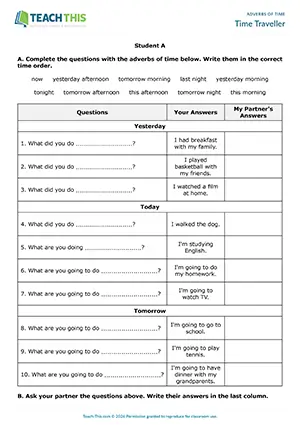
ESL Adverbs of Time Activity - Grammar, Vocabulary and Speaking: Gap-fill, Ordering, Information Gap, Asking and Answering Questions - Group and Pair Work
In this engaging adverbs of time activity, students complete a gap-fill in chronological order, then interview a partner to find out about their day. First, in two....
Yesterday, Today, Tomorrow
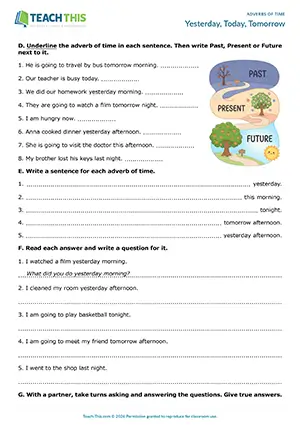
ESL Adverbs of Time Worksheet - Grammar and Vocabulary Exercises: Binary Choice, Gap-fill, Identifying, Writing Questions - Speaking Activity - Pair Work
In this comprehensive adverbs of time worksheet, students learn and practice adverbs of time with the present simple, past simple and 'be going to'...
Amazing Athletes
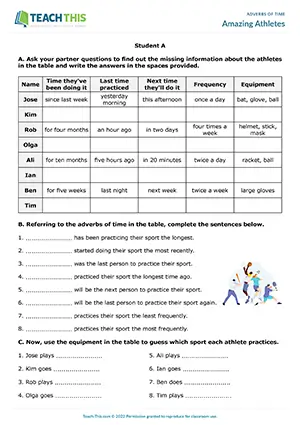
ESL Adverbs of Time Activity - Grammar and Speaking: Information Gap, Asking and Answering Questions, Gap-fill, Guessing - Pair Work
In this engaging adverbs of time speaking activity, students exchange and complete information about athletes using time adverbs. First, students find out missing...
Time to Learn
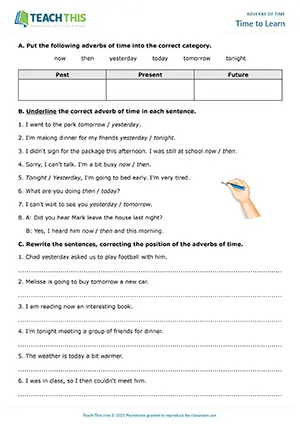
ESL Definite Adverbs of Time Worksheet - Vocabulary and Reading Exercises: Categorising, Error Correction, Answering Questions - Speaking Activity
In this free adverbs of time worksheet, students learn and practice definite time adverbs related to points of time. To begin, students categorise six...
Definite Frequency

ESL Adverbs of Definite Frequency Worksheet - Grammar and Vocabulary Exercises: Matching, Sentence Completion - Speaking Activity - Pair Work
Here is a productive adverbs of definite frequency worksheet for intermediate students. Students start by matching adverbs of definite frequency with...
Relationships in Time
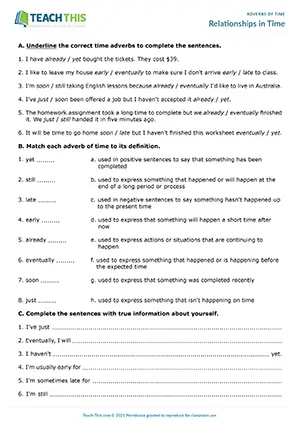
ESL Time Adverbs: Relationships in Time Worksheet - Vocabulary and Reading Exercises: Binary Choice, Matching, Sentence Completion, Gap-fill
This detailed time adverbs worksheet can be used to introduce students to indefinite adverbs that demonstrate relationships in time. First, students underline...
Time for a Review
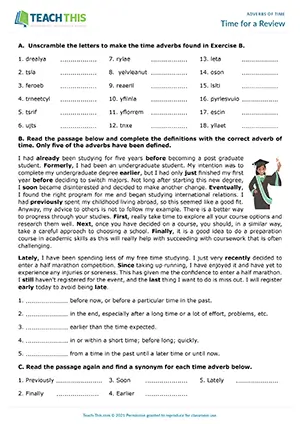
ESL Indefinite Adverbs of Time Worksheet - Grammar, Reading and Vocabulary Exercises: Unscrambling, Matching, Gap-fill, Writing Sentences
In this useful indefinite adverbs of time worksheet, students review indefinite time adverbs that demonstrate relationships in time. To start, students...
Time to Talk!
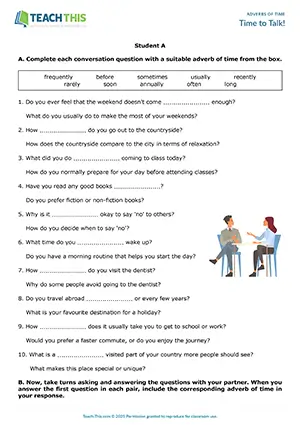
ESL Adverbs of Time Activity - Vocabulary and Speaking: Gap-fill, Asking and Answering Questions, Controlled and Freer Practice Group and Pair Work
In this interesting adverbs of time speaking activity, students complete, ask and answer conversation questions containing common adverbs of time. First, in...
What Happened When?

ESL Adverbs of Time Game - Grammar and Vocabulary: Unscrambling - Group Work
In this fun adverbs of time game, students race to put words in the correct order to make sentences containing adverbs of indefinite time. The first team to show and then read out each sentence in the correct order wins three points. Teams that show or...
Understanding Adverbs of Time
Adverbs of time are words and phrases that tell us when, for how long, or how often an action happens, such as 'yesterday,' 'soon,' 'already,' and 'twice a week.' When students place them in the wrong position in a sentence or pair them with the wrong tense, the meaning shifts or sounds unnatural, and a reader or listener may misunderstand the intended timeframe entirely.
This page covers adverbs of time across Elementary (A1-A2), Pre-intermediate (A2), and Intermediate (B1) levels, with ten resources including games, worksheets, and speaking activities, and one free download.
The table below maps the main categories of adverbs of time, with examples, typical sentence position, and the tenses they most commonly appear with.
| Category | Examples | Typical Position in Sentence | Common Tense Association |
|---|---|---|---|
| Definite points of time | yesterday, today, tomorrow, last week, next month | End of sentence | Past simple with past adverbs ('She called yesterday.'); present or future forms with future adverbs ('He leaves tomorrow.') |
| Indefinite points of time | recently, soon, already, just, yet, still | Before the main verb or at the end | Present perfect ('I've just arrived.'); 'soon' and 'yet' also appear with future and negative forms |
| Definite frequency | once a week, twice a month, every day, three times a year | End of sentence | Any tense ('She goes to the gym three times a week.') |
| Indefinite frequency | always, usually, often, sometimes, rarely, never | Before the main verb; after the verb 'be' | Any tense ('He is always late.' / 'They rarely complain.') |
| Duration | for two hours, all day, since Monday, for a long time | End of sentence | Past simple, present perfect, or continuous tenses ('We've been waiting for an hour.') |
| Relationships in time | afterwards, eventually, previously, meanwhile, finally | Beginning or end of a clause | Any tense, commonly used in narrative ('She finished the report. Afterwards, she went home.') |
When to Use Adverbs of Time
Sequencing Events in a Narrative: When telling a story or recounting a series of events, writers use adverbs of time to signal the order and spacing of actions so that readers can follow the sequence without confusion, as in 'She left the office at noon. Eventually, she reached the coast.'
Expressing Change Over Time: Speakers use adverbs of time to highlight that something is different from how it used to be, signaling contrast or personal progress to the listener, as in 'I used to struggle with presentations. Lately, I've felt much more confident.'
Setting Expectations About the Future: Writers and speakers use adverbs of time to frame an upcoming event as certain, probable, or imminent, managing the listener's sense of urgency or readiness, as in 'We'll announce the results shortly.'
3-Step Framework for Teaching Adverbs of Time
1. Build the Tense-Adverb Link: Start by having students write sentences from prompts, choosing the correct tense (past simple, present continuous, or be going to) based on the adverb of time in the prompt. This trains students to treat the adverb as a tense signal rather than just a time label, and it builds a reliable mental connection between the two before any freer practice begins.
2. Practice Through a Real Task: Move students into a speaking task built around adverbs expressing definite points of time. Give them a timeline to complete first, then ask them to write questions that match a set of given answers. When they put those questions to a partner and record the responses, they process each adverb in a genuine communicative exchange rather than recognizing it in isolation.
3. Raise the Stakes with a Team Game: Push students toward sentence-level accuracy under competitive pressure. In teams, students race to put scrambled words into the correct order to make sentences containing adverbs of indefinite time. A wrong answer costs the team one point, and the first team to correctly match all completed sentences to their corresponding times earns five bonus points, giving every group a reason to stay sharp until the final round.
Common Mistakes with Adverbs of Time
Present Perfect with a Definite Past Time Adverb: Students often use the present perfect tense alongside a definite past time adverb such as 'yesterday' or 'last week,' not realizing these adverbs always require the simple past. Wrong: 'I have seen her yesterday.' Correct: 'I saw her yesterday.'
Confusing 'still' and 'yet': Students often use 'still' and 'yet' interchangeably, not recognizing that 'yet' belongs in questions and negative sentences for something expected but unfinished, while 'still' describes something ongoing. Wrong: 'I haven't still finished my homework.' Correct: 'I haven't finished my homework yet.'
Common Questions About Teaching Adverbs of Time
What is a good worksheet for teaching adverbs of time?
The free worksheet Time to Learn covers definite adverbs of time and their position in a sentence. Students categorize six definite adverbs of time, underline the correct adverb in a set of sentences, then rewrite sentences to correct adverb position errors. It closes with a partner discussion task where students use the target adverbs in their own answers.
What is a useful speaking activity for adverbs of time?
The activity Time to Talk! has students complete conversation questions with adverbs of time from a box, then pair up with someone from the other group to ask and answer them. For the first question in each set, students must include the matching adverb of time in their response, which keeps the target language in use throughout the conversation.
How do I teach students to match adverbs of time with the right tense?
Linking adverbs of time to the correct tense is the focus of the worksheet Yesterday, Today, Tomorrow. Students identify the adverb in each sentence and decide whether it refers to the past, present, or future, then complete sentences by putting verbs into their correct form. A final task has students write their own answers using the target adverbs.
Become a Teach This Member
Get unlimited access to the full library, plus new resources added every week.
Unlimited Resource Access
Download from 3000+ worksheets, activities, and games.
Save 5+ Hours Weekly
Cut lesson prep time with ready-to-use resources, plus teacher notes and answer keys.
Trusted Professional Quality
Classroom-tested, editable resources created by experienced ESL professionals.
Fresh Content Weekly
Get 5 new resources added to the library each week.
Here's what our members are saying...


