
Quantifiers ESL Games, Worksheets & Activities
Do They Have Any...?
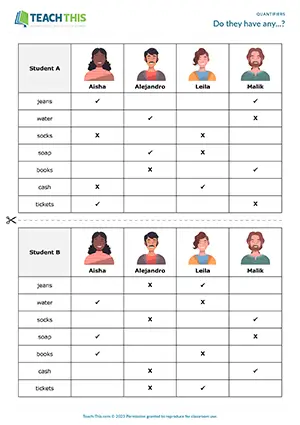
ESL Some and Any Activity - Grammar and Speaking: Information Gap, Asking and Answering Questions from Prompts, Table Completion - Pair Work
In this quantifiers information gap activity, students ask and answer questions with 'some' and 'any' about what people have in their travel bags. In pairs...
How Much and How Many

ESL How Much How Many Worksheet - Grammar and Vocabulary Exercises: Categorising, Gap-fill, Ordering, Matching, Forming Questions - Speaking Activity
In this free quantifiers worksheet, students use 'How much' and 'How many' with countable and uncountable nouns to ask and answer questions about...
Many Guesses

ESL How Much How Many Game - Grammar and Speaking: Guessing, Gap-fill, Asking and Answering Questions - Pair Work
In this fun quantifiers guessing game, students predict information about a partner and ask 'How much' and 'How many' questions to check their guesses. Working alone, students complete...
Some or Any?
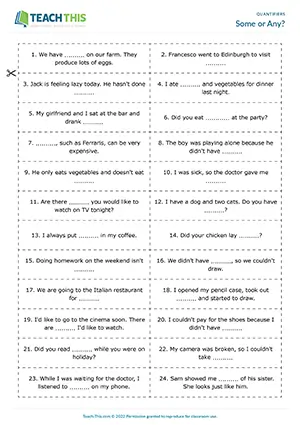
ESL Some and Any Game - Grammar: Gap-fill, Matching - Group Work
In this engaging 'some' and 'any' game, students race to use all their phrase cards by completing sentences. In groups, students take turns picking up a sentence card and reading it aloud. All the students look at their phrase cards for a match...
Athletes
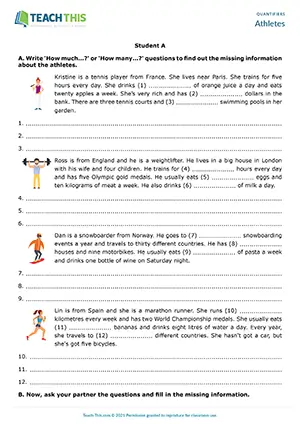
ESL Quantifiers Activity - Grammar and Speaking: Information Gap, Asking and Answering Questions, Freer Practice - Pair Work
In this intriguing quantifiers speaking activity, students write 'How much' and 'How many' questions in order to find out missing information in a text about...
Health Questionnaire
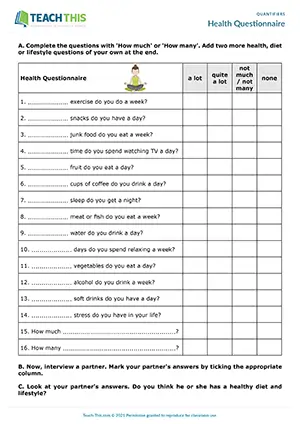
ESL How Much How Many Activity - Speaking: Question Completion, Asking and Answering Questions, Discussion - Pair Work
In this insightful How much and How many speaking activity, students ask and answer health, diet and lifestyle questions with 'How much' and 'How many' and...
How Much or How Many?
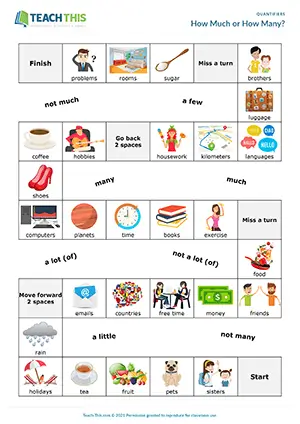
ESL How Much How Many Board Game - Grammar and Speaking: Asking and Answering Questions, Freer Practice - Group Work
In this entertaining How much and How many board game, students ask conversation questions with 'How much' or 'How many' and reply using quantifiers...
Much, Many, A few, A little
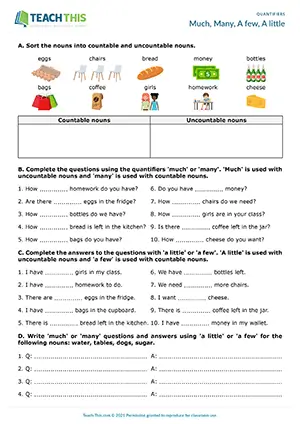
ESL Quantifiers Worksheet - Grammar and Vocabulary Exercises: Categorising, Gap-fill, Writing and Answering Questions
This free quantifiers worksheet helps students learn and practice how to use much, many, a few and a little with countable or uncountable nouns. Students start by sorting nouns into countable and uncountable ...
Much, Many, Some, Any

ESL Quantifiers Worksheet - Grammar and Vocabulary Exercises: Gap-fills
Here is a useful quantifiers worksheet to help students learn the grammatical rules associated with much, many, some and any. Working alone, students complete the 20 sentences on the worksheet with much, many, some or any. Next, students...
Place your Bets
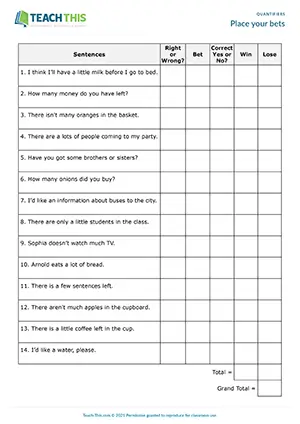
ESL Quantifiers Activity - Grammar and Vocabulary: Identifying, Error Correction
In this handy quantifiers error correction activity, students identify and correct errors in sentences that contain quantifiers. First, students read sentences on the worksheet, some of which contain errors in the use of quantifiers. If students...
Quantifiers Race
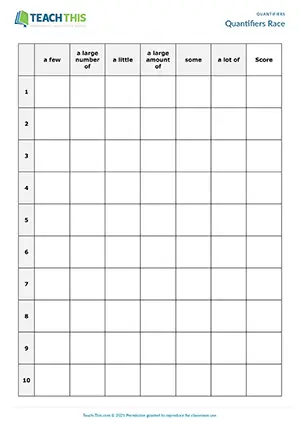
ESL Quantifiers Game - Vocabulary, Grammar and Speaking: Categorising, Forming Sentences, Freer Practice
In this creative quantifiers game, students race to write down countable and uncountable nouns that belong to different quantifiers and categories. The worksheet contains five columns with quantifiers as...
Ask Yourself

ESL Quantifiers Game - Vocabulary and Speaking: Gap-fill, Asking and Answering Questions, Freer Practice - Group Work
In this free quantifiers game, students race to complete questions with quantifiers (much, many, a few, enough, a lot of, any) and then answer the questions by speaking for 30 seconds. In groups...
Expressions of Quantity

ESL Expressions of Quantity Worksheet - Vocabulary, Grammar and Writing Exercises: Categorising, Writing Questions, Gap-fill, Writing an Email
In this comprehensive expressions of quantity worksheet, students use the topic of a children's birthday party to practice quantifiers. Students start...
Quantifiers Board Game
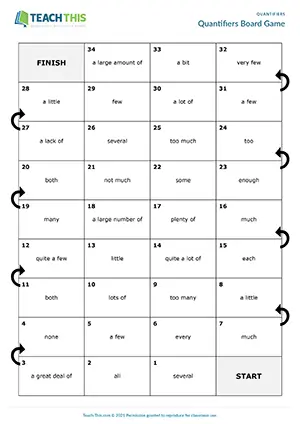
ESL Quantifiers Board Game - Vocabulary and Speaking: Forming Sentences - Group Work
Here is a rewarding quantifiers board game to help students practice or review quantifiers. Players take it in turns to roll the dice and move their counter along the board. When a player lands on a quantifier...
Understanding Quantifiers
Quantifiers express amounts and numbers without always giving an exact figure, as in 'some water', 'a few questions' and 'enough chairs'. Choosing a quantifier that fits the noun and the intended meaning helps students ask about quantities, describe what is available and explain whether they have enough.
This page has 14 resources across A1-A2, A2 and B1: six games, four worksheets and four activities. Three resources are available as free downloads: How Much and How Many; Much, Many, A few, A little; and Ask Yourself.
The table gives examples of quantifiers with plural countable nouns and uncountable nouns.
| Quantifier | Noun type and use | Example |
|---|---|---|
| some | Plural countable or uncountable nouns; an unspecified quantity, including in offers and requests | 'Would you like some tea?' |
| any | Plural countable or uncountable nouns; often used in neutral questions and negative statements | 'Do you have any questions?' |
| many / how many | Plural countable nouns; a large number or a question about number | 'How many chairs do we need?' |
| much / how much | Uncountable nouns; a large amount or a question about amount | 'We don't have much time.' |
| a few / a little | A small quantity: a few with plural countable nouns; a little with uncountable nouns | 'We have a few apples and a little milk.' |
| a lot of / lots of | Plural countable or uncountable nouns; a large quantity | 'There are a lot of people here.' |
| enough | Plural countable or uncountable nouns; a sufficient quantity | 'We have enough food for everyone.' |
| several | Plural countable nouns; a number greater than two but not very large | 'She asked several questions.' |
| no | Countable or uncountable nouns; zero quantity | 'There is no milk left.' |
How to Use Quantifiers
Check the noun's meaning in context: Use 'How much coffee?' for an amount of coffee and 'How many cups of coffee?' for a number of servings. Model the complete noun phrase so students can see what is being counted.
Connect the choice to the speaker's purpose: Contrast a neutral availability question, 'Is there any tea?', with an offer, 'Would you like some tea?' Teach these as useful patterns rather than a rule that every question requires 'any'.
Separate grammar from style: 'Many people work here' is grammatical. In everyday affirmative statements, 'a lot of' is often more conversational, particularly instead of unmodified 'much'; however, expressions such as 'so much time' and 'too many people' are natural in affirmative sentences.
3-Step Framework for Teaching Quantifiers
1. Connect Quantifiers with Noun Types: For an A2 sequence, begin by sorting nouns into countable and uncountable groups. Students then complete 'much' and 'many' questions and 'a little' and 'a few' answers before writing their own. This establishes the noun choices needed to build questions.
2. Ask Questions to Find Missing Information: Give partners texts with different information about athletes. Students prepare 'How much' and 'How many' questions, exchange answers and fill their gaps, then compare worksheets. Having a real information gap gives a purpose to the question forms practiced in the first stage.
3. Extend Questions into Conversation: Use a board game in which students form a 'How much' or 'How many' question from the noun on their square. After the group checks the question, everyone answers using quantifiers. This moves the sequence from finding supplied facts to asking and answering questions about wider topics.
Common Mistakes with Quantifiers
Using a counting expression with an uncountable noun: 'A few' needs a plural countable noun, whereas 'a little' can describe a small amount of water. Incorrect: 'We have a few water.' Correct: 'We have a little water.' To count containers instead, say 'We have a few bottles of water.'
Combining 'not' and 'no' to express zero quantity: In standard English, use a negative verb with 'any' or an affirmative verb with 'no'. Incorrect in standard English: 'We don't have no milk.' Correct: 'We don't have any milk.' Alternatively, say 'We have no milk.' Some dialects use negative concord, so explain this as the standard English pattern being practiced.
Common Questions About Teaching Quantifiers
What worksheet can I use for teaching how much and how many?
The free worksheet How Much and How Many builds from noun categorising to personal questions. Students choose 'How much' or 'How many', order words and match questions with answers. They then complete picture-based questions, answer with true information and interview a partner, connecting question formation with everyday communication.
What game can I use for practicing some and any?
In the game Some or Any?, students listen to a sentence card and find a phrase card that completes it. They read the full sentence for the group to check, then remove the matching pair. Trying to use all their phrase cards gives students repeated practice choosing 'some' and 'any' in context.
What speaking activity can I use for practicing quantifiers in everyday conversations?
The speaking activity Health Questionnaire connects quantifiers with diet and lifestyle. Students complete 'How much' and 'How many' questions, add two of their own and interview a partner. They record answers using expressions such as 'quite a lot' and 'not much', then discuss what those quantities suggest about their partner's habits.
Become a Teach This Member
Get unlimited access to the full library, plus new resources added every week.
Unlimited Resource Access
Download from 3000+ worksheets, activities, and games.
Save 5+ Hours Weekly
Cut lesson prep time with ready-to-use resources, plus teacher notes and answer keys.
Trusted Professional Quality
Classroom-tested, editable resources created by experienced ESL professionals.
Fresh Content Weekly
Get 5 new resources added to the library each week.
Here's what our members are saying...


