
Online Communication ESL Activities, Worksheets & Games
Fill in the Form

ESL Online Forms Activity - Reading and Speaking: Running Dictation - Vocabulary and Reading Exercises: Form Completion, Matching
In this useful online forms activity, students practice completing forms used for online transactions with personal details. First, in pairs, students take part in...
Swipe Right

ESL Online Profiles Worksheet - Reading and Writing Exercises: Gap-fill, Writing Sentences - Speaking Activity: Discussion, Communicative Practice
This fun online dating worksheet helps students learn about and practice writing online profiles. Students start by reading the profiles of six people on a...
Video Conferencing Language

ESL Video Conferencing Activity - Reading and Vocabulary Exercises: Matching, Categorising - Speaking Activity: Performing a Dialogue - Pair and Group
In this productive video conferencing language activity, students practice vocabulary and phrases used in online conference calls. First, in...
Chat Abbreviations
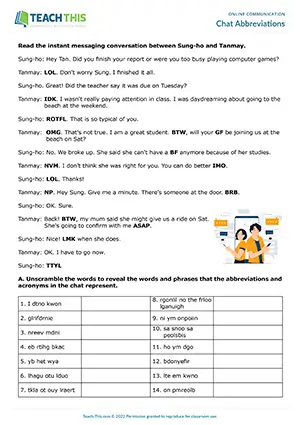
ESL Chat Abbreviations Worksheet - Vocabulary Exercises: Unscrambling, Matching, Gap-fill - Pair Work
In this free chat abbreviations worksheet, students learn and practice instant messaging abbreviations and acronyms that people often use in online chats and text messages. Students begin by reading...
Get the Message

ESL Online Communication Games - Vocabulary: Matching, Gap-fill, Betting - Pair Work
Here are two engaging text message abbreviations and acronyms games for students to play in class. First, students play a pelmanism game. In pairs, students take turns turning over a phrase card...
Items For Sale
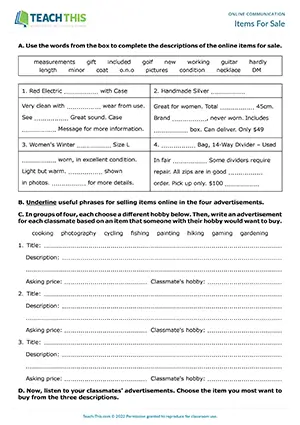
ESL Online Advertising Activity - Vocabulary and Writing: Gap-fill, Identifying, Guided Writing - Group Work
In this handy online advertisements activity, students practice writing descriptions of items for sale. First, students use words from a box to complete descriptions of online items for sale. Students then...
Online Shopping

ESL Online Shopping Worksheet - Vocabulary Exercises: Matching, Gap-fill - Speaking Activity: Asking and Answering Questions, Freer Practice - Pair Work
In this comprehensive online shopping worksheet, students practice vocabulary associated with shopping online. First, in pairs, students list popular...
Troublesome Transactions

ESL Online Transactions Game - Vocabulary: Running Dictation, Matching, Table Completion - Pair Work
This enjoyable online transactions game helps students practice vocabulary and phrases related to transacting online. In pairs, one student is the reader and the other is the writer. The reader runs to...
On the Web
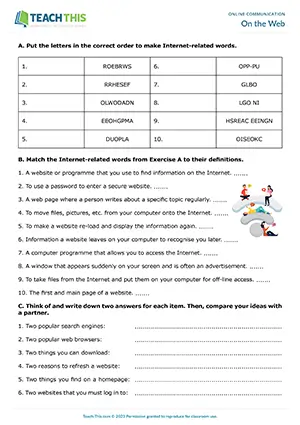
ESL Internet Worksheet - Vocabulary Exerices: Unscrambling, Matching, Gap-fill, Binary Choice - Speaking Activity: Asking and Answering Questions - Pair Work
In this insightful Internet vocabulary worksheet, students practice words related to using the Internet. First, students unscramble words related to the...
What Is Online Communication Language?
Online communication in English spans a wide range of distinct contexts, each with its own vocabulary and conventions: filling in forms, writing profiles, messaging, video conferencing, and shopping online all require different language choices. Learners who carry casual messaging habits into professional digital contexts, using abbreviations like 'lol' or 'tbh' in a work email or video call, come across as unprofessional in ways they may not notice until it causes a real problem.
This page covers online communication across A2, B1, and B2 levels, with nine resources including worksheets, speaking activities, and games, with one available as a free download.
The table below maps the key digital contexts covered in online communication lessons to their characteristic vocabulary and a real-world example of each in use.
| Context | Key Vocabulary and Phrases | Example in Use |
|---|---|---|
| Online forms | Username, password, date of birth, billing address, confirm password | 'Please enter your date of birth in DD/MM/YYYY format.' |
| Online profiles | Bio, interests, profile picture, handle, followers | 'Write a short bio telling people about yourself and your interests.' |
| Instant messaging | lol, brb, omg, tbh, idk, gtg, thx | 'Gtg! Talk later! Thx for the help.' |
| Video conferencing | You're on mute, can you hear me, share your screen, I'll hand over to | 'Sorry, could you say that again? I think you're on mute.' |
| Online shopping | Add to cart, checkout, shipping, tracking number, out of stock | 'Your order has been dispatched. Use your tracking number to follow its progress.' |
| Online advertising | Condition, asking price, collection only, make an offer, barely used | 'Barely used. Asking price is $30. Collection only.' |
| Internet general | Browser, download, upload, stream, bandwidth, pop-up, cookie | 'Your browser needs to accept cookies to continue.' |
When to Use Online Communication Language
Switching from casual to professional messaging: When a learner moves from messaging friends to contacting a teacher, employer, or client digitally, they need to drop abbreviations and emoji and switch to full sentences and a neutral tone, as in writing 'I wanted to follow up on my application' rather than 'just checking in re: the job lol.'
Managing a video call as host or participant: When technical problems arise during an online meeting, having ready-made phrases for interrupting politely, flagging connection issues, or handing over to another speaker prevents the meeting from stalling, as in 'Sorry to interrupt, but I think you might be on mute.'
Writing an online listing or profile: When learners need to describe themselves or an item in a public digital space, the conventions shift toward concise, scannable language with specific details rather than full prose, as in 'Barely used. Great condition. Open to offers.'
3-Step Framework for Teaching Online Communication Language
1. Anchor Vocabulary in a Real-World Task: Open with a running dictation that puts learners on their feet and gives the vocabulary immediate practical purpose. One student runs to read a text about someone's personal details, runs back, and dictates what they read to their partner, who writes it down. That information then goes straight to work: learners use it to complete an online application form for a language course, so every vocabulary item lands in a context they will actually encounter outside the classroom.
2. Build Confidence with a Low-Stakes Game: Move learners into a two-part game that first builds recognition through a pelmanism matching activity, then tests how well the vocabulary has stuck with a betting round. In the betting stage, learners decide how confident they are about each answer and wager between 1 and 10 points accordingly, writing bets in a 'bet' column and transferring scores to either a 'win' or 'lose' column depending on whether they are right. The betting mechanic turns a vocabulary check into something learners are genuinely invested in.
3. Push Fluency Under Competitive Pressure: Round off the sequence with a running dictation race that sends learners out of the classroom to read sentences from a sheet on the wall, then sprint back to dictate them to their partner. Once all six sentences are dictated and roles are swapped, pairs race to complete a table matching each person and the item they bought or tried to buy with a problem. The first pair to complete the table correctly wins, which keeps the energy high and the reading purposeful.
Common Mistakes with Online Communication Language
Literal translation of interruption phrases in video calls: Students often produce direct word-for-word translations of interruption phrases from their first language when trying to speak up in a video call, which can sound abrupt or rude to a native English speaker. Wrong: 'Wait. I want to speak now.' Correct: 'Sorry to jump in, but I just wanted to add something.'
Writing in text speak in a formal online context: Students often use the informal abbreviations and shortcuts they have picked up from social media and messaging apps when writing emails or filling in online forms, not realising that these are only acceptable in casual one-to-one digital conversations. Wrong: 'Hi, I wud like 2 apply 4 the job. Pls find my CV attached. Thx' Correct: 'Dear Sir or Madam, I would like to apply for the position. Please find my CV attached. Thank you.'
Common Questions About Teaching Online Communication Language
What is a useful worksheet for teaching chat abbreviations?
The free worksheet Chat Abbreviations gives learners an instant messaging conversation to read first, so the abbreviations arrive in real context before any exercises begin. Students then unscramble letters to work out what each abbreviation stands for, match them to definitions, and complete sentences, building recognition step by step rather than making learners memorize a list.
What is a good speaking activity for practicing video conferencing language?
Video Conferencing Language is a speaking activity that takes learners from vocabulary exercises to a full group performance. They order, match, and categorize key phrases, then create a dialogue for an online class or meeting, practicing it three times and taking turns as host, so every learner leads before the group presents to the class.
What is a fun activity for practicing online profile writing?
In the worksheet Swipe Right, learners write their own online profile, then a classmate reads it aloud and the class tries to guess whose it is. Before writing, they read six dating app profiles and discuss which people would suit each other, arriving at their own profile with a clear sense of what to include.
Become a Teach This Member
Get unlimited access to the full library, plus new resources added every week.
Unlimited Resource Access
Download from 3000+ worksheets, activities, and games.
Save 5+ Hours Weekly
Cut lesson prep time with ready-to-use resources, plus teacher notes and answer keys.
Trusted Professional Quality
Classroom-tested, editable resources created by experienced ESL professionals.
Fresh Content Weekly
Get 5 new resources added to the library each week.
Here's what our members are saying...


