
Describing People's Appearance ESL Activities, Games, Worksheets & Lessons
Name the Classmate
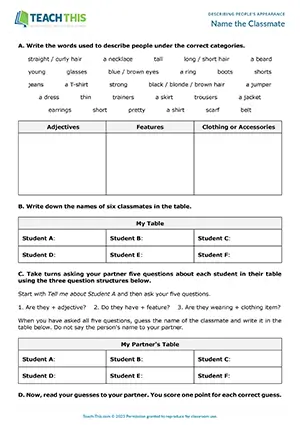
ESL Describing Appearance Game - Vocabulary: Categorising, Asking and Answering Questions, Guessing - Pair Work
In this engaging describing people game, students ask questions about people's appearance in order to guess the names of six classmates a partner has written down. First, students categorise...
Describe a Classmate
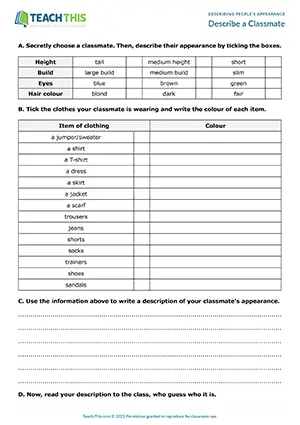
ESL Describing Appearance Activity - Vocabulary and Writing: Table Completion, Writing and Reading a Description, Guessing
In this fun describing appearance activity, students describe a classmate's physical appearance and clothing to the class, who guess who it is. First, students secretly choose a classmate to...
Describing People Lesson
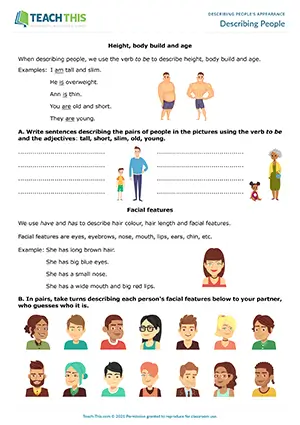
ESL Describing People Lesson - Vocabulary and Writing Exercises: Gap-fill, Writing and Drawing Descriptions - Speaking Activities: Describing, Guessing - Pair Work
This free describing people lesson helps to teach students how to describe people's appearance and clothing. First, students learn to use the verb 'to be' to...
Describing People's Appearance
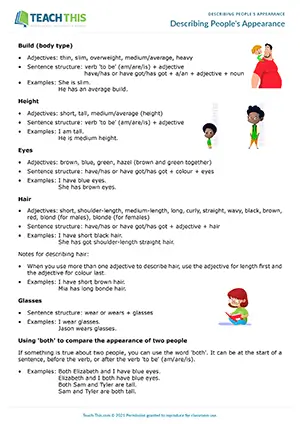
ESL Describing People Worksheet - Vocabulary, Grammar and Reading Exercises: Identifying, Error Correction, Gap-fill, Writing Sentences
This useful describing appearance worksheet helps students practice describing someone's build, height, hair, and eyes. Students also practice using 'both'...
Pen Friend
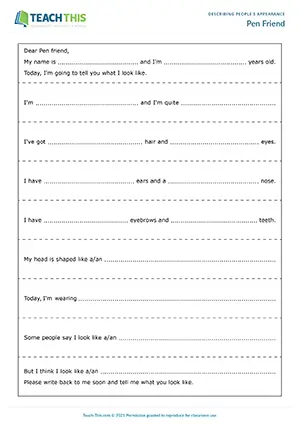
ESL Describing Appearance Activity - Vocabulary and Writing: Sentence Completion - Group Work
In this creative describing people activity, students write a chain pen friend letter as an invented person, describing their height, weight, facial features, clothing and general appearance. First...
Appearance Crossword
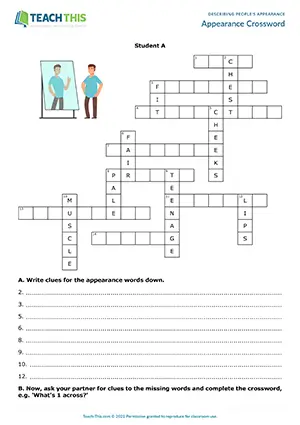
ESL Appearance Adjectives Activity - Vocabulary: Writing and Giving Clues, Guessing - Group and Pair Work
In this memorable describing appearance activity, students complete a crossword by describing and guessing words and adjectives related to physical appearance. First, in two groups, students invent...
Appearance Practice
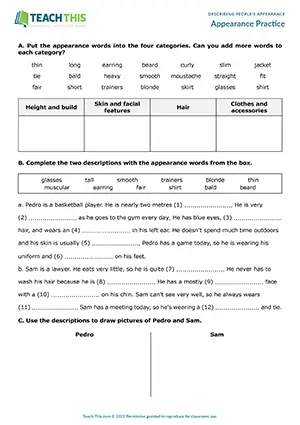
ESL Appearance Worksheet - Vocabulary Exercises: Categorising, Gap-fill, Drawing, Writing Sentences - Speaking Activity: Describing, Drawing - Pair Work
In this comprehensive describing people worksheet, students learn vocabulary for describing appearance and practice describing people. First...
Describe and Draw
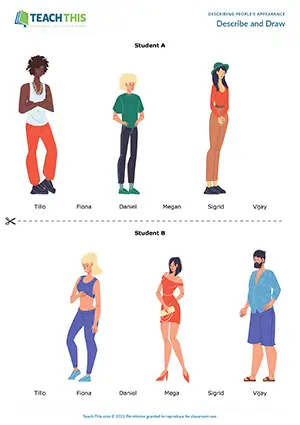
ESL Describing Appearance Activity - Speaking: Describing, Drawing - Pair Work
Here is an enjoyable describing people speaking activity to help students practice describing people's physical appearance, clothing and body posture. In pairs, students take turns describing people on their worksheet to their...
Let's face it!
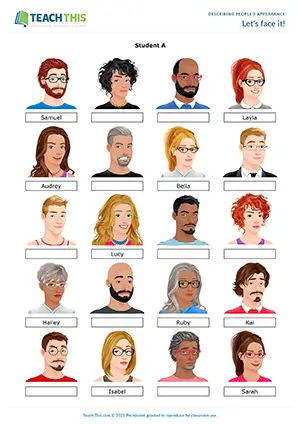
ESL Describing Appearance Activity - Speaking: Describing, Identifying - Pair Work
In this free describing appearance speaking activity, students match names to faces by giving and listening to descriptions of people's facial features and hair. In pairs, students take turns naming and describing the people on their worksheet for...
Who am I?
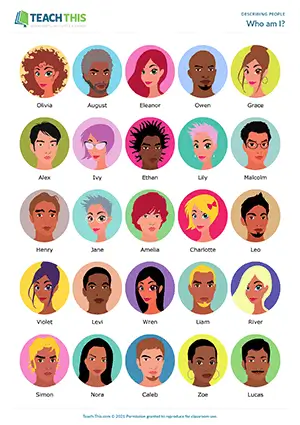
ESL Describing Appearance Game - Speaking: Asking Questions, Identifying - Pair Work
In this entertaining describing appearance game, students ask yes/no questions about appearance in order to find out their secret identity. In pairs, one student picks a person at random from the...
Appearance Antics
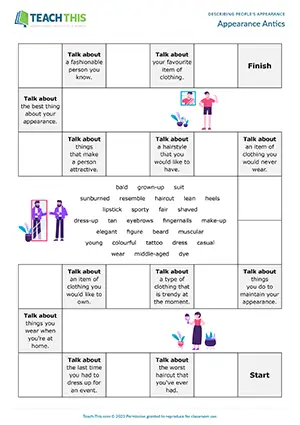
ESL Describing Appearance Board Game - Vocabulary and Speaking: Gap-fill, Impromptu Speech, Freer Practice - Group Work
Here is a fun appearance vocabulary board game to help students practice describing how people look. In groups, students take turns picking up a card...
Can you name...?
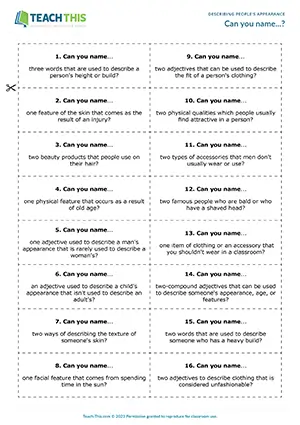
ESL Describing Appearance Game - Vocabulary: Providing Vocabulary - Pair and Group Work
In this imaginative describing appearance game, teams race to come up with words used to describe appearance based on prompts. In two teams, students take turns picking up a card, reading...
Describing Someone
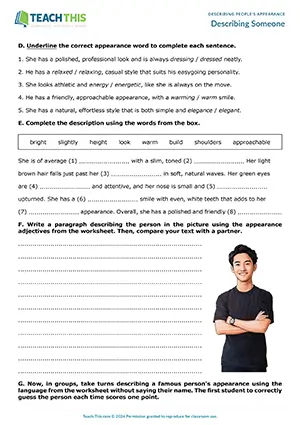
ESL Appearance Adjectives Worksheet - Vocabulary and Writing Exercises: Gap-fill, Writing a Description - Speaking Game: Describing, Guessing
In this productive adjectives of appearance worksheet, students practice describing people's appearance using related adjectives. First, students write...
Partners in Crime
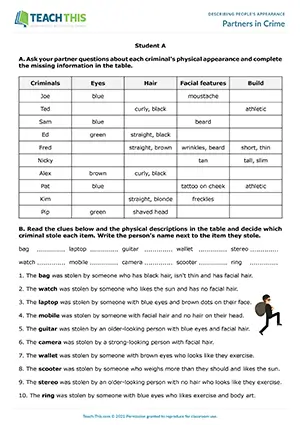
ESL Describing People Activity - Speaking: Information Gap, Asking and Answering Questions, Identifying - Pair Work
In this rewarding describing appearance speaking activity, students ask questions about people's physical appearance in order to solve a crime puzzle. In pairs, students take turns asking their partner...
Whose Pet?
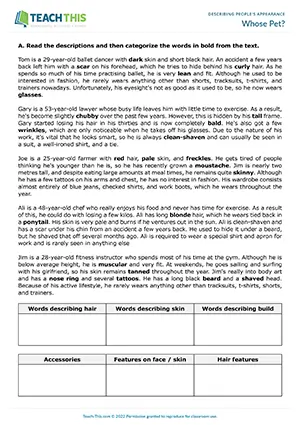
ESL Describing Appearance Activity - Reading and Vocabulary: Categorizing, Scanning, Identifying - Speaking Activity: Asking and Answering Questions - Pair Work
This interesting describing people activity helps students practice vocabulary used to describe people's appearance. First, students read descriptions of five...
Using People's Appearance Vocabulary
People's appearance vocabulary covers the words and structures used to communicate what someone looks like, including physical features such as height, build, hair, and eyes, as well as clothing and accessories. Students who cannot describe appearance accurately struggle to give useful eyewitness information, report a missing person, or write a character that a reader can actually picture.
This page covers describing people's appearance from A1 to B2 level, with 15 resources spanning pair games, writing worksheets, speaking activities, a full lesson plan, and a board game, including two free downloads.
This table shows the key structures used to describe each aspect of a person's appearance, with a positive and negative example for each.
| Appearance Category | Key Structure | Positive Example | Negative Example |
|---|---|---|---|
| Height and build | subject + is/are + adjective | 'She is tall and slim.' | 'He isn't very tall.' |
| Hair | subject + has/have + noun phrase | 'He has short dark hair.' | 'She doesn't have curly hair.' |
| Eyes and facial features | subject + has/have + noun phrase | 'She has blue eyes and high cheekbones.' | 'He doesn't have a beard.' |
| Clothing and accessories | subject + is/are wearing + noun | 'She is wearing a red jacket.' | 'He isn't wearing a hat.' |
| General appearance | subject + looks + adjective OR subject + looks like + noun phrase | 'She looks elegant.' | 'He doesn't look very tidy.' |
How to Use People's Appearance Vocabulary
Describing from Head to Toe: Work through a description in a consistent order, starting with the most general features before moving to the specific: height and build first, then hair, then facial features, then clothing. This gives your listener a clear mental image that builds progressively, for example 'She's tall and slim, with long dark hair, brown eyes, and she was wearing a red jacket.'
Choosing the Most Distinctive Feature First: When you need to help someone pick a person out of a crowd quickly, lead with the feature that stands out most rather than starting from the top. A bright item of clothing or an unusual hairstyle is more useful as an opening detail than height, for example 'Look for the man in the bright orange coat with the shaved head.'
Using Both Positive and Negative Structures: Combine positive statements with negative ones to give a more precise picture and rule out confusion, for example 'She has dark hair but she doesn't have a fringe, and she isn't very tall.' This is especially useful when several people share one obvious feature.
3-Step Framework for Teaching People's Appearance Vocabulary
1. Build Vocabulary Through Sorting and Structured Questioning: Start by giving students a bank of appearance words to sort into categories such as adjectives, physical features, and clothing or accessories. This grounds the vocabulary before students use it communicatively. Then push them straight into using it by asking and answering questions with three structures: 'Are they + adjective,' 'Do they have + feature,' and 'Are they wearing + clothing item.' Sorting and applying the language in the same activity locks the vocabulary in far more effectively than a list-based approach.
2. Build Fluency Through Vocabulary in Context: Once students have a working vocabulary set, move to activities where they must retrieve the right word under light time pressure. A sentence-completion race works well here: one student reads a sentence aloud with a gap, replacing the missing word with 'blank,' for example 'Maya is very BLANK. She looks good in everything she wears,' and the other students race to supply the correct appearance word. This pushes students to connect form and meaning quickly rather than recalling words in isolation.
3. Apply the Language to a Real-World Purpose: The most effective final step is giving students a communicative reason to describe someone precisely. A problem-solving context does this well: students ask questions about various people's appearance to complete missing information about a set of individuals in a table, then use the physical descriptions alongside a set of crime clues to decide which criminal stole each item. When accuracy affects the outcome, students pay close attention to the specific vocabulary they choose.
Common Mistakes with People's Appearance Vocabulary
Wrong Adjective Order: Students often place appearance adjectives in the wrong sequence when combining two or more descriptors, because English has a strict instinctive order that is rarely taught explicitly. Wrong: 'She has dark short hair and big brown beautiful eyes.' Correct: 'She has short dark hair and beautiful big brown eyes.'
Dropping 'like' before a noun phrase after 'look': Students often write 'look' directly before a noun phrase, omitting 'like,' because they apply the same pattern used before adjectives. Wrong: 'He looks a businessman.' Correct: 'He looks like a businessman.'
Common Questions About Teaching People's Appearance Vocabulary
What is a fun describing appearance game?
In the game Who am I? each yes/no question costs a point, so the student who identifies their secret identity in the fewest questions wins. Students ask about appearance features like hair and build to narrow down who they are, which pushes them to think carefully about which question will eliminate the most options.
What is a good lesson for teaching how to describe people?
The free Describing People Lesson builds all three key structures in sequence: 'to be' for height and build, 'have' and 'has' for hair and facial features, then clothing. It ends with a drawing activity where students read descriptions and draw pictures of three thieves, giving them a real reason to read the language carefully.
What is a useful worksheet for practicing appearance adjectives?
The worksheet Describing Someone starts students with the adjectives they already know for each physical feature, then sends them to a dictionary to find synonyms and antonyms. The worksheet builds toward a group game where students describe a famous person's appearance without saying their name, and the first correct guess scores a point.
Become a Teach This Member
Get unlimited access to the full library, plus new resources added every week.
Unlimited Resource Access
Download from 3000+ worksheets, activities, and games.
Save 5+ Hours Weekly
Cut lesson prep time with ready-to-use resources, plus teacher notes and answer keys.
Trusted Professional Quality
Classroom-tested, editable resources created by experienced ESL professionals.
Fresh Content Weekly
Get 5 new resources added to the library each week.
Here's what our members are saying...


