
Academic Word List (AWL) Sublist 1 & 2 Worksheets
AWL Sublist 1 Words 1-10

AWL Vocabulary Worksheet - Vocabulary Exercises: Unscrambling, Gap-fill, Multiple Choice, Rewriting Sentences
This useful AWL vocabulary worksheet helps students become familiar with and practice words 1 to 10 from AWL Sublist 1 and their corresponding word families. Students begin by rearranging words to...
AWL Sublist 1 Words 11-20
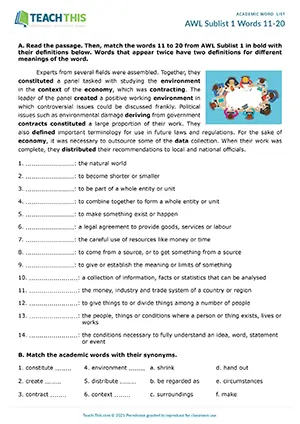
AWL Vocabulary Worksheet - Vocabulary and Reading Exercises: Matching, Table Completion, Gap-fill
This free AWL vocabulary worksheet helps students learn and practice words 11 to 20 from AWL Sublist 1 and their related word families. First, students read a passage containing AWL Sublist 1 words...
AWL Sublist 1 Words 21-30
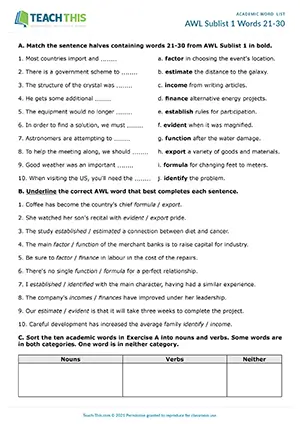
AWL Vocabulary Worksheet - Vocabulary Exercises: Matching, Binary Choice, Categorising, Multiple Choice, Gap-fill
In this productive AWL vocabulary worksheet, students familiarise themselves with words 21 to 30 from AWL Sublist 1 and their related word families. Students begin by matching sentence halves together that...
AWL Sublist 1 Words 31-40
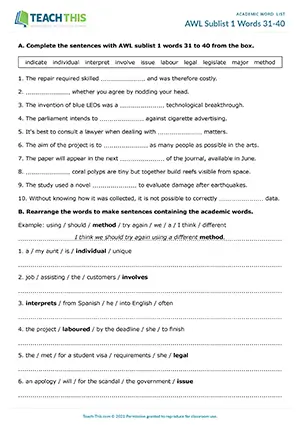
AWL Vocabulary Worksheet - Vocabulary Exercises: Gap-fill, Unscrambling, Changing Word Form, Rewriting Sentences
This handy AWL vocabulary worksheet helps students practice using words 31 to 40 from AWL Sublist 1 and their associated word families. To start, students complete sentences with AWL Sublist...
AWL Sublist 1 Words 41-50
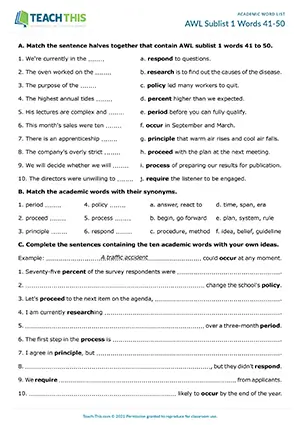
AWL Vocabulary Worksheet - Vocabulary Exercises: Matching, Sentence Completion, Multiple Choice, Gap-fill
Here is a comprehensive AWL vocabulary worksheet to help students gain familiarity with words 41 to 50 from AWL Sublist 1. To begin, students match sentence halves together that contain...
AWL Sublist 1 Words 51-60
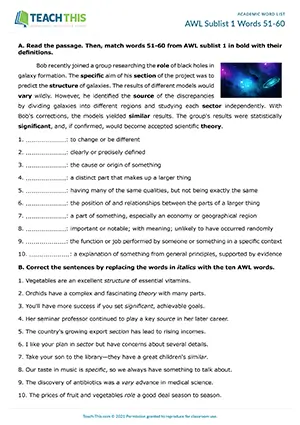
AWL Vocabulary Worksheet - Reading and Vocabulary Exercises: Matching, Error Correction, Gap-fill, Rewriting Sentences
In this detailed AWL vocabulary worksheet, students practice words 51 to 60 from AWL Sublist 1 and their corresponding word families. Students begin by reading a short passage that contains...
AWL Sublist 2 Words 1-10
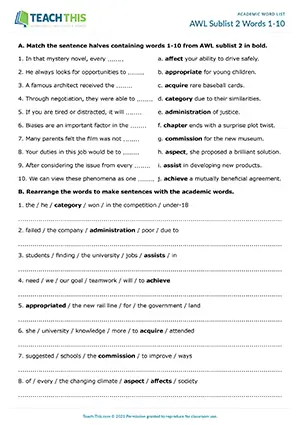
AWL Vocabulary Worksheet - Vocabulary Exercises: Matching, Changing Word Forms, Sentence Completion, Multiple Choice
Here is a free AWL vocabulary worksheet familiarising students with words 1 to 10 from AWL Sublist 2. First, students match sentence halves containing words 1-10 from AWL Sublist 2. Next, students...
AWL Sublist 2 Words 11-20
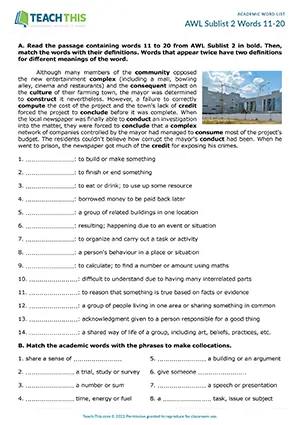
AWL Vocabulary Worksheet - Reading and Vocabulary Exercises: Matching, Gap-fill, Binary Choice, Rewriting Sentences
This insightful AWL vocabulary worksheet gives students practice at using words 11 to 20 from AWL Sublist 2 and their associated word families. Students start by reading a passage and matching words...
AWL Sublist 2 Words 21-30
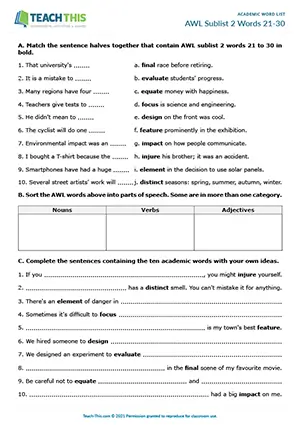
AWL Vocabulary Worksheet - Vocabulary Exercises: Matching, Categorising, Sentence Completion, Multiple Choice, Gap-fill
This informative AWL vocabulary worksheet helps students gain familiarity with words 21 to 30 from AWL Sublist 2 by completing exercises that use various forms of the words in context. First, students...
AWL Sublist 2 Words 31-40
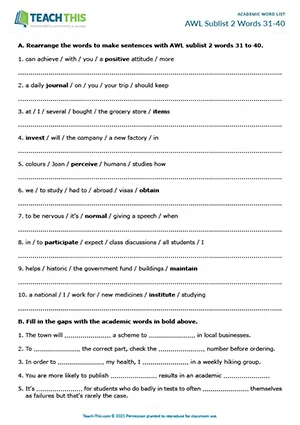
AWL Vocabulary Worksheet - Vocabulary Exercises: Unscrambling, Gap-fill, Binary Choice, Rewriting Sentences
In this engaging AWL vocabulary worksheet, students practice words 31 to 40 from AWL Sublist 2 and their corresponding word families. First, students rearrange words to make sentences with AWL...
AWL Sublist 2 Words 41-50
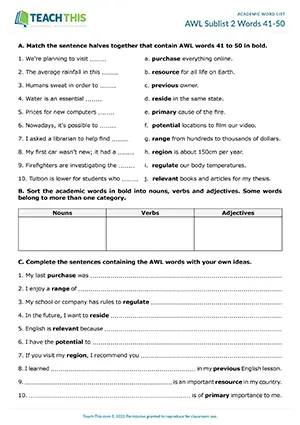
AWL Vocabulary Worksheet - Vocabulary Exercises: Matching, Categorising, Sentence Completion, Changing Word Forms, Multiple Choice, Gap-fill
In this useful AWL vocabulary worksheet, students practice words 41 to 50 from AWL Sublist 2 and their associated word families. To start, students match...
AWL Sublist 2 Words 51-60
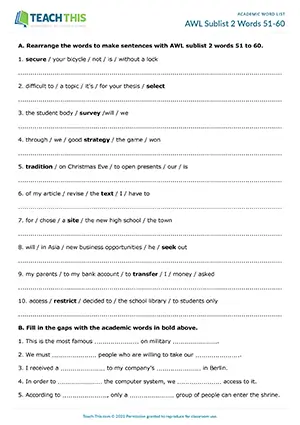
AWL Vocabulary Worksheet - Vocabulary Exercises: Unscrambling, Changing Word Forms, Rewriting Sentences
In this comprehensive AWL vocabulary worksheet, students practice words 51 to 60 from AWL Sublist 2 and their word families. First, students rearrange words to make sentences with AWL Sublist 2...
Using Academic Word List Vocabulary
Academic Word List (AWL) vocabulary helps students understand and express ideas in academic texts. Learning related word forms alongside meanings and common combinations helps students use the vocabulary accurately in their own sentences.
This page contains 12 worksheets covering Sublists 1 and 2, including two free downloads. Each sublist is divided into six groups of ten words, with exercises covering meaning, word families and sentence use. The resources are organised by sublist rather than CEFR level.
Use the reference below to connect vocabulary knowledge with practical reading and writing decisions. The examples illustrate language patterns rather than identify the contents of a particular ten-word worksheet.
| Focus | What students check | Illustrative example |
|---|---|---|
| Meaning in context | How the surrounding sentence clarifies a word | In 'The analysis revealed a pattern', the analysis involves examining information. |
| Word families | How related forms perform different grammatical jobs | 'analyse' is a verb; 'analysis' is a noun; 'analytical' is an adjective. |
| Collocations | Which words commonly occur together | 'conduct research', 'analyse data', 'a significant difference' |
| Sentence structure | Which form fits the position and intended meaning | 'The findings are significant.' 'The findings differ significantly.' |
| Rewriting | What else must change when a different word form is used | 'The researchers analysed the data.' 'The researchers conducted an analysis of the data.' |
How to Develop Academic Word List Vocabulary
Select a manageable group: Choose a worksheet according to the words students need and what they already know. Check familiarity before teaching the group, and use the numbered ranges to organise coverage rather than assuming they represent proficiency levels.
Record more than a definition: Ask students to keep a short example, a useful word combination and relevant family members together. Check each form in context so students do not assume that related words can replace one another without other sentence changes.
Return to words in new contexts: After controlled practice, ask students to use selected words in a short explanation related to their studies. Revisit them in later reading or writing and check meaning, word form and natural combinations together.
3-Step Framework for Teaching Academic Word List Vocabulary
Use this progression across lessons with selected word groups. The worksheets cover different vocabulary sets, so review the relevant meanings whenever you introduce a new set rather than treating the sequence as one continuous exercise on identical words.
1. Establish meaning through reading: Students read a short passage and match target words with definitions. They then replace unsuitable vocabulary in sentences with words from the set. Ask them to explain which contextual clues support their choices before moving to word-form work.
2. Connect forms with sentence structure: Students complete and reorder sentences, then use supplied suffixes to produce related forms. Rewriting sentences with a specified form makes them consider the surrounding grammar as well as the target word. Check the whole sentence after each change.
3. Apply vocabulary to personal ideas: Students match sentence halves, classify words as nouns, verbs or adjectives and complete sentence beginnings with their own ideas. Subsequent word-form exercises provide another accuracy check. Finish by having students explain the meaning and grammatical role of a word in one of their own sentences.
Common Mistakes with Academic Word List Vocabulary
Choosing the wrong member of a word family: Related words share meaning but perform different grammatical roles. Incorrect: 'The researchers analysis the data.' Correct: 'The researchers analyse the data.' Use the noun in a different pattern, such as 'The researchers conducted an analysis of the data.'
Treating every academic noun as countable: Check how a noun is used rather than automatically adding an article or plural ending. Incorrect: 'The report provides an evidence for the claim.' Correct: 'The report provides evidence for the claim.' To count individual items, use a phrase such as 'two pieces of evidence'.
Common Questions About Teaching Academic Word List Vocabulary
How can I teach academic vocabulary in context?
The worksheet AWL Sublist 2 Words 11-20 begins with a reading passage and definition matching. Students then combine academic words with phrases to form collocations, choose suitable words for sentences and rewrite sentences using specified word forms. This connects meaning, common word combinations and grammatical use within one resource.
What free worksheet can I use for teaching AWL vocabulary?
The worksheet AWL Sublist 1 Words 11-20 introduces academic words through a reading passage. Students match words to definitions and synonyms, then complete a word family table. They use forms from the table to finish sentences, linking the vocabulary they have read with choices about meaning and sentence structure.
How can students practice academic word families?
The free worksheet AWL Sublist 2 Words 1-10 combines sentence matching and word ordering with word formation. Students use supplied prefixes and suffixes to build related forms, then select the form that fits each sentence. This helps them connect changes in word form with the grammatical demands of a sentence.
Become a Teach This Member
Get unlimited access to the full library, plus new resources added every week.
Unlimited Resource Access
Download from 3000+ worksheets, activities, and games.
Save 5+ Hours Weekly
Cut lesson prep time with ready-to-use resources, plus teacher notes and answer keys.
Trusted Professional Quality
Classroom-tested, editable resources created by experienced ESL professionals.
Fresh Content Weekly
Get 5 new resources added to the library each week.
Here's what our members are saying...


