
Business Meetings Worksheets, Activities & Role-Plays
Clarifying in Meetings

Business English Meetings Worksheet - Reading and Vocabulary Exercises: Categorising, Gap-Fill - Speaking Activity: Role-Play, Freer Practice - Group Work
In this handy business meetings worksheet, students practice language to clarify information and role-play a meeting using the expressions. To begin, students...
The Meeting Zone
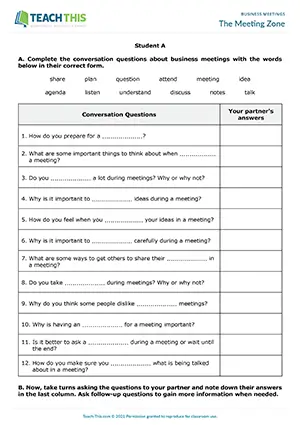
Business English Meetings Activity - Vocabulary and Speaking: Gap-fill, Asking and Answering Questions, Freer Practice - Group and Pair Work
In this engaging talking about meetings activity, students practice useful vocabulary related to meetings by completing conversation questions with...
Beginning a Meeting
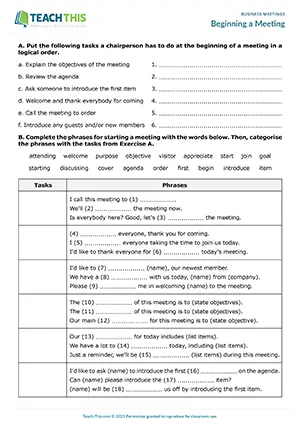
Business English Meetings Worksheet - Reading and Vocabulary Exercises: Gap-fill, Categorising, Error Correction - Speaking Activity: Role-Play
In this free business meetings worksheet, students practice language a chairperson would use for beginning a meeting. First, students put the tasks a...
Setting the Agenda
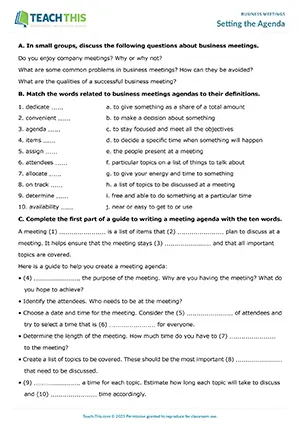
Business English Meeting Agendas Worksheet - Vocabulary and Reading Exercises: Matching, Gap-fill, Form Completion, Ordering
In this comprehensive business meeting agenda worksheet, students learn the basic elements of a typical business meeting agenda. Students begin by...
Who's taking the minutes?
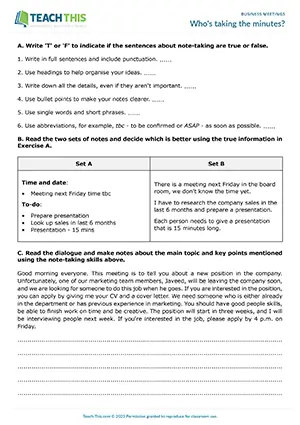
Business English Meeting Minutes Worksheet - Reading and Writing Exercises: True or False, Note-taking - Listening and Speaking Activity: Role-play, Freer Practice
In this productive note-taking worksheet and activity, students practice taking notes in a business meeting context. First, students decide if sentences about note...
Business Meeting Expressions
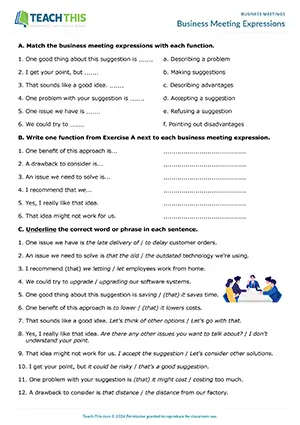
Business English Meetings Worksheet - Vocabulary and Reading Exercises: Binary Choice - Speaking Activity: Role-Play, Communicative Practice - Group Work
In this comprehensive business meetings worksheet, students learn and practice useful expressions for business meetings. First, students match business...
Meeting Dialogues
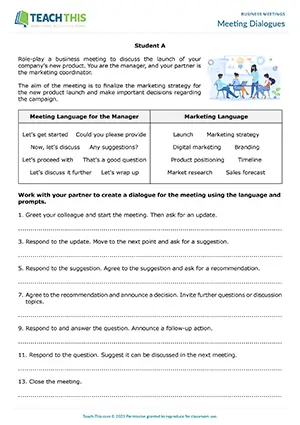
Business English Meetings Activity - Vocabulary and Writing Exercises: Writing a Dialogue - Speaking Activity: Delivering a Dialogue, Freer Practice - Pair Work
In this useful business meetings role-play activity, students practice words and phrases related to meetings and use them in a meeting role-play. First, students...
That's a Great Idea!
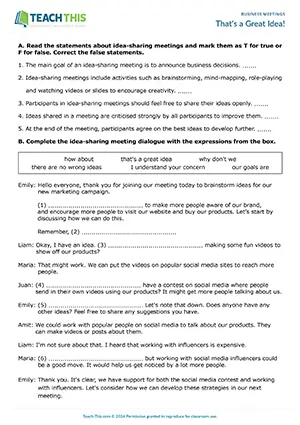
Business English Meetings Worksheet - Reading and Vocabulary Exercises: True or False, Gap-fill - Speaking Activity: Role-play, Freer Practice - Group Work
In this business meetings worksheet, students practice useful expressions for idea-sharing meetings. To begin, students read statements about idea-sharing meetings...
Taking Part in Business Meetings
Taking part in business meetings involves understanding the purpose of a discussion, contributing relevant ideas and checking that information is clear. Students need language for different roles, from asking for clarification as a participant to organising discussion or recording its main points.
This page contains eight resources across A2, B1 and B2, including worksheets, speaking activities and role-plays, with one free worksheet.
The table shows meeting functions with hypothetical workplace examples.
| Meeting function | Purpose | Example language |
|---|---|---|
| State the purpose | Help participants understand what the meeting needs to achieve. | 'The aim today is to agree on the training schedule.' |
| Introduce an agenda item | Direct attention to the next topic. | 'Let's move on to the proposed dates.' |
| Ask for clarification | Check a point that is unclear. | 'Could you explain what you mean by a flexible start date?' |
| Invite a contribution | Give another participant an opportunity to speak. | 'Maya, what do you think about that option?' |
| Offer a suggestion | Introduce an option for the group to consider. | 'We could run the sessions on separate days.' |
| Check an agreed action | Confirm the task, responsibility and timing. | 'So, Alex will send the revised schedule by Friday. Is that correct?' |
How to Communicate in Business Meetings
Match the language to the role: A chairperson may introduce topics and invite contributions, while participants ask questions and offer ideas. Give learners clear roles so they know what they are trying to accomplish with each expression.
Check understanding before moving on: Encourage students to ask about unclear dates, terms or proposals. A short clarification question can establish shared meaning before the group makes a decision or records an action.
Distinguish suggestions from decisions: An idea raised during discussion is not automatically an agreed action. Before summarising or recording an outcome, check what was accepted, who is responsible and whether a deadline was agreed.
3-Step Framework for Teaching Business Meetings
This sequence develops clarification at A2, agenda planning at B1 and participation in a meeting at B2. Use the stages across lessons as appropriate to learners' levels, rather than combining them into one mixed-level lesson.
1. Check Meaning in a Meeting: Students identify clarification expressions in a dialogue, categorise them by function and complete another exchange. They practice the dialogue in groups before using the expressions in a three-person role-play. This gives learners language for resolving uncertainty while a discussion is taking place.
2. Organise the Discussion: Students match agenda vocabulary with definitions, complete a writing guide and add their own ideas to an agenda. They then order example agenda items and assign start times. This connects meeting language with a planned sequence of topics.
3. Contribute and Review the Outcome: Students match meeting expressions to functions, select suitable wording and identify expressions in a model dialogue. They then conduct a three-person meeting role-play and give feedback on its outcome. This brings functional language into an exchange where participants need to respond to one another.
Common Mistakes with Business Meeting Language
Adding about after discuss: Discuss takes a direct object when naming the topic. Incorrect: 'Let's discuss about the schedule.' Correct: 'Let's discuss the schedule' or 'Let's talk about the schedule.'
Recording a proposal as an agreement: Notes should reflect the status of an idea accurately. Inaccurate record: Writing 'The team agreed to move the meeting' when someone only suggested it. Accurate record: 'Moving the meeting was suggested; no decision was made.'
Common Questions About Teaching Business Meetings
What role-play helps students practice business meetings?
The activity Meeting Dialogues starts with a model meeting dialogue that students complete using supplied words and phrases. Pairs then use a scenario, language boxes and prompts to write their own dialogue before performing it to the class. This provides support for students to practice a meeting exchange with a partner.
What free worksheet helps teach starting a meeting?
The worksheet Beginning a Meeting introduces the tasks and language used by a chairperson at the start of a meeting. Students order tasks, complete and categorise phrases, and improve opening comments. They then prepare their own comments from prompts and take turns chairing the opening, putting the language into spoken use.
What worksheet helps teach taking meeting minutes?
The worksheet and activity Who's taking the minutes? helps students evaluate notes before making their own from a meeting dialogue. Partners then take turns speaking from information cards while the listener records notes. Changing partners and summarising the information gives students a practical reason to make their notes clear and usable.
Become a Teach This Member
Get unlimited access to the full library, plus new resources added every week.
Unlimited Resource Access
Download from 3000+ worksheets, activities, and games.
Save 5+ Hours Weekly
Cut lesson prep time with ready-to-use resources, plus teacher notes and answer keys.
Trusted Professional Quality
Classroom-tested, editable resources created by experienced ESL professionals.
Fresh Content Weekly
Get 5 new resources added to the library each week.
Here's what our members are saying...


