
Adverbial Clauses ESL Worksheets, Games & Activities
Adverbial Clause Adventure
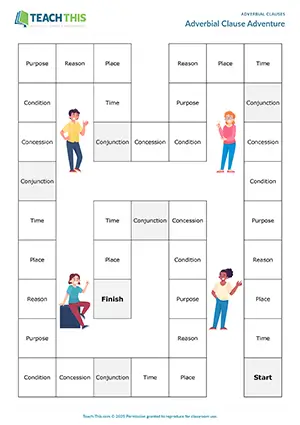
ESL Adverbial Clauses Board Game - Speaking: Forming Sentences, Free Practice - Group Work
In this challenging adverbial clauses board game, students practice forming sentences using various types of adverbial clauses and subordinating conjunctions. In groups, students take turns rolling...
Adverbial Clauses Challenge
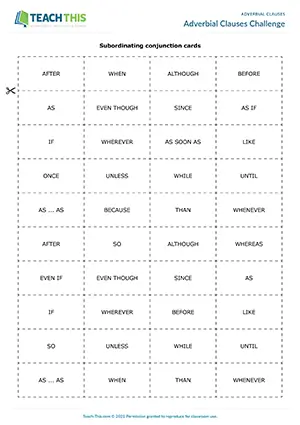
ESL Adverbial Clauses Game - Grammar and Speaking: Forming Sentences, Freer Practice - Group Work
In this free adverbial clauses game, students make sentences containing adverbial clauses with specific subordinating conjunctions and verbs. Students take turns turning over a subordinating conjunction card...
Adverbial Clause or Phrase?
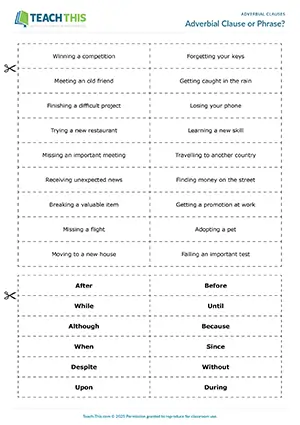
ESL Adverbial Clauses and Phrases Worksheet and Game - Grammar and Writing: Categorising, Rewriting and Forming Sentences - Group Work
Here is a productive adverbial clauses worksheet and game to help students recognize the differences between adverbial clauses and phrases and...
Introduction to Adverbial Clauses
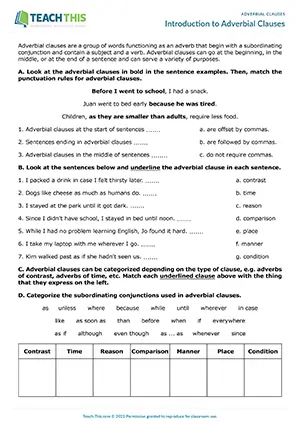
ESL Adverbial Clauses Worksheet - Grammar Exercises: Matching, Identifying, Categorising, Forming Sentences
This comprehensive adverbial clauses worksheet helps students to recognise and practice using adverbial clauses worksheet helps students to recognise and practice using adverbial clauses in...
Adverbial Clauses Practice
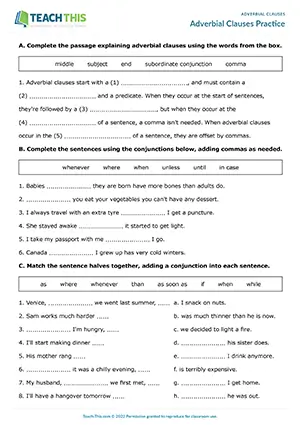
ESL Adverbial Clauses Worksheet - Grammar Exercises: Gap-fill, Matching, Creating Sentences
Here is a useful adverbial clauses worksheet to help students practice a variety of adverbial clauses and their related subordinating conjunctions. First, students complete a text explaining adverbial clauses...
Perfect Match
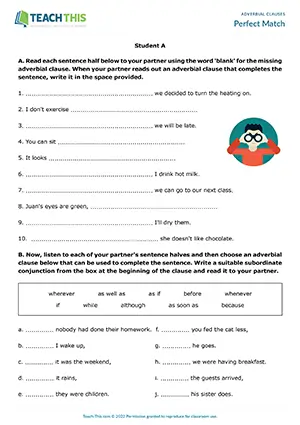
ESL Adverbial Clauses Activity - Grammar and Speaking: Matching, Sentence Completion - Pair Work
In this engaging adverbial clauses activity, students race to match adverbial clauses to sentence halves, adding in a suitable subordinating conjunction for each one. Student A begins by reading...
Understanding Adverbial Clauses
An adverbial clause is a dependent clause that modifies the main clause in a sentence, expressing a relationship such as time, reason, condition, or contrast, and it always begins with a subordinating conjunction like 'after', 'because', 'if', or 'although'. When the clause opens the sentence, it needs a comma, as in 'After I finish my homework, I will watch TV.' Students who use the wrong subordinating conjunction, or who drop the comma when the clause comes first, produce sentences that feel logically broken and harder for any reader to follow.
This page covers adverbial clauses at B1 and B2 levels, with six activities ranging from grammar worksheets and group board games to a pair sentence-matching race, including one activity available as a free download.
The table below maps the main types of adverbial clauses, the subordinating conjunctions that introduce each type, and an example sentence for each one.
| Type | Function | Common Subordinating Conjunctions | Example |
|---|---|---|---|
| Time | Says when an action happens | after, before, when, while, until, as soon as | 'After she finished the report, she sent it to her manager.' |
| Reason / Cause | Explains why an action happens | because, since, as | 'He stayed late because he wanted to finish the project.' |
| Purpose | States the goal or intention of an action | so that, in order that | 'She spoke slowly so that everyone could understand.' |
| Condition | Sets the terms under which something happens | if, unless, provided that | 'Unless you leave now, you will miss the train.' |
| Concession | Acknowledges a fact that works against the main point | although, even though, while, whereas | 'Although it was raining, they continued the match.' |
| Result | Describes the outcome or consequence | so...that, such...that | 'It was so cold that the pipes froze overnight.' |
| Manner | Describes how an action is carried out | as, as if, as though | 'He spoke as though he had never heard the news.' |
When to Use Adverbial Clauses
Setting the Scene Before the Main Point: Writers front an adverbial clause when the background condition or timing needs to register before the main action can make full sense, as in 'Once the contract is signed, we can begin production.'
Signaling Unexpected Contrast: A concession clause tells the reader that the main point holds despite a contrary fact, giving a statement balance and honesty, as in 'Even though the results were disappointing, the team remained committed to the project.'
Stating Conditions in Formal Writing: Conditional adverbial clauses give formal writing its precision by tying outcomes to specific requirements, which is why they appear frequently in policy and business documents, as in 'The warranty is valid provided that the product has been installed by a certified technician.'
3-Step Framework for Teaching Adverbial Clauses
1. Build Recognition Before Production: Start students with a structured worksheet that takes them through adverbial clauses from the ground up, spotting examples in sentences, matching punctuation rules, and categorizing subordinating conjunctions by type. The sequence ends with students completing sentences using their own ideas and discussing them with a partner, which gives them a relaxed first attempt at real production before any competitive pressure enters the room.
2. Raise the Stakes with a Board Game: Move the class into a board game where every landing on a clause square puts a student on the spot for 30 seconds to produce a correct sentence. The penalty rule does the heavy lifting: if a player forms an incorrect sentence or can't think of anything to say, they move back two squares, which keeps every player listening carefully to every sentence, not just their own.
3. Push Structural Flexibility with Conversion Work: Once students can produce adverbial clauses confidently, push them to move between clauses and their equivalent phrases, which demands real grammatical understanding rather than pattern recall. In the game stage, a player who forms a correct sentence scores one point, then immediately tries to convert it to the opposite structure, clause to phrase or phrase to clause, for an extra point. That second move is where real accuracy gets tested.
Common Mistakes with Adverbial Clauses
Sentence Fragment from a Standalone Adverbial Clause: Students often write the adverbial clause as a separate sentence, cutting it off from the main clause with a full stop instead of connecting it with a comma. Wrong: 'Although she studied hard. She failed the exam.' Correct: 'Although she studied hard, she failed the exam.'
Confusing 'Despite' with 'Although': Students often use 'despite' to introduce a full clause because both words express concession, but 'despite' must be followed by a noun or noun phrase, not a subject-plus-verb construction. Wrong: 'Despite she was tired, she continued working.' Correct: 'Although she was tired, she continued working.'
Common Questions About Teaching Adverbial Clauses
What is a good game for practicing adverbial clauses with intermediate students?
At B1 level, card-based games give students immediate speaking practice with real grammatical stakes. In the game Adverbial Clauses Challenge, available free, students flip a conjunction card and a verb card and build a sentence on the spot, for example 'After Tom ate lunch, he went to the gym.' A variation awards a bonus point for naming the clause type.
What is a useful adverbial clauses worksheet?
The worksheet Adverbial Clauses Practice takes students through a structured sequence of gap-fill, matching, and sentence-ordering tasks before finishing with a writing exercise where students describe the function of each clause type and list subordinators that work with it, pushing them to connect meaning and form rather than just complete fill-in-the-blank drills.
What is an engaging speaking activity for practicing adverbial clauses?
For adverbial clause speaking practice, a sentence-matching race gets students listening and producing at the same time. In the activity Perfect Match, Student A reads each sentence half using the word 'blank' for the missing clause, while Student B finds a matching adverbial clause and adds an appropriate subordinating conjunction. The first pair to finish wins.
Become a Teach This Member
Get unlimited access to the full library, plus new resources added every week.
Unlimited Resource Access
Download from 3000+ worksheets, activities, and games.
Save 5+ Hours Weekly
Cut lesson prep time with ready-to-use resources, plus teacher notes and answer keys.
Trusted Professional Quality
Classroom-tested, editable resources created by experienced ESL professionals.
Fresh Content Weekly
Get 5 new resources added to the library each week.
Here's what our members are saying...


