
Talking About Companies Worksheets & Games
Company Department Bingo

Business English Company Departments Game - Vocabulary: Bingo, Matching - Group Work
In this fun company departments game, students play bingo by matching company departments with descriptions of their functions. In groups, the bingo caller begins by reading a sentence...
Comparing Companies
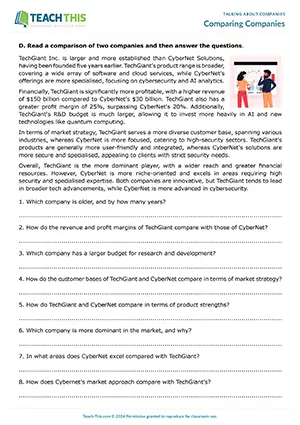
Business English Comparing Companies Worksheet - Vocabulary and Reading Exercises: Gap-fill - Speaking Activity: Discussion, Freer Practice - Pair Work
In this useful talking about companies worksheet, students practice making direct and general comparisons of companies using a variety of comparative and...
Company Knowledge Exchange
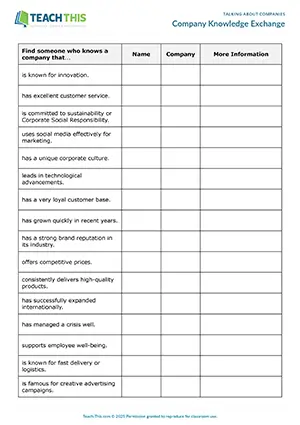
Business English Talking About Companies Activity - Speaking: Asking and Answering Questions, Controlled and Freer Practice
In this 'Find Someone Who' activity about companies, students ask and answer questions about company characteristics and business practices. Students begin by reviewing the yes/no questions...
Company Types
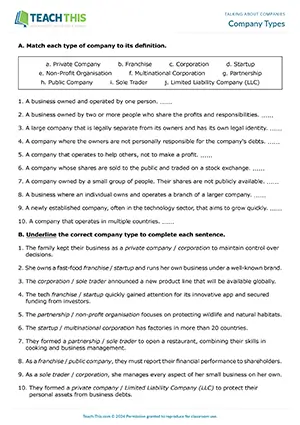
Business English Company Types Worksheet - Vocabulary, Reading and Writing Exercises: Matching, Binary Choice, Ordering, Writing a Description
In this informative company types worksheet, students learn the names of different types of companies and practice giving a company description. First, students...
Corporate Quest
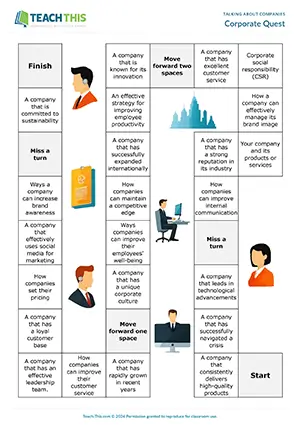
Business English Talking About Companies Board Game - Vocabulary and Speaking: Impromptu Speech, Communicative Practice - Group Work
In this free talking about companies board game, students practice talking about companies, business scenarios, traits and strategies. Players take turns...
Talking About Companies
Talking about companies involves explaining what a business does, describing its departments and characteristics, and comparing it with other organisations. Students need language for asking relevant questions, giving clear descriptions and supporting comparisons with specific information.
This page contains five resources across B1 and B2, including worksheets, games and a speaking activity, with one free board game. They cover department functions, company types, comparisons and discussion of company characteristics and business practices.
The table gives example language for describing and discussing companies. The examples illustrate sentence patterns rather than facts about named businesses.
| Communication function | Purpose | Example language |
|---|---|---|
| Describe the business | Explain its main products or services. | 'The company produces packaging for food manufacturers.' |
| Describe its location | Say where it is based or operates. | 'Its head office is in Bangkok, and it operates in three countries.' |
| Explain a department's function | Describe what part of the organisation does. | 'The customer service department handles enquiries and complaints.' |
| Compare companies | Identify a difference using a clear basis. | 'Company A has more branches than Company B.' |
| Ask for supporting detail | Find out what a general description refers to. | 'You said the company is innovative. Can you give an example?' |
| Explain a preference | Connect an opinion with a reason. | 'I would choose Company B because its delivery times suit our schedule.' |
How to Describe and Compare Companies
Move from an overview to relevant details: Start with what the company does, then add information that serves the conversation, such as its location, departments or products. Explain a department's function instead of assuming the listener knows what its name means in that organisation.
Make the basis of a comparison clear: Specify whether you are comparing size, prices, products or another feature. Use comparative and superlative forms accurately, and distinguish a supported difference from a personal preference or a claim you have not checked.
Develop the exchange with follow-up questions: Ask for an example or explanation when someone describes a company in broad terms. Listen to the answer and use it to extend the discussion, giving learners a reason to move beyond company names and short yes/no responses.
3-Step Framework for Talking About Companies
The first stage introduces department functions at B1. The later B2 stages connect company types with a written and spoken description. Use the stages across lessons according to learners' levels; the final two stages draw on different parts of the same worksheet.
1. Recognise Department Functions: A caller reads descriptions of what departments do while players identify and cross off matching names on bingo cards. Players first aim for four in a row, then a full card, with the caller checking a claimed win. This connects organisational vocabulary with meaning before learners build broader descriptions.
2. Organise a Company Description: Students match company types to definitions, choose appropriate types in sentences and order sections of a model description. This moves from identifying vocabulary to seeing how information fits together in a text, preparing learners to organise a description of their own.
3. Describe a Company for a Listener: Students use the model to write about the company they work for, then read their descriptions aloud with the company type replaced by 'blank' for classmates to guess. This gives listeners a reason to attend to the details. As a teacher adaptation for learners without employment experience, provide a fictional company profile to describe.
Common Mistakes with Language for Talking About Companies
Using more with an -er comparative: Use one comparative form when comparing company size. Incorrect: 'Company A is more larger than Company B.' Correct: 'Company A is larger than Company B.'
Omitting in after specialise: Use specialise in when naming a company's area of work. Incorrect: 'The company specialises software development.' Correct: 'The company specialises in software development.'
Common Questions About Teaching Company Language
What worksheet helps teach company comparisons?
The worksheet Comparing Companies develops comparative and superlative language through sentence exercises and a model text. Students then ask questions about three companies and their products, record answers and explain which company they would buy from. This connects accurate comparison forms with using information to express and support a preference.
What game helps practice talking about companies?
The free board game Corporate Quest gives students company-related topics to discuss for 30 seconds. Players move around the board and speak about the topic they land on, moving back two squares if they stop early. The timed turns provide practice sustaining a response about business scenarios, characteristics and strategies.
How can students practice asking about companies?
The activity Company Knowledge Exchange uses a class survey about company characteristics and business practices. Students ask yes/no questions, record a classmate's name and a company after a positive answer, then ask for further detail. Sharing their findings with the class gives the follow-up questions a purpose beyond collecting names.
Become a Teach This Member
Get unlimited access to the full library, plus new resources added every week.
Unlimited Resource Access
Download from 3000+ worksheets, activities, and games.
Save 5+ Hours Weekly
Cut lesson prep time with ready-to-use resources, plus teacher notes and answer keys.
Trusted Professional Quality
Classroom-tested, editable resources created by experienced ESL professionals.
Fresh Content Weekly
Get 5 new resources added to the library each week.
Here's what our members are saying...


