
Present Perfect Just, Yet & Already ESL Activities, Games & Worksheets
Have just and Haven't yet
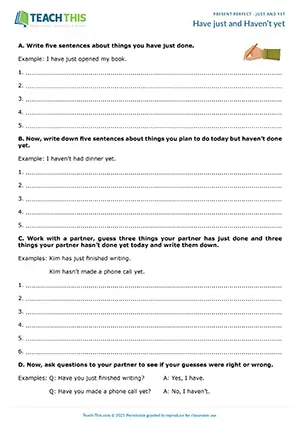
ESL Just and Yet Activity - Grammar, Writing and Speaking: Writing Sentences, Guessing, Asking and Answering Questions - Pair Work
This productive present perfect just and yet activity helps students practice making sentences and questions with just and yet. Students start by writing down five sentences about things they have just...
Introduction to Just, Yet and Already
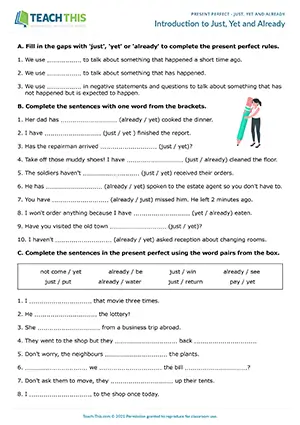
ESL Just, Yet and Already Worksheet - Grammar Exercises: Gap-fill, Sentence Completion, Writing Sentences
This free present perfect worksheet helps students learn and practice the present perfect with just, yet and already. First, students complete present perfect usage rules with just, yet and already...
Just, Yet and Already Practice
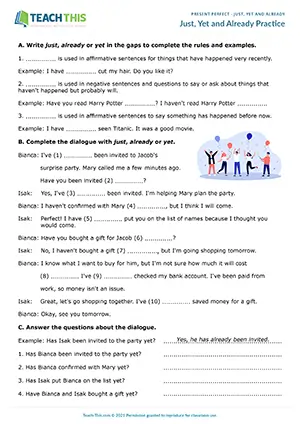
ESL Just, Yet and Already Worksheet - Grammar and Reading Exercises: Gap-fill, Short Answer Questions, Binary Choice, Writing Sentences
In this useful present perfect worksheet, students learn and practice how to use just, already and yet. Students begin by writing just, already or yet in gaps...
Prompts and Pictures
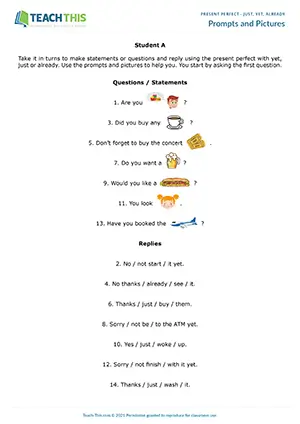
ESL Just, Yet and Already Activity - Grammar and Speaking: Forming Statements, Questions and Responses, Controlled Practice - Pair Work
In this imaginative just, yet and already speaking activity, students make questions and statements and reply using yet, just, and already. In pairs, students...
The Just, Yet, Already Experience
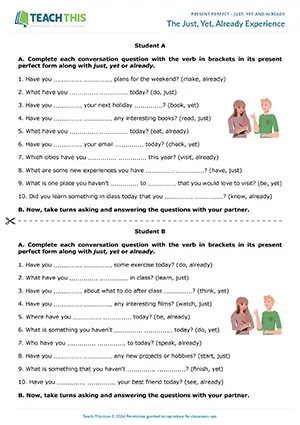
ESL Just, Yet and Already Activity - Grammar and Speaking: Forming, Asking and Answering Questions - Group and Pair Work
This insightful just, yet and already speaking activity helps students practice forming, asking and answering present perfect conversation questions with just, yet and already. First, in two groups...
Tell me about your day
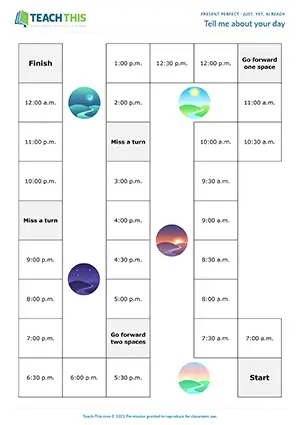
ESL Just, Yet and Already Board Game - Grammar and Speaking: Forming Sentences, Freer Practice - Group Work
In this fun just, yet and already board game, students make present perfect sentences about what they have normally just done, what they haven't done yet, and what they have already done at certain...
The Bucket List
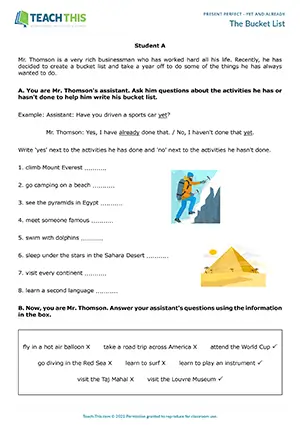
ESL Yet and Already Activity - Speaking: Asking and Answering Questions - Pair Work
In this free present perfect yet and already activity, students ask and answer questions about someone's bucket list using yet and already. In pairs, one student takes on the role of Mr. Thomson's assistant and the other plays the role of Mr. Thomson...
What has just happened?
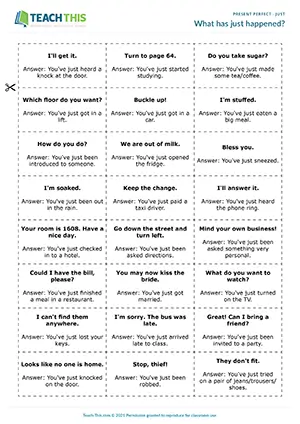
ESL Present Perfect with Just Game - Grammar and Speaking: Guessing, Forming Sentences, Freer Practice - Group Work
In this engaging present perfect with just game, students listen to common everyday expressions and guess what has just happened. In groups, students take turns picking up a card and...
Understanding the Present Perfect with Just, Yet and Already
The present perfect with just, yet and already uses three small words to place a recent action in time: 'just' means moments ago ('She's just left'), 'yet' appears in questions and negatives to ask about or deny completion ('Has she left yet?'), and 'already' signals the action happened sooner than expected ('He's already left'). When students mix up these three words, they change the sentence's meaning entirely, so 'I've already called' and 'I've just called' tell the listener two different things about when the call happened.
This page covers present perfect with just, yet and already across A2 and B1 levels, with eight resources including pair activities, speaking games, a board game, and worksheets, including two free downloads.
This table shows how just, yet and already each function differently in present perfect sentences.
| Adverb | Typical Meaning | Position in Sentence | Used In | Example |
|---|---|---|---|---|
| just | action completed very recently | between have/has and the past participle | affirmative sentences | 'She has just sent the email.' |
| yet | completion not confirmed or denied | end of sentence | negatives and questions | 'He hasn't replied yet.' / 'Have you called yet?' |
| already | action completed sooner than expected | between have/has and the past participle, or end of sentence | affirmative sentences and emphatic questions | 'They have already left.' / 'Have you already eaten?' |
When to Use the Present Perfect with Just, Yet and Already
Announcing Very Recent News: Speakers choose 'just' with the present perfect when they want to share something the listener doesn't yet know, giving the news a sense of immediacy, as in 'I've just heard we got the contract.'
Expressing Surprise at Speed: 'Already' fits naturally when the speaker wants to signal that something happened faster than expected, adding a tone of surprise without needing extra words, as in 'You've already finished? That was quick.'
Checking on Progress Politely: 'Yet' in a question lets a speaker check whether something has been done without sounding demanding or impatient, making it a natural fit for workplace and household exchanges, as in 'Have you sent that report yet?'
3-Step Framework for Teaching the Present Perfect with Just, Yet and Already
1. Lock in the Rules First: Start with the rules before any production. Give students a worksheet where they first complete the usage rules for just, yet and already themselves, filling in the blanks to cement each adverb's role, then immediately apply those rules by rewriting sentences to place 'already' or 'yet' in exactly the right position. Working out the rule and then testing it in the same sitting locks the distinctions in far more effectively than copying notes from a board.
2. Move into Controlled Speaking: Once students can write the forms accurately, move them straight into speaking. A picture-prompt pair activity works well here: one student generates questions or statements from picture cues on their worksheet, their partner picks up the correct adverb from word prompts on their own sheet and responds, and they alternate roles throughout. The built-in prompt structure keeps the grammar accurate while the back-and-forth keeps students engaged.
3. Push for Personal Production: Finish with a board game that pushes students into fully personal production. When a player lands on a time square, they must produce three present perfect sentences covering all three adverbs for that time of day, for instance: 'At 8 a.m., I have just had breakfast. I haven't gone to school yet. I have already had a shower.' Any grammar mistake or a sentence that doesn't make sense for that time sends the player back a square, so accuracy matters right to the finish line.
Common Mistakes with the Present Perfect with Just, Yet and Already
Using 'yet' in Affirmative Sentences: Students often use 'yet' in a positive statement where 'already' is needed, treating the two words as interchangeable. Wrong: 'I have finished my homework yet.' Correct: 'I have already finished my homework.'
Placing 'just' at the End of the Sentence: Students often put 'just' at the end of a present perfect sentence, which may reflect word order from their first language. Wrong: 'She has called just.' Correct: 'She has just called.'
Common Questions About Teaching the Present Perfect with Just, Yet and Already
What is a fun game for practicing just, yet and already?
The game What has just happened? gives students a fun way to practice 'just' in the present perfect. Players take turns reading a bold everyday expression aloud, such as 'I'll get it,' and the rest race to call out the correct present perfect sentence, for example 'You've just heard a knock at the door.' The student with the most cards wins.
What worksheet can I use to practice just, yet and already?
The worksheet Just, Yet and Already Practice works well because it mixes grammar and reading in one activity. Students complete a dialogue using all three adverbs, then answer present perfect comprehension questions about it. Later tasks move into binary choice and sentence writing, giving students repeated contact with the forms across different exercise types.
How can I get students to use yet and already in a speaking activity?
The activity The Bucket List gives students a clear communicative role that makes yet and already feel natural. One student acts as Mr. Thomson's assistant, asking present perfect yes/no questions with 'yet,' while their partner replies with 'already' for affirmative answers and 'yet' for negative answers. It is also a free download.
Become a Teach This Member
Get unlimited access to the full library, plus new resources added every week.
Unlimited Resource Access
Download from 3000+ worksheets, activities, and games.
Save 5+ Hours Weekly
Cut lesson prep time with ready-to-use resources, plus teacher notes and answer keys.
Trusted Professional Quality
Classroom-tested, editable resources created by experienced ESL professionals.
Fresh Content Weekly
Get 5 new resources added to the library each week.
Here's what our members are saying...


