
Modal Verbs of Ability ESL Activities, Games & Worksheets
Ability Bingo
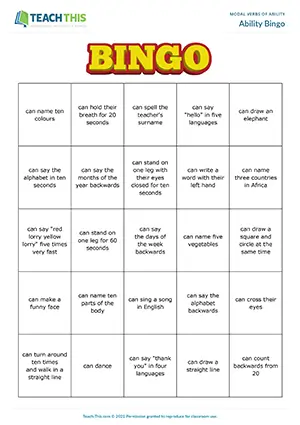
ESL Can You Game - Speaking: Asking and Answering Questions
In this free 'Can you...?' bingo game, students ask 'Can you...?' questions and demonstrate simple challenges as they race to complete a row on a bingo card. First, students go around the classroom asking 'Can you...?' questions to find classmates with the...
Can or Can't?
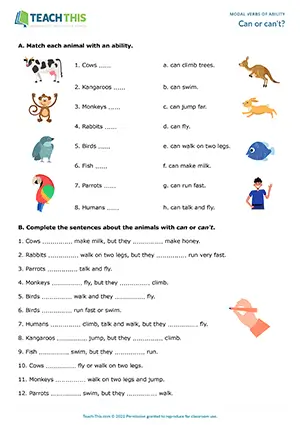
ESL Can and Can't Worksheet - Grammar Exercises: Gap-fill, Ordering, Sentence Completion - Speaking Activity: Asking and Answering Questions - Pair Work
In this useful can and can't worksheet, students discover what they and others can do as they practice describing abilities and asking and answering questions...
Can you or can't you?
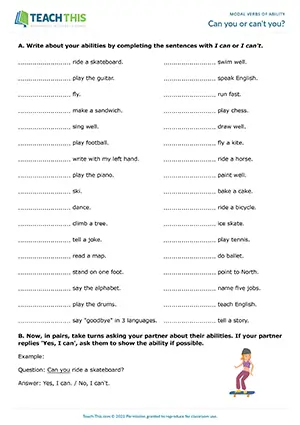
ESL Can and Can't Worksheet - Vocabulary and Speaking: Sentence Completion, Asking and Answering Questions - Pair Work
In this productive can and can't speaking activity, students discover what they have in common by asking questions and finding abilities they share. First, students complete sentences about their own...
Can you...?
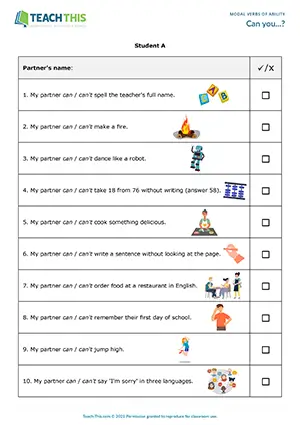
ESL Can and Can't Game - Speaking: Guessing, Asking and Answering Questions - Pair Work
In this fun can and can't guessing game, students predict their partner's abilities and put their guesses to the test with quick challenges. First, students guess their partner's abilities and circle...
Prove It!
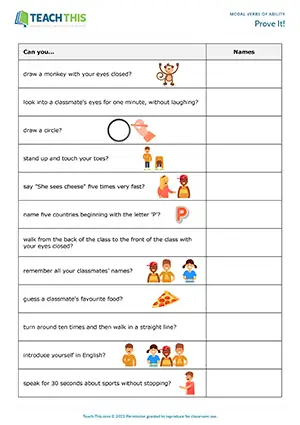
ESL Can and Can't Activity - Speaking: Asking and Answering Questions
In this engaging can and can't speaking activity, students discover their classmates' abilities as they race to complete their worksheet with different names. First, students move around the classroom and ask 'Can you...?' questions...
Can and Could
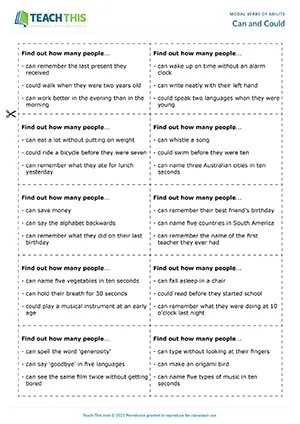
ESL Past and Present Abilities Activity - Speaking: Survey, Asking and Answering Questions, Freer Practice - Group Work
In this free can and could speaking activity, students find out about their classmates' past and present abilities. Students go around their group finding out about their classmates' past and present abilities...
Crazy Abilities
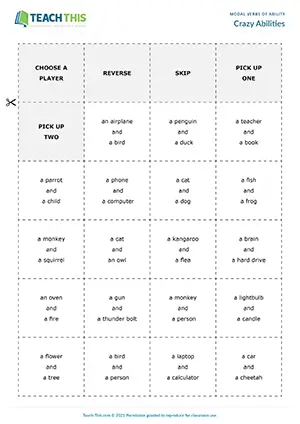
ESL Modal Verbs of Ability Game - Vocabulary and Speaking: Asking and Answering Questions, Freer Practice - Group Work
This engaging modal verbs of ability game is based on the card game Crazy Eights. In the game, students say what ability or skill two things have in common using...
Fibber
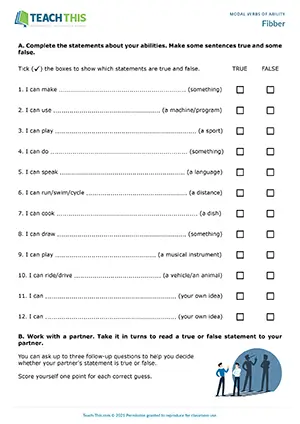
ESL Modal Verbs of Ability Game - Grammar: Sentence Completion, True or False, Asking Questions, Guessing, Controlled and Freer Practice - Pair Work
In this humorous can and can't activity, students play a true or false guessing game about their abilities. First, students complete statements on their worksheet...
Fun Ability Test
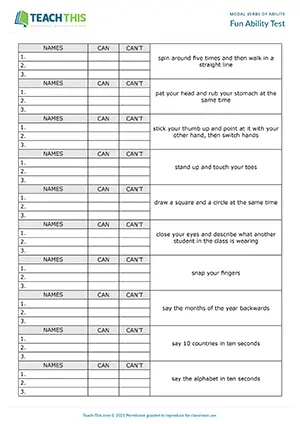
ESL Can and Can't Activity - Grammar: Table Completion, Writing Summaries - Group Work
Here is an entertaining can and can't activity in which students try to complete various challenges and fill in a chart to show what members of their group can and can't do. In groups of three, students...
How well can you…?
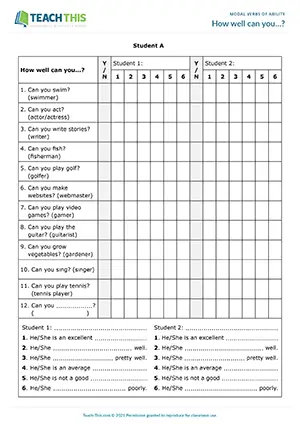
ESL Modal Verbs of Ability Activity - Speaking: Asking and Answering Questions, Sentence Completion - Pair Work
In this insightful can and can't speaking activity, students practice talking about skills and levels of ability using modal verbs and adverbs of manner. In pairs, students take it in turns to ask their partner...
Past and Present Abilities
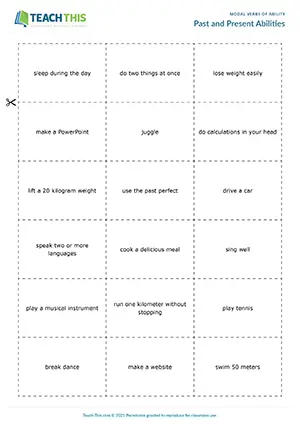
ESL Can and Could Game - Vocabulary and Speaking: Asking and Answering Questions, Freer Practice - Group Work
In this enjoyable can and could speaking activity, students play a true or false guessing game about past and present abilities. In groups, students take it in turns to pick up a card and use the prompt on...
The Leftorium
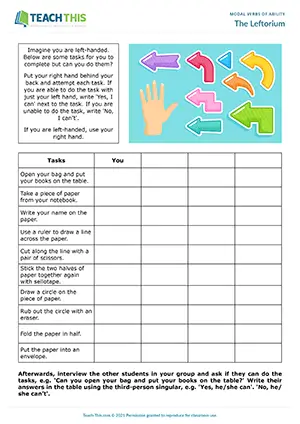
ESL Can and Can't Activity - Speaking: Asking and Answering Questions, Controlled Practice - Group Work
In this interesting modal verbs of ability speaking activity, students try completing certain tasks with their left hand. Students then ask and answer questions about their left-handed abilities using...
What could they do?
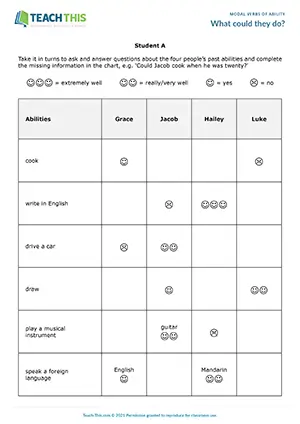
ESL Could and Couldn't Activity - Speaking: Information Gap, Asking and Answering Questions, Controlled Practice - Pair Work
In this rewarding could and couldn't speaking activity, students ask and answer questions about four people's past abilities using could, couldn't and adverbs of degree. Each student looks at information in a...
Ability Bluff
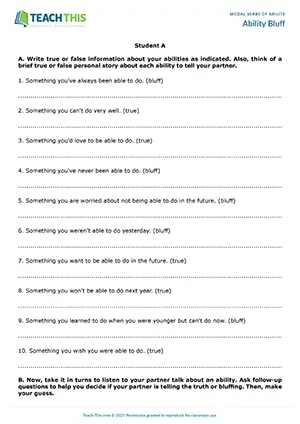
ESL Be Able to Game - Speaking: Writing True or False Sentences, Story Telling, Asking Questions, Guessing - Group and Pair Work
In this free be able to game, students practice modal verbs of ability and expressions with 'be able to'. In two groups, students complete true and false information about...
What's missing?
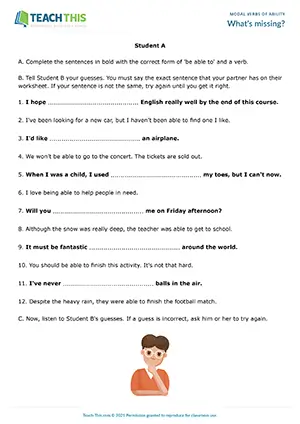
ESL Be Able to Activity - Vocabulary: Gap-fill, Discussion - Pair Work
In this memorable be able to activity, students complete sentences with the correct form of 'be able to' and a verb. One student begins by reading the first sentence to their partner, adding in the appropriate form of be able to and verb. The student...
When could you first do this?
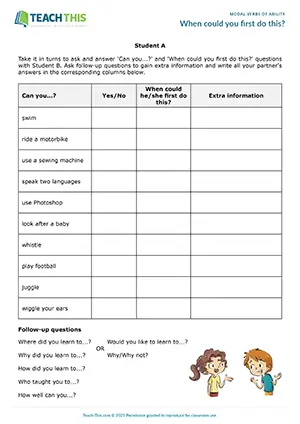
ESL Can and Could Activity - Speaking: Asking and Answering Questions, Controlled and Freer Practice - Pair Work
In this compelling can and could speaking activity, students ask and answer questions about present and past abilities. In pairs, students take it in turns to ask their partner a 'Can you...?' question from...
Understanding Modal Verbs of Ability
Modal verbs of ability are words like 'can', 'can't', 'could', and 'couldn't' that speakers use to say what someone is or was able to do. Students who mix up 'can' and 'could' risk sounding like they are talking about the past when they mean the present, which confuses the listener right away.
This page covers modal verbs of ability from elementary (A1-A2) to intermediate (B1), with 16 resources comprising speaking activities, games and worksheets, including three free downloads.
The table below maps the key modal verb forms used to express ability in English across present, past, and future time.
| Modal / Form | Time Reference | Affirmative Structure | Negative Structure | Question Structure | Example |
|---|---|---|---|---|---|
| can | present ability | subject + can + base verb | subject + can't + base verb | Can + subject + base verb? | 'She can speak Spanish.' |
| could | past ability (general) | subject + could + base verb | subject + couldn't + base verb | Could + subject + base verb? | 'He could read at age four.' |
| be able to | present ability (formal/alternative) | subject + am/is/are + able to + base verb | subject + am/is/are + not able to + base verb | Am/Is/Are + subject + able to + base verb? | 'They are able to work independently.' |
| was/were able to | past ability (general or specific event) | subject + was/were + able to + base verb | subject + wasn't/weren't + able to + base verb | Was/Were + subject + able to + base verb? | 'She was able to finish the report on time.' |
| will be able to | future ability | subject + will be able to + base verb | subject + won't be able to + base verb | Will + subject + be able to + base verb? | 'He will be able to join the team next month.' |
| has/have been able to | present perfect ability | subject + has/have + been able to + base verb | subject + hasn't/haven't + been able to + base verb | Has/Have + subject + been able to + base verb? | 'I have been able to drive since I was eighteen.' |
When to Use Modal Verbs of Ability
Stating a current practical skill: A speaker chooses 'can' when they want to state a skill quickly and directly in conversation without drawing attention to how or when they learned it, as in 'I can drive a forklift' during a job interview where practical competencies are being listed.
Anchoring a skill to a past period of life: A writer uses 'could' to place an ability clearly in the past, signaling that the skill belonged to an earlier version of themselves and may no longer apply, as in 'I could run a mile in under six minutes when I was at school.'
Committing to a future capability: A speaker chooses 'will be able to' when they want to make a forward-looking promise or prediction about gaining a skill at a specific point, as in 'After the training program, I will be able to manage the software without assistance.'
3-Step Framework for Teaching Modal Verbs of Ability
1. Build the Foundation with Forms and Questions: Start with controlled practice using 'can' and 'can't' to describe abilities. Students complete sentences about animals, use a chart to answer questions about Mia and Leo, and put words in order to form questions. They then ask and answer questions with a partner, preparing them to discuss abilities more freely.
2. Push into Freer Speaking with a Group Card Game: Once students control the forms, move to a card game where students say what ability or skill two things have in common using 'can'. A player lays a card, poses a question to the next player such as 'What can a penguin and a duck do?', and that player must give an acceptable answer before laying down their own card. This mechanic pushes students to search actively for shared abilities, which generates a high volume of natural 'can' production under mild competitive pressure.
3. Extend to 'Be Able To' with a Bluffing Game: Round off the sequence at Intermediate level by introducing 'be able to' through a bluffing game. Students write true and false statements about their own abilities and prepare a brief personal story about each one to tell a partner. Their partner listens, asks follow-up questions, and tries to decide if the student is telling the truth or bluffing. This format pushes students to use 'be able to' in extended, spontaneous speech.
Common Mistakes with Modal Verbs of Ability
Using 'could' for a single completed past event: Students often use 'could' to describe one specific successful action in the past, when English requires 'was/were able to' for a particular completed event rather than a general past ability. Wrong: 'The firefighters could rescue everyone from the building.' Correct: 'The firefighters were able to rescue everyone from the building.'
Adding 'to' directly after 'can' or 'could': Students often insert 'to' after 'can' or 'could' by analogy with phrases like 'want to' or 'need to', treating these modal verbs as if they follow the same pattern as other common verb structures. Wrong: 'She can to speak three languages.' Correct: 'She can speak three languages.'
Common Questions About Teaching Modal Verbs of Ability
What is a fun game for practicing 'can' and 'can't'?
The game Ability Bingo gets students moving around the classroom asking 'Can you...?' questions. When a classmate says 'Yes, I can', they must demonstrate the ability before their name goes in the square. The first student to get five names in a row wins. Available as a free download.
How can I get students practicing past abilities with 'could' and 'couldn't'?
In the activity What could they do?, each student gets a chart showing what four people could do and how well when they were twenty. Partners take turns asking and answering questions to complete the missing information, then write a paragraph about their own past abilities at a chosen age.
What is an effective speaking activity for practicing modal verbs of ability?
Moving students past 'Yes, I can' requires activities that demand graded responses. The activity How well can you…? does this by asking students to rate their level of ability using adverbs, then form new pairs and report on their partner's abilities using the third person.
Become a Teach This Member
Get unlimited access to the full library, plus new resources added every week.
Unlimited Resource Access
Download from 3000+ worksheets, activities, and games.
Save 5+ Hours Weekly
Cut lesson prep time with ready-to-use resources, plus teacher notes and answer keys.
Trusted Professional Quality
Classroom-tested, editable resources created by experienced ESL professionals.
Fresh Content Weekly
Get 5 new resources added to the library each week.
Here's what our members are saying...


