
Reading Skills EAP Worksheets & Games
Essential Reading Skills
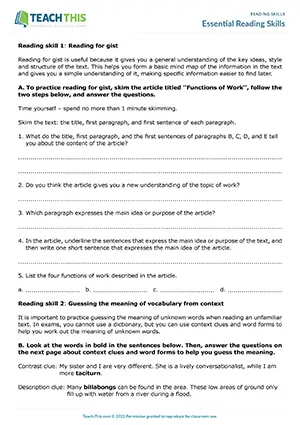
EAP Reading Skills Worksheet - Reading Exercises: Skimming, Guessing Vocabulary from Context, Scanning, Reading for Detail
In this informative reading skills worksheet, students learn and practice useful reading skills that include reading for gist, inferring meaning from context, understanding text organisation, and reading for...
Gist and Specific Information Challenge
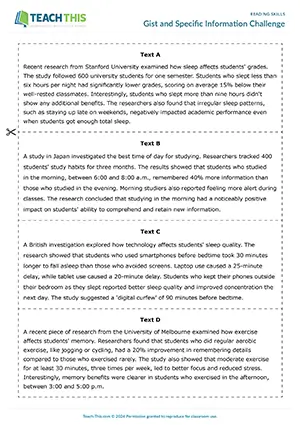
EAP Reading Skills Game - Reading: Reading for Gist and Specific Detail, Answering Comprehension Questions
Here is a fun academic reading skills game to help students practice reading for gist and specific information. First, teams discuss the difference between reading for gist and reading for specific info...
KWL Chart
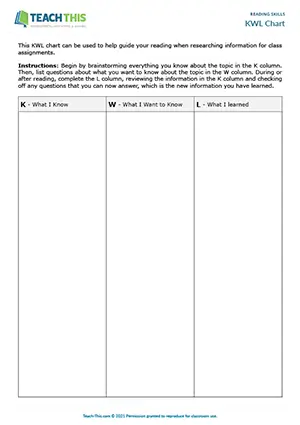
EAP Reading Skills Worksheet - Reading Activity: Brainstorming, Listing, Table Completion
In this useful reading skills activity, students become familiar with KWL, an acronym for Know, Want-to-know, and Learned. It is an effective way to help students read with purpose. KWL is easy to use...
Paragraph Prediction
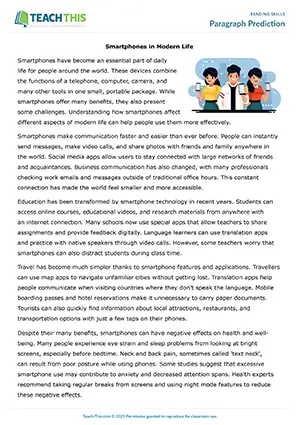
EAP Reading Skills Game - Reading and Writing: Making Predictions, Summary Writing - Pair Work
Here is a dynamic reading skills game to develop students' ability to predict content, which aids reading comprehension by activating prior knowledge and connecting what students already know...
Using Context Clues
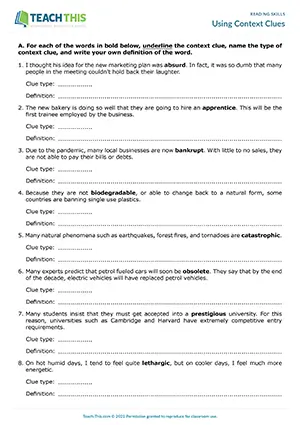
EAP Context Clues Worksheet - Reading and Writing Exercises: Identifying, Labelling, Writing Sentences
In this free context clues worksheet, students learn and practice how to use five common context clues to infer the meaning of unfamiliar words. To begin, students read an introduction that explains...
Academic Reader's Race
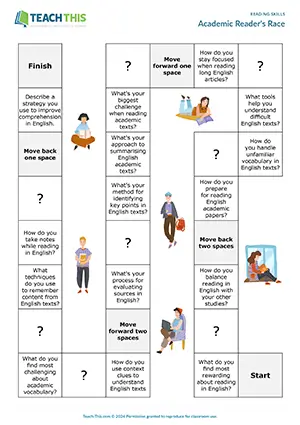
EAP Reading Skills Game - Vocabulary and Speaking: Impromptu Speech, Multiple-Choice Questions, Communicative Practice - Group Work
This engaging reading skills board game helps students review and reinforce their knowledge of skills and strategies that are critical for successful academic reading...
Academic Reading Strategies
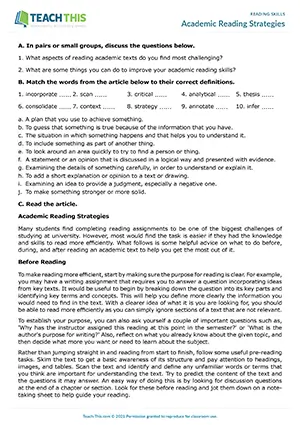
EAP Reading Skills Worksheet - Reading and Writing Exercises: Matching, True or False Questions, Short Answer Questions, Writing a Summary
This handy academic reading strategies worksheet helps to introduce strategies that help students become more effective readers. As a lead-in, students discuss...
Critical Reading Questionnaire
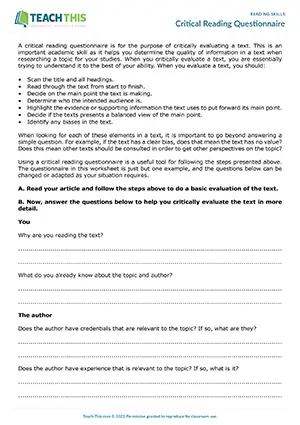
EAP Reading Skills Worksheet - Reading Exercise: Short Answer Questions
This comprehensive critical reading worksheet helps students become familiar with the steps required to critically evaluate a text for use in their studies by answering questions that help determine the appropriateness and...
Understanding Academic Reading Skills
Academic reading skills help students select an approach that suits their purpose, from gaining an overview to examining details and evaluating a source. Effective readers check their interpretations against the text and adjust their approach when the task requires closer attention.
This page contains eight resources across B1 and B2, including worksheets and games on gist, specific information, prediction, context clues, reading strategies and critical evaluation. One worksheet is available as a free download.
The table connects reading approaches with the decisions students make before, during and after reading.
| Approach | Purpose | Useful check |
|---|---|---|
| Preview and predict | Form an initial expectation from the title and selected sentences | 'What do I expect, and what will I need to confirm?' |
| Read for gist | Identify the text's broad focus | 'How would I describe the main message in one sentence?' |
| Scan for information | Locate a relevant detail or passage | 'Which part is likely to answer my question?' |
| Read closely | Check precise meaning and relationships | 'What qualification or connection would a quick reading miss?' |
| Use context clues | Work out a likely meaning for an unfamiliar word | 'Which nearby words support this meaning?' |
| Read critically | Assess a text's relevance and usefulness for a purpose | 'What makes this source suitable for my research question?' |
How to Develop Academic Reading Skills
Make the purpose explicit: Before reading, ask students to identify what they need from the text. Looking for one detail, understanding an argument and deciding whether to use a source require different amounts and kinds of attention.
Treat initial interpretations as provisional: Predictions and guesses can guide reading, but students should revise them when the full text provides different information. Encourage them to explain what changed their understanding.
Connect sentences as well as words: When meaning is unclear, trace pronoun references and sentence connectors. Understanding what a word means is only part of comprehension; students also need to see which ideas are being linked, contrasted or developed.
3-Step Framework for Teaching Academic Reading Skills
Use this sequence across B1 lessons to move from initial expectations to supported understanding and purposeful timed practice.
1. Predict, then check against the text: Pairs read a title, introduction and the first sentence of each paragraph, then write short predictions of what follows. They exchange predictions, read the full text and compare it with those expectations. Ask them to distinguish a plausible prediction from information the text actually confirms.
2. Examine how meaning is constructed: Students practice gist reading, use contextual and grammatical clues to interpret vocabulary, and trace reference words and connectors. They finish with detailed comprehension questions. Use these tasks to explain why an initial interpretation fits or needs revision, rather than relying on the overall impression alone.
3. Switch approaches to suit the task: Teams first read a short text for gist and identify key terms related to its focus. They then receive a longer period to answer detailed questions, earning points for accurate answers. Afterward, discuss which questions required a quick overview and which required locating and checking a specific passage.
Common Mistakes with Academic Reading Skills
Treating a prediction as a finding: A title can suggest a topic without establishing the author's position. Unsupported conclusion: 'The title mentions online learning, so the author must support it.' Better approach: 'The text concerns online learning; I need to read further to establish the author's position.'
Assigning a reference word to the nearest noun automatically: Check the meaning of the surrounding sentences rather than relying only on distance. In the example 'The students interviewed the researchers after they had published their findings', the pronoun is ambiguous without more context. Unjustified certainty: 'They definitely refers to the researchers because that noun is nearest.' Better approach: Check the wider passage for who published the findings and acknowledge uncertainty if it remains unresolved.
Common Questions About Teaching Academic Reading Skills
What free worksheet helps teach context clues?
The worksheet Using Context Clues introduces five clue types with example sentences. Students then infer the meanings of unfamiliar words, underline the surrounding clues, identify each clue type and write definitions in their own words. Requiring both a meaning and its supporting clue helps students explain how they reached their interpretation.
What worksheet helps students read with a purpose?
The worksheet KWL Chart asks students to record what they know, what they want to find out and what they learn from reading. Afterwards, they revisit their initial ideas and questions. Comparing the columns helps students identify misconceptions, check which questions the text answered and recognise what they still need to investigate.
How can I teach students to evaluate reading sources?
The worksheet Critical Reading Questionnaire guides students through evaluating three teacher-selected articles on the same topic, with different levels of quality and relevance. They complete an initial check and a detailed questionnaire for each text, then compare their judgements. Discussing which articles suit the research topic connects evaluation criteria with source selection.
Become a Teach This Member
Get unlimited access to the full library, plus new resources added every week.
Unlimited Resource Access
Download from 3000+ worksheets, activities, and games.
Save 5+ Hours Weekly
Cut lesson prep time with ready-to-use resources, plus teacher notes and answer keys.
Trusted Professional Quality
Classroom-tested, editable resources created by experienced ESL professionals.
Fresh Content Weekly
Get 5 new resources added to the library each week.
Here's what our members are saying...


