
Small Talk ESL Activities, Role-Plays, Games & Worksheets
Both of Us
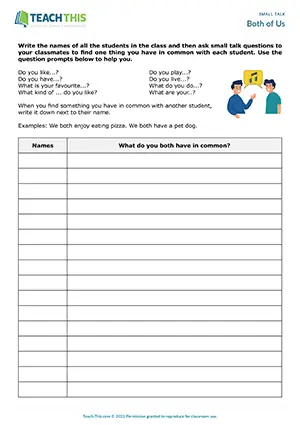
ESL Small Talk Activity - Speaking: Asking and Answering Questions, Communicative Practice
In this insightful small talk speaking activity, students find out what they have in common with their classmates by asking and answering common small talk questions. First, students write the names of all the...
Small Talk Questions
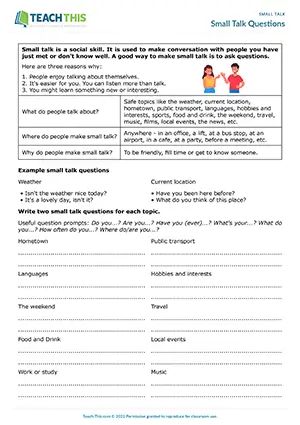
ESL Small Talk Activity - Writing and Speaking: Writing, Asking and Answering Questions, Communicative Practice - Pair Work
In this free small talk speaking activity, students practice writing, asking and answering questions on common small talk topics. Students begin by...
What's Your Plan for the Weekend?
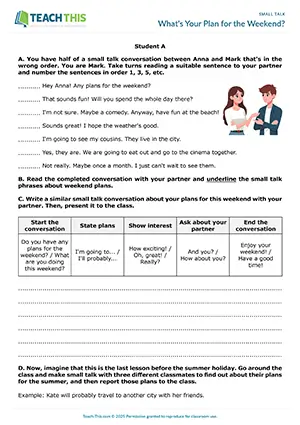
ESL Small Talk Activity - Reading, Writing and Speaking: Information Gap, Ordering, Identifying, Preparing and Delivering a Dialogue, Freer Practice - Pair Work
In this rewarding small talk activity, students reconstruct a conversation about weekend plans, highlight useful small talk expressions, and then create and perform...
Common Responses
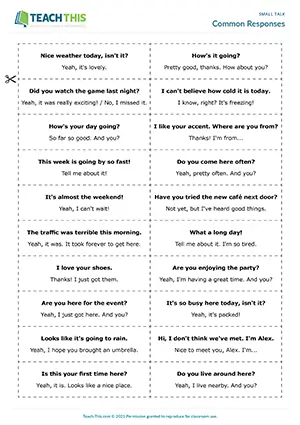
ESL Small Talk Game - Speaking: Forming Responses, Communicative Practice - Group Work
In this fun small talk game, students practice replying to small talk statements and questions with commonly used responses. In groups, students take turns picking up a card and reading the small talk...
Conversation Starters
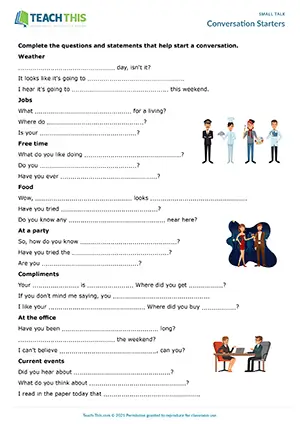
ESL Conversation Starters Activity - Speaking: Gap-fill, Role-Play, Asking and Responding to Questions and Statements, Communicative Practice - Pair Work
In this communicative small talk activity, students complete small talk questions and statements to start a conversation and then use them to practice making...
I Must Be Going Now
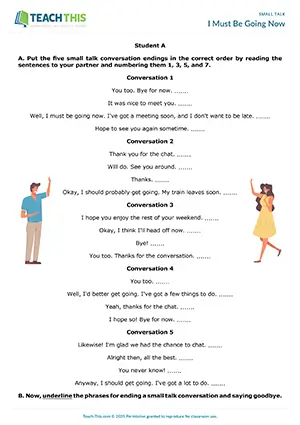
ESL Ending a Conversation and Saying Goodbye Activity - Speaking: Ordering, Role-Play, Identifying - Pair Work
In this productive saying goodbye activity, students practice phrases for ending a small talk conversation and saying goodbye between casual acquaintances or people who just met. First, in pairs...
Small Talk Role-Play
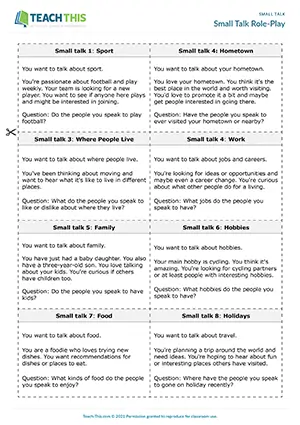
ESL Small Talk Role-Play - Speaking Activity: Communicative Practice - Group Work
In this engaging small talk role-play, students take on the role of people meeting for the first time at a networking event and practice making small talk by introducing themselves and steering the conversation toward a particular topic. First...
Small Talk Techniques
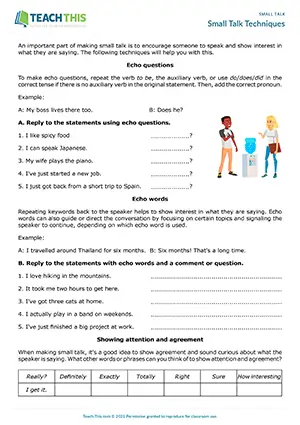
ESL Small Talk Worksheet - Vocabulary Exercises: Categorising, Writing Questions, Identifying - Speaking Activity: Role-Play, Communicative Practice - Pair Work
In this free small talk worksheet, students learn four techniques to make small talk and keep a conversation going. First, students read about using echo...
That's Fantastic!
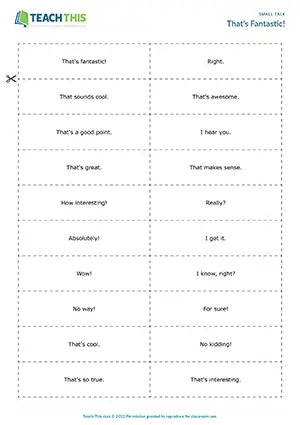
ESL Small Talk Game and Role-Play - Writing and Speaking: Responding, Writing a Dialogue, Role-Play, Communicative Practice - Pair and Group Work
In this useful small talk game and role-play, students practice using common conversational phrases that show interest in what someone is saying...
How to Make Small Talk
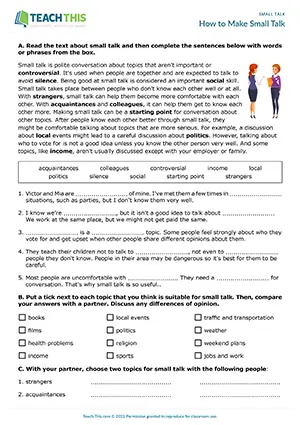
ESL Small Talk Worksheet - Vocabulary Exercises: Gap-fill, Matching, Writing Responses - Speaking Activities: Discussion, Role-Play, Freer Practice - Pair Work
This comprehensive small talk worksheet helps students develop an understanding of small talk, identify suitable small talk topics, learn about conversation...
Social English
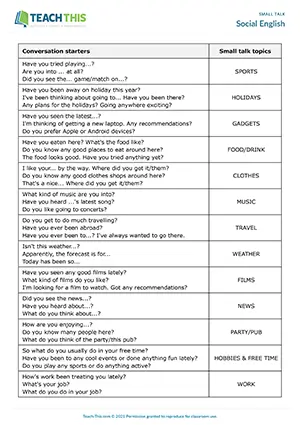
ESL Small Talk Role-Plays - Speaking Activity: Communicative Practice - Pair Work
In these communicative small talk role-plays, students use conversation starters to make small talk in two authentic situations. In the first role-play, one student uses the conversation starters to find a small talk topic their partner is interested in...
What Is Small Talk?
Small talk is functional language for opening, maintaining, redirecting, and closing brief social conversations in everyday situations. When learners choose topics, responses, or exits that do not fit the relationship or setting, they can sound abrupt, uninterested, or overly personal.
This page covers small talk across A2, B1, and B2 levels, with 11 resources ranging from speaking activities and role-plays to games and worksheets, including two free downloads.
Small talk works best when learners match light, friendly phrases to the situation, speaker relationship, and level of familiarity.
| Situation | Speaker | Purpose | Example Phrase |
|---|---|---|---|
| Meeting someone new | Colleague or classmate | Open a first conversation | 'Have you been here before?' |
| Starting a light conversation | Neighbor or coworker | Create friendly contact | 'How's your week going?' |
| Showing interest | Listener | Encourage the speaker | 'Really? What was that like?' |
| Finding shared ground | Speaker | Build connection | 'I like hiking too.' |
| Changing topic gently | Speaker | Move the conversation on | 'Speaking of weekends, do you have any plans?' |
| Closing politely | Speaker | End the exchange naturally | 'It was nice talking to you.' |
How to Use Small Talk Language
Start low-pressure contact: Use a neutral opener to begin contact without asking for private details, as in 'How's your morning going?'
Fill shared waiting time: Use a short comment plus a question to make a pause feel natural when people wait together, as in 'This line is moving slowly today, isn't it?'
Warm up before the main point: Use a brief friendly exchange before moving into the main purpose of a conversation, as in 'Good to see you. How was your weekend?'
3-Step Framework for Teaching Small Talk
1. Build Safe Topic Habits: Have students generate questions around common topics, then keep each exchange alive for a set time, such as one minute, so they practice moving beyond one-turn answers.
2. Practice Natural Exits: Give learners short endings to order from 1 to 8, then have them identify the phrases that close the conversation and say goodbye without sounding sudden.
3. Add Social Direction: Put students into situations where one partner tries to find a topic the other wants to discuss, while another steers conversation away from a certain small talk topic, so learners practice both opening and redirecting talk.
Common Mistakes with Small Talk
Literal Greeting Translation: Students often translate friendly questions from their first language and ask things that sound too personal in English. Wrong: 'Where are you going?' Correct: 'How's your day going?'
Over-answering Routine Questions: Students often treat small talk questions like requests for full information, so a simple opener turns into a long or overly personal answer. Wrong: 'I am very stressed because I argued with my landlord and I have many money problems.' Correct: 'I'm OK, thanks. How about you?'
Common Questions About Teaching Small Talk
What is a fun small talk game?
For quick response practice, the game Common Responses gives students a bold small talk statement or question such as 'Nice weather today, isn't it?' Other students respond, for example 'Yeah, it's lovely.' Students score one point for each appropriate response and two points if they match the response on the card.
What is a good worksheet for practicing small talk?
The free worksheet Small Talk Techniques gives learners a practical toolkit, including echo questions, echo words, words and phrases to show attention and agreement, and Wh follow-up questions. It moves from short replies to mini-dialogue analysis, then students keep a conversation going for two minutes using the four small talk techniques.
What is an engaging speaking activity for small talk?
In the activity Small Talk Role-Play, students get a realistic networking challenge. Students complete a profile card, read a small talk card with a secret topic, a reason, and a question, then steer conversations toward that assigned topic. Classmates later guess each other's small talk topics and reasons for bringing them up.
Become a Teach This Member
Get unlimited access to the full library, plus new resources added every week.
Unlimited Resource Access
Download from 3000+ worksheets, activities, and games.
Save 5+ Hours Weekly
Cut lesson prep time with ready-to-use resources, plus teacher notes and answer keys.
Trusted Professional Quality
Classroom-tested, editable resources created by experienced ESL professionals.
Fresh Content Weekly
Get 5 new resources added to the library each week.
Here's what our members are saying...


