
Noun Phrases ESL Games & Activities
A Fun but Challenging Game

ESL Noun Phrases Game - Grammar and Vocabulary: Matching, Gap-fill - Group Work
In this engaging noun phrases game, students complete sentences by creating noun phrases with adjective pairs and 'but'. Teams take turns picking up a noun card and placing it face up on the table, e.g. town. That team then has one minute to...
Noun Phrase Pelmanism
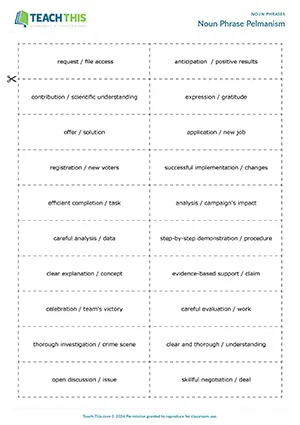
ESL Noun Phrases Game - Vocabulary and Speaking: Matching, Pelmanism, Forming Phrases - Pair Work
In this productive noun phrases game, students match verb phrases to prompts from which they form noun phrases. In pairs, students take turns turning over one verb phrase card and one noun...
Reforming Race

ESL Noun Phrases Game - Grammar, Vocabulary and Speaking: Reforming Sentences, Controlled and Freer Practice - Pair Work
In this free noun phrases game, students practice changing verb phrases in sentences to noun phrases. In pairs, students take turns picking up a card and...
Wayne and Wendy's Wonderful Wedding
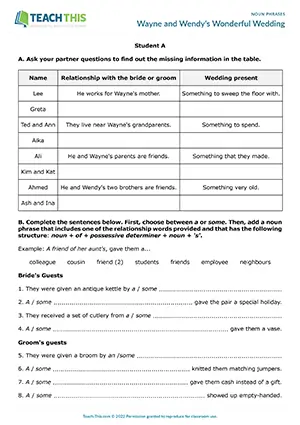
ESL Noun Phrases Activity - Grammar and Vocabulary: Information Gap, Asking and Answering Questions, Table and Sentence Completion - Pair Work
Here is a useful noun phrases activity to help students practice double possessive noun phrases with possessive determiners. First, students ask their partner...
Understanding Noun Phrases
A noun phrase is a group of words built around a head noun, expanded by determiners, adjectives, prepositional phrases, or other modifiers, that functions as a subject, object, or complement in a sentence. When students rely on bare nouns or simple noun-plus-adjective combinations, their language sounds flat and imprecise, and they cannot convey detail, ownership, or complex description efficiently.
This page offers four noun phrase games and activities at B2 (upper-intermediate) level, with one available as a free PDF download.
The table below shows the key noun phrase structures, what each one adds to the head noun, and an example of each.
| Structure Type | What It Adds | Example |
|---|---|---|
| Determiner + Noun | Specifies the noun | 'The report was ready.' |
| Adjective(s) + Noun | Describes the noun | 'A detailed financial report arrived.' |
| Noun + Prepositional Phrase | Adds context or detail | 'The report on the merger surprised everyone.' |
| Noun + Relative Clause | Identifies or defines | 'The report that she submitted was excellent.' |
| Possessive + Noun | Shows ownership | 'The manager's report covered all issues.' |
| Noun + Noun (compound) | Classifies | 'The project report deadline was moved.' |
When to Use Noun Phrases
Adding Precision and Detail: When a speaker or writer needs to identify something exactly rather than refer to it vaguely, a noun phrase with a prepositional phrase or relative clause makes the reference precise and complete, as in 'the report on last quarter's sales figures.'
Showing Ownership and Relationship: When a speaker or writer wants to signal who something belongs to or how things are related without using a separate clause, a possessive noun phrase expresses the connection concisely, as in 'the director's decision to postpone the launch.'
Building a Formal, Dense Register: In academic and professional writing, compressing information into a noun phrase rather than spreading it across multiple clauses produces the dense, formal style expected in reports and presentations, as in 'the government's unexpected decision to raise interest rates' rather than 'the government decided unexpectedly to raise interest rates.'
3-Step Framework for Teaching Noun Phrases
1. Build Noun Phrase Structures Through Matching: Start with a pair-based memory game where students turn over verb phrase cards and noun phrase prompt cards. When a verb phrase matches a prompt, the student reads the verb phrase aloud and then uses the prompt to produce the corresponding noun phrase orally. This keeps the activity productive rather than passive: every match requires a student to form and say the noun phrase before they can claim the cards. With 20 pairs in play, students encounter a wide range of noun phrase patterns in a short time.
2. Push Transformation Under Real-Time Pressure: Once students can identify and produce noun phrases from prompts, challenge them to work in the other direction. One student reads aloud a sentence built around a verb phrase, and the other student has to replace that verb phrase with a noun phrase that carries the same meaning, then move their counter forward on a correct transformation. The physical movement and competitive element make accurate transformation feel urgent rather than routine.
3. Extend to Contextual and Possessive Structures: At B2, students also need to handle noun phrases in context, including possessive structures and double possessives with determiners. An information gap activity sends students asking and answering questions to complete a table, then using a relationship word bank to write sentences in the required noun phrase structure. A separate game targets adjective-pair noun phrases: teams pick a noun card and have one minute to place it in a sentence using an adjective pair joined by 'but', scoring a point for every correct placement and losing a point for an incorrect one.
Common Mistakes with Noun Phrases
Wrong Adjective Order: Students often place adjectives in the wrong order within a noun phrase because their first language uses a different sequence or they treat all adjectives as interchangeable in position. Wrong: 'a metal old big box.' Correct: 'a big old metal box.'
Omitting the Determiner: Students often drop the determiner before a countable singular noun when building a noun phrase, because many languages do not use articles or determiners in the same way, producing a bare noun where English requires a complete noun phrase. Wrong: 'She gave him report.' Correct: 'She gave him the report.'
Common Questions About Teaching Noun Phrases
What is a fun game for practicing noun phrases?
The free game Reforming Race puts real pressure on noun phrase production. Students take turns reading a sentence built around a verb phrase aloud while their partner races to restate it as a noun phrase with the same meaning. Each correct transformation moves a counter forward on the board, so accuracy matters every round.
What is a useful activity for teaching possessive noun phrases?
The activity Wayne and Wendy's Wonderful Wedding moves students through two stages. First, they exchange information about wedding guests in an information gap task and complete a table. Then they work alone to write sentences using a relationship word bank and the required noun phrase structure, consolidating both speaking and written production.
How do I teach noun phrases with adjectives?
In the game A Fun but Challenging Game, teams pick a noun card and have one minute to place it in a gapped sentence using a pair of adjectives joined by 'but', for example 'It's in a remote but charming town.' A correct placement scores a point; an incorrect one loses a point.
Become a Teach This Member
Get unlimited access to the full library, plus new resources added every week.
Unlimited Resource Access
Download from 3000+ worksheets, activities, and games.
Save 5+ Hours Weekly
Cut lesson prep time with ready-to-use resources, plus teacher notes and answer keys.
Trusted Professional Quality
Classroom-tested, editable resources created by experienced ESL professionals.
Fresh Content Weekly
Get 5 new resources added to the library each week.
Here's what our members are saying...


