
At the Dentist's ESL Worksheets, Role-Plays & Activities
A Visit to the Dentist
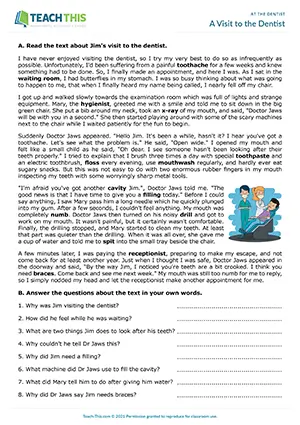
ESL At the Dentist's Worksheet - Reading and Vocabulary Exercises: Reading Comprehension, Crossword, Gap-fill, Comparing
In this free 'At the dentist's' worksheet, students learn and practice vocabulary associated with going to the dentist. First, students read a text...
Dentist Dialogue
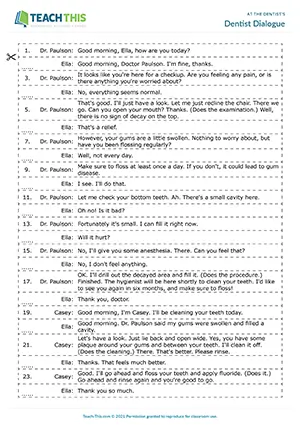
ESL At the Dentist's Role-Play - Speaking Activity: Ordering, Role-Play, Communicative Practice - Pair Work
In this communicative 'At the dentist's' speaking activity, students practice responding to dentists and dental hygienists. In pairs, students read cards that contain a dialogue between a dentist...
Using Visiting the Dentist's Language
At the dentist's functional language covers the phrases patients and dental professionals use to carry out a dental appointment in English, from describing a problem and asking about treatment options to understanding instructions during a procedure and arranging a follow-up. Students who lack this language often struggle to explain their symptoms clearly or to follow what the dentist is telling them, which is critical when they are living or studying abroad.
This page covers at the dentist's functional language at B2 level, with one free worksheet and one role-play activity.
The phrases below cover the key communicative situations in a dental appointment, from the first description of a problem through to booking a follow-up.
| Situation | Speaker | Example Phrase |
|---|---|---|
| Describing a problem | Patient | 'I've had a really bad toothache for the past few days.' |
| Asking about pain | Dentist | 'Does it hurt when I press here?' |
| Explaining a diagnosis | Dentist | 'You have a small cavity that will need filling.' |
| Recommending treatment | Dentist | 'I'd recommend a root canal to save the tooth.' |
| Giving instructions during treatment | Dentist or Hygienist | 'Open wide and try to keep still.' |
| Asking about aftercare | Patient | 'How long should I avoid eating after the procedure?' |
| Giving aftercare advice | Dentist | 'Avoid hard or sticky foods for the next 24 hours.' |
| Booking a follow-up | Patient or Receptionist | 'I'd like to make a follow-up appointment, please.' |
How to Use Visiting the Dentist's Language
Describing Dental Pain to a Professional: Students need to describe the location, type, and triggers of pain precisely, since a vague description slows diagnosis and can lead to the wrong treatment, as in 'It's a sharp pain on my upper left side that gets worse with cold drinks.'
Following Instructions Mid-Treatment: Students need to understand and respond to short instructions from the dentist or hygienist immediately, since there is no time to ask for clarification during a procedure, as in 'Rinse out now and bite down gently on this.'
Asking About and Responding to Treatment Options: Students need enough language to follow a diagnosis, ask a clarifying question, and give informed consent rather than simply agreeing to whatever is proposed, as in 'Is an extraction the only option, or could the tooth be saved?'
2-Step Framework for Teaching Visiting the Dentist's Language
1. Start With Vocabulary in Context: Before students can handle any kind of role-play, they need to meet the key dental vocabulary in a meaningful setting. A reading text about a dentist visit gives students the language in context, and following it up with a crossword built from the bold vocabulary in that same text reinforces the words without drilling them in isolation. The most valuable closing move is asking students to complete sentences about their own dental health and then compare answers with a partner, which turns passive vocabulary recognition into genuine personal communication.
2. Build to a Fully Improvised Role-Play: Once students have the vocabulary, move them into a structured role-play that gradually removes its own scaffolding. Starting by ordering the dentist's and hygienist's lines, then slotting in the patient's response cards at the correct numbered positions, gives students a clear map of how the conversation works before they perform it. The real payoff comes at the end, when students remove the patient's lines entirely and respond to the dentist and hygienist by themselves, without any written prompts to fall back on.
Common Mistakes with Visiting the Dentist's Language
Using 'tooth pain' instead of 'toothache': Students often use 'pain' as a general word and say 'tooth pain,' but native speakers use 'toothache' for the persistent discomfort associated with a dental problem. Wrong: 'I have a tooth pain that has lasted for three days.' Correct: 'I have a toothache that has lasted for three days.'
Using 'do' instead of 'have' for dental procedures: Students often say 'do a filling' or 'do a root canal,' but English uses 'have' when a professional performs a procedure on you. Wrong: 'The dentist told me I need to do a filling next week.' Correct: 'The dentist told me I need to have a filling next week.'
Common Questions About Teaching Visiting the Dentist's Language
What is a good role-play activity for teaching dentist vocabulary and phrases?
The activity Dentist Dialogue builds toward an improvised performance rather than just a scripted read-through. Students first order the dentist's and hygienist's lines, then slot in the patient's response cards, and finally remove the patient's lines entirely and respond without any written prompts. The role-play gets harder as it goes.
Become a Teach This Member
Get unlimited access to the full library, plus new resources added every week.
Unlimited Resource Access
Download from 3000+ worksheets, activities, and games.
Save 5+ Hours Weekly
Cut lesson prep time with ready-to-use resources, plus teacher notes and answer keys.
Trusted Professional Quality
Classroom-tested, editable resources created by experienced ESL professionals.
Fresh Content Weekly
Get 5 new resources added to the library each week.
Here's what our members are saying...


