
Cultural Celebrations ESL Activities, Worksheets & Games
Tanabata
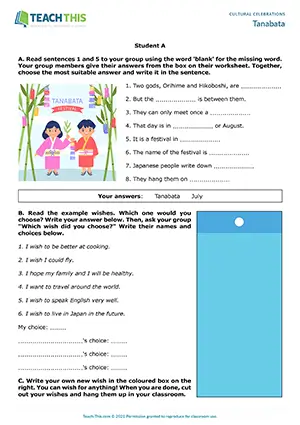
ESL Tanabata Activity - Vocabulary and Speaking: Matching, Gap-fill, Asking and Answering Questions, Writing Sentences - Group Work
In this insightful Tanabata activity, students learn about the Japanese festival of Tanabata and take part in one of the traditions by writing wishes on a tanzaku...
The Day of the Dead
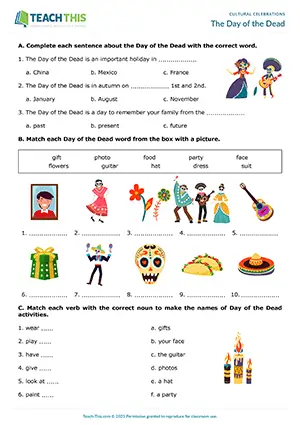
ESL Day of the Dead Worksheet - Vocabulary Exercises: Multiple Choice, Matching, Gap-fill, Identifying, Sentence Completion
This free Day of the Dead worksheet helps students practice vocabulary related to this Mexican holiday. First, students complete Day of the Dead sentences with the correct word. Students then match...
Celebrations Challenge
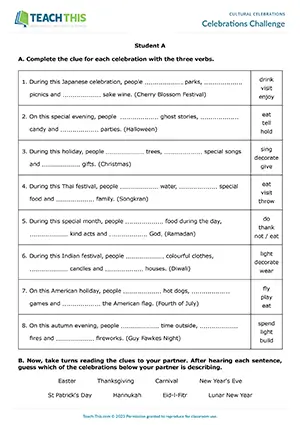
ESL Cultural Celebrations Activity - Vocabulary: Gap-fill, Guessing - Pair Work
This enjoyable cultural celebrations activity helps students practice the names of popular cultural celebrations and related verbs. First, in two groups, students complete clues for different cultural celebrations with verbs. Next, students pair up...
New Year's Eve Around the World
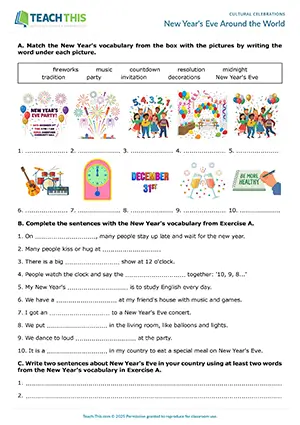
ESL New Year's Eve Worksheet - Vocabulary and Reading Exercises: Matching, Gap-fill - Speaking Activity: Answering Questions - Pair Work
In this enjoyable New Year's Eve worksheet, students practice vocabulary related to New Year's Eve, read about how the celebration is different in other countries and...
The 4th of July
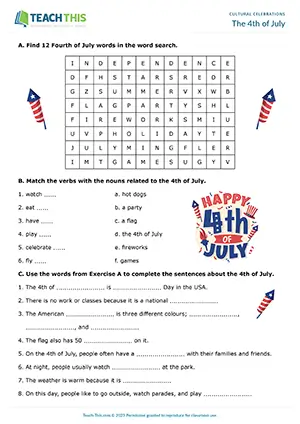
ESL 4th of July Worksheet - Vocabulary and Writing Exercises: Word Search, Matching, Gap-fill, Categorising, Sentence Completion - Speaking Activity - Pair Work
This comprehensive 4th of July worksheet helps students practice vocabulary related to American Independence Day. First, students find 12 Fourth of July words...
Travelling Revellers
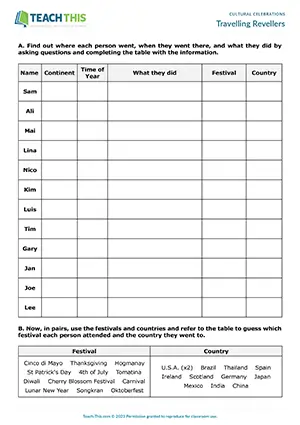
ESL Cultural Celebrations Activity - Vocabulary and Speaking: Role-play, Asking and Answering Questions, Table Completion, Guessing - Group Work
This cultural celebrations role-play activity helps to familiarise students with the names of different cultural celebrations and festivals. In groups, students take on...
Celebrations Board Game
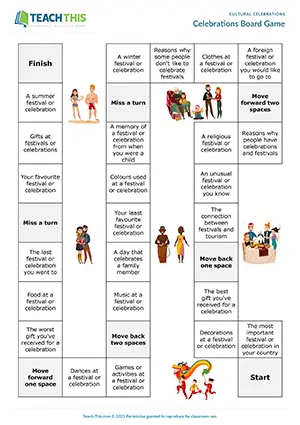
ESL Festivals and Celebrations Board Game - Speaking: Impromptu Speech, Communicative Practice - Group Work
This fun cultural celebrations board game helps students talk about various celebrations and festivals. In groups, students take turns rolling the dice and moving their counter along the board. When a student...
Good Times
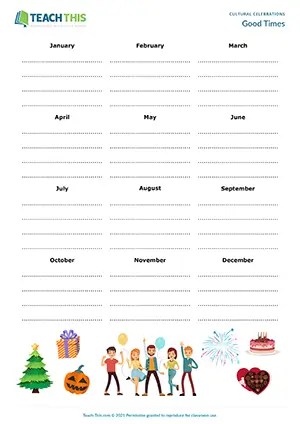
ESL Celebrations Activity - Speaking: Listing, Asking and Answering Questions, Freer Practice - Pair Work
In this cultural celebrations speaking activity, students talk about personal and public celebrations they have throughout the year. Working alone, students write down all the celebrations they have...
It's Carnival Time!
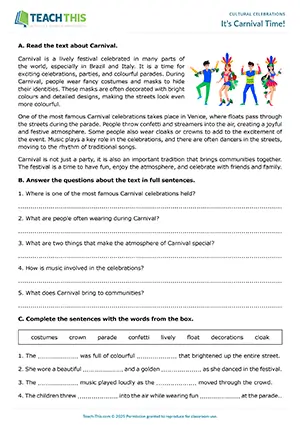
ESL Celebrations Worksheet and Activity - Reading and Vocabulary Exercises: Reading Comprehension Questions, Gap-fill, Ordering - Pair Work
In this free Carnival worksheet and activity, students learn about the Christian festival of Carnival and its associated vocabulary. First, students read a text about...
Thanksgiving
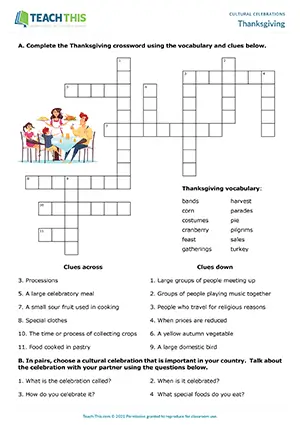
ESL Thanksgiving Worksheet - Reading and Vocabulary Exercises: True or False, Comprehension Questions, Crossword - Speaking Activity - Pair Work
In this useful Thanksgiving worksheet, students learn about the American celebration of Thanksgiving and related vocabulary by completing a variety of...
Which festival?
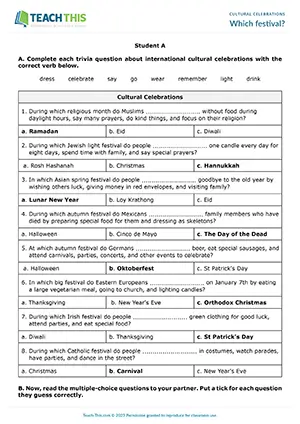
ESL Festivals Activity - Vocabulary, Reading and Listening: Gap-fill, Asking Trivia Questions, Guessing - Group and Pair Work
In this engaging cultural celebrations trivia quiz activity, students complete trivia questions about cultural celebrations with common verbs and then ask them to a partner. In two groups...
Chinese New Year Bingo
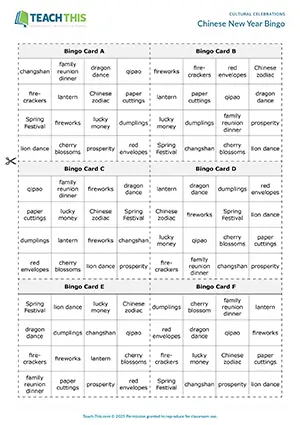
ESL Chinese New Year Game - Vocabulary: Bingo, Matching - Group Work
In this Chinese New Year vocabulary game, students play bingo by listening to definitions and matching them to words commonly associated with the Chinese New Year festival. In groups, the bingo caller reads a definition at random from...
Lunar New Year Crossword
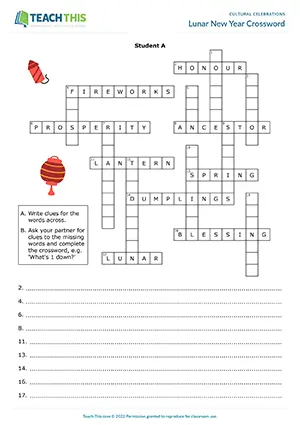
ESL Lunar New Year Crossword - Vocabulary Activity: Crossword, Writing Clues, Describing, Guessing - Group and Pair Work
In this productive Lunar New Year activity, students complete a crossword by describing and guessing words related to the festival. In two groups, students invent and write down clues for the Lunar New Year...
New Year's Eve Board Game
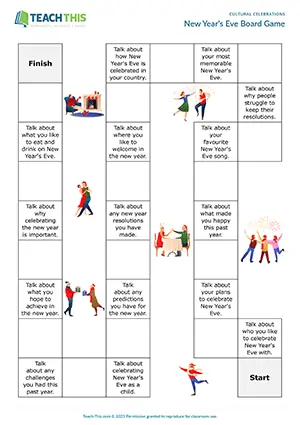
ESL New Year's Eve Game - Vocabulary and Speaking: Impromptu Speech, Multiple Choice, Guessing, Freer Practice - Group Work
In this free New Year's Eve board game, students practice vocabulary related to New Year's Eve and talk in response to topic-related prompts. Players...
Ramadan
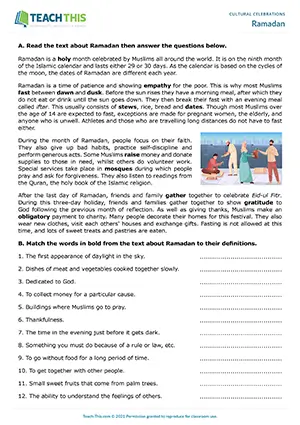
ESL Ramadan Worksheet - Reading and Vocabulary Exercises: Matching, True or False, Multiple-Choice and Short Answer Reading Comprehension Questions
In this detailed Ramadan worksheet, students learn about the Muslim holiday Ramadan and its associated vocabulary. First, students read a text about Ramadan and...
St. Patrick's Day
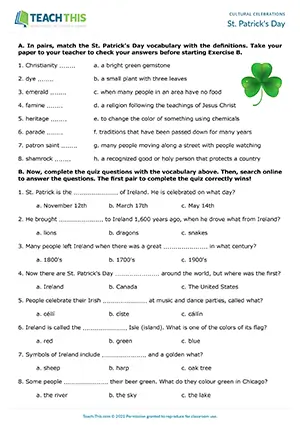
ESL St. Patrick's Day Activity - Vocabulary: Matching, Answering Multiple-Choice Quiz Questions - Pair Work
In this entertaining St. Patrick's Day activity, pairs of students race to search for information about St. Patrick's Day in order to complete a matching activity and quiz the fastest. Pairs begin by...
Using Cultural Celebrations Vocabulary
Cultural celebrations vocabulary covers the names of festivals and holidays from around the world, the verbs used to describe what people do during them, and the cultural context that makes those events meaningful to the people who observe them. Students who lack this vocabulary often default to vague, repetitive language when talking about traditions, describing everything with 'do' or 'have' instead of the specific verbs a fluent speaker would reach for naturally.
This page covers cultural celebrations vocabulary across A1-A2, A2, B1, and B2 levels, with 16 resources ranging from role-plays and board games to reading worksheets and vocabulary games, including three resources available as free downloads.
The table below shows common situations where cultural celebrations vocabulary is used, who is typically speaking, and a natural example phrase.
| Situation | Typical Speaker | Example Phrase |
|---|---|---|
| Describing a personal tradition | Student or adult learner | 'We light lanterns and set off fireworks to welcome the New Year.' |
| Explaining a holiday to someone unfamiliar with it | Any speaker | 'During Carnival, people wear costumes and dance in the streets for several days.' |
| Discussing cultural events at work or school | Student or professional | 'We always have a big meal together on Thanksgiving.' |
| Showing interest in another person's culture | Any speaker | 'I heard that during Diwali people decorate their homes with oil lamps and rangoli.' |
| Writing about cross-cultural comparisons | Student | 'Unlike trick-or-treating, Día de los Muertos centers on honouring deceased relatives.' |
When to Use Cultural Celebrations Vocabulary
Describing Personal Traditions: When a student wants to explain how their own family or community marks a specific occasion, cultural celebrations vocabulary gives them the precise nouns and verbs they need to be specific rather than vague, as in 'We light lanterns and set off fireworks to welcome the New Year.'
Showing Cultural Curiosity in Conversation: When the topic of holidays or festivals comes up with a native speaker or international colleague, knowing the names and key customs of their celebrations shows genuine respect and keeps the conversation going naturally, as in 'I heard that during Diwali people decorate their homes with oil lamps and rangoli.'
Writing About Cross-Cultural Comparisons: In writing tasks that ask students to compare customs across countries, celebrations vocabulary allows them to describe similarities and contrasts accurately rather than avoiding the topic altogether, as in 'Unlike the Western tradition of trick-or-treating, Día de los Muertos centers on honouring deceased relatives with offerings at home altars.'
3-Step Framework for Teaching Cultural Celebrations
1. Build Personal Connection First: Before introducing any new vocabulary, get students to map out their own celebration year. Ask them to write down all the celebrations they have throughout the year in a monthly calendar and make notes on how they celebrate each one. This personal inventory gives every student something real and specific to contribute when the class moves into group discussion, and it surfaces vocabulary gaps naturally without any pressure.
2. Build Festival Knowledge Through Peer Questioning: Once students have their own vocabulary grounded, move them into a knowledge-building task where they have to use that vocabulary actively. Put students into two groups and have them complete trivia questions about cultural celebrations with the correct verb, then pair them up across groups to take turns reading their multiple-choice questions to their partner, who tries to guess the correct answer. The cross-group pairing means every student encounters a fresh set of questions and has to listen carefully to win.
3. Push Fluency With Timed Speaking: Close the sequence with a speaking challenge that raises the stakes just enough to push fluency. Students take turns landing on a topic square and talking about it for 30 seconds without stopping. If a student stops talking before the time is up, they go back to their previous square, which creates genuine energy in the room and rewards students who have built up their celebrations vocabulary across the earlier steps.
Common Mistakes with Cultural Celebrations Vocabulary
Using 'make' instead of 'have' or 'throw' for celebrations: Students often use 'make' when describing a celebration or party, transferring directly from their L1 where the equivalent verb is used this way, which sounds unnatural in English. Wrong: 'We made a big celebration for the festival.' Correct: 'We had a big celebration for the festival.'
Confusing 'eve' with the day itself: Students often use 'eve' to refer to the day of the celebration rather than the night before it, which shifts the meaning of what they are describing and can confuse the reader. Wrong: 'On Christmas Eve, we open presents and eat a big meal together.' Correct: 'On Christmas Day, we open presents and eat a big meal together.'
Common Questions About Teaching Cultural Celebrations
What is a useful worksheet for teaching Carnival vocabulary?
In the free worksheet It's Carnival Time!, students read a text about the Christian festival of Carnival and answer comprehension questions in complete sentences. They then complete sentences with words from a box, before working in pairs to arrange sentence strips in the correct order to reveal a Carnival story.
What is an engaging activity for teaching celebrations from different cultures?
The activity Travelling Revellers gives each student the role of a traveller who has attended a celebration somewhere in the world. Students go around asking where each person went, when they went, and what they did, completing a table as they go. At the end, they use the information to guess which festival each person attended.
What is a fun board game for discussing New Year's Eve traditions?
The free board game New Year's Eve Board Game has two types of squares. Landing on a 'Talk about' square means responding to a New Year's Eve prompt for 30 seconds without stopping or moving back two squares. Landing on a blank square means answering a multiple-choice question about New Year's Eve in ten seconds.
Become a Teach This Member
Get unlimited access to the full library, plus new resources added every week.
Unlimited Resource Access
Download from 3000+ worksheets, activities, and games.
Save 5+ Hours Weekly
Cut lesson prep time with ready-to-use resources, plus teacher notes and answer keys.
Trusted Professional Quality
Classroom-tested, editable resources created by experienced ESL professionals.
Fresh Content Weekly
Get 5 new resources added to the library each week.
Here's what our members are saying...


