
ESL Grammar Activities,
Games and Worksheets
Bring grammar to life with engaging speaking activities, games and worksheets. Find practical resources to help your students understand grammar and use it with confidence.
Free resources available. Full access with a membership.
Find grammar resources for your lesson
Choose a topic below to explore activities, games and worksheets for your class.
Explore active and passive voice through ESL grammar games that show how sentence focus changes the message. Students decide whether the person doing an action or the person receiving it matters more.
Grammar focus: Active and passive sentence structures, verb forms and sentence transformations.
Resource types: Sentence-matching games, statement rewriting, gap-fills and timed verb-formation challenges.
Levels: Intermediate (B1) to upper-intermediate (B2).
Make the relationships between ideas clearer. Students connect information within longer sentences and develop more precise ways to explain their meaning.
Grammar focus: Adverbial clause types, subordinating conjunctions and sentence formation.
Resource types: Worksheets, matching tasks, gap-fills, categorising activities, games and speaking activities.
Levels: Intermediate (B1) to upper-intermediate (B2).
Add detail without making every sentence longer and more complicated. Students develop more precise descriptions and carry that language into conversation.
Grammar focus: Recognising adverbial phrases and using them accurately in sentences.
Resource types: Worksheets, matching exercises, error-correction tasks, games and speaking activities.
Levels: Upper-intermediate (B2).
Turn future plans into conversations about organising activities with classmates. Students consider whether they are expressing an intention or describing an arrangement already made.
Grammar focus: Future plans, intentions and arrangements; explaining choices with 'because' and 'so'.
Resource types: Worksheets, sentence-building games, board games, scheduling tasks, matching and question-completion activities.
Levels: Elementary (A1/A2) to intermediate (B1).
Explore what people intend to do and what they think will happen. Everyday situations give learners a meaningful context for talking about the future.
Grammar focus: Affirmative and negative statements with 'be going to'.
Resource types: Worksheets, gap-fills, sentence-formation tasks, role-plays, miming and guessing games.
Levels: Elementary (A1/A2) to pre-intermediate (A2).
Discover what classmates are planning and listen for the details that make each answer useful. Students move beyond announcing their own intentions to finding out about others.
Grammar focus: Forming and answering 'Wh' questions with 'be going to'.
Resource types: Worksheets, board games, racing games, information-gap tasks and speaking activities.
Levels: Elementary (A1/A2) to pre-intermediate (A2).
Find out whether classmates share the same plans. Students listen carefully to responses and use the information to confirm or revise their guesses.
Grammar focus: Yes/no questions and answers with 'be going to' for future plans and intentions.
Resource types: Worksheets, guessing games, information-gap tasks and speaking activities.
Levels: Elementary (A1/A2) to pre-intermediate (A2).
Make everyday comparisons more precise with comparative adjective activities. The collection progresses from straightforward descriptions to more demanding patterns, allowing teachers to choose an appropriate challenge.
Grammar focus: Comparative adjectives, comparisons with 'than' and 'as ... as', and correlative comparisons.
Resource types: Worksheets, surveys, board games, running dictations and speaking activities.
Levels: Elementary (A1/A2) to upper-intermediate (B2).
Compare people, places and things, then explain which stands out. Students connect their language choices with opinions and decisions rather than simply changing adjective endings.
Grammar focus: Forming and using comparative and superlative structures.
Resource types: Worksheets, gap-fills, board games, quizzes, speaking activities and creative writing tasks.
Levels: Elementary (A1/A2) to advanced (C1).
Use first conditional worksheets and activities to explore possible situations and their likely consequences. Students connect a condition with an outcome and explain how one event could affect another.
Grammar focus: First conditional sentence structure and use for real future possibilities.
Resource types: Worksheets, sentence-building activities, role-plays and board games.
Levels: Intermediate (B1) to upper-intermediate (B2).
Imagine a particular moment during a day trip, at work or over the weekend. Students describe the scene from that future viewpoint and find out about other people's plans.
Grammar focus: Forming and using the future continuous to describe actions in progress at a future time.
Resource types: Worksheets, information-gap tasks, role-plays, speaking activities and board games.
Levels: Intermediate (B1) to upper-intermediate (B2).
Look at a future situation from two perspectives: what will still be happening and what will already be complete. Students choose the meaning that fits the context.
Grammar focus: Future continuous and future perfect forms, meanings and contrasts.
Resource types: Worksheets, role-plays and speaking activities for individual, pair and group work.
Levels: Upper-intermediate (B2).
Look ahead and consider the time spent on an ongoing activity. Students connect a future reference point with something that began earlier and continues up to it.
Grammar focus: Future perfect continuous structure and use for duration up to a future point.
Resource types: Worksheets, games and activities combining controlled and freer practice.
Levels: Upper-intermediate (B2).
Set a future reference point and consider what will be finished by then. Students develop their own ideas about achievements and completed actions.
Grammar focus: Forming and using the future perfect simple to describe future completion.
Resource types: Worksheets, guessing games, sentence races, speaking activities and group discussions.
Levels: Intermediate (B1) to upper-intermediate (B2).
Respond to situations as they arise and consider what the future might hold. Students explore how their choice of language communicates certainty, willingness or intention.
Grammar focus: Predictions, offers, promises and decisions with 'will' and 'won't'.
Resource types: Worksheets, prediction games, horoscope activities and board games.
Levels: Elementary (A1/A2) to intermediate (B1).
Choose language that reflects what a speaker means about the future. Students distinguish different intentions instead of treating all future forms as interchangeable.
Grammar focus: 'Will', 'be going to', the present continuous and other future forms.
Resource types: Worksheets, discussions, role-plays and board games.
Levels: Pre-intermediate (A2) to advanced (C1).
Make the order and timing of future events clear. Students connect actions so listeners understand which event sets the time for another.
Grammar focus: Future time clauses and the verb forms used to connect future events.
Resource types: Worksheets, error-correction tasks, battleships, true-or-false games and board games.
Levels: Intermediate (B1) to upper-intermediate (B2).
Move beyond memorising isolated verb patterns with gerund and infinitive practice. Students make choices in context and develop confidence using familiar structures when expressing their own ideas.
Grammar focus: Gerund and infinitive forms and their use in context.
Resource types: Worksheets, board games and speaking activities combining controlled and freer practice.
Levels: Pre-intermediate (A2) to upper-intermediate (B2).
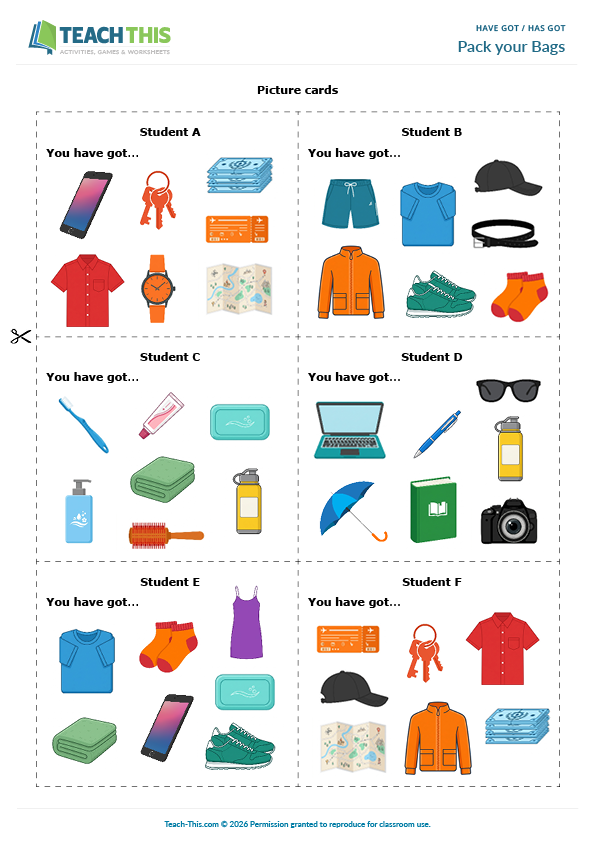
Exchange details about everyday items, appearance and school timetables. Students use information about people and their belongings to discover similarities and differences.
Grammar focus: Affirmative and negative statements, questions and answers with 'have got' and 'has got'.
Resource types: Worksheets, information-gap tasks, guessing games and speaking activities.
Levels: Elementary (A1/A2) to pre-intermediate (A2).
Imagine how life could be different and reflect on things that cannot be changed. Students express personal reactions while distinguishing present concerns from past regrets.
Grammar focus: 'I wish' and 'If only' for desires, regrets, annoyance and hypothetical situations.
Resource types: Worksheets, games, reading and writing tasks, and speaking activities.
Levels: Intermediate (B1) to upper-intermediate (B2).
Make classroom and everyday exchanges clear and direct. Students consider what another person needs to do and how to communicate that message appropriately.
Grammar focus: Imperatives for instructions, commands, requests and warnings.
Resource types: Worksheets, games, role-plays and speaking activities.
Levels: Beginner (A1) to upper-intermediate (B2).
Make irregular forms easier to recall when they are needed. Students connect familiar verbs with meaningful sentences rather than learning each form only as an isolated item.
Grammar focus: Irregular verb forms, including the present, past simple and past participle.
Resource types: Worksheets, games and speaking activities.
Levels: Elementary (A1/A2) to upper-intermediate (B2).
Choose a conditional pattern to match the intended meaning. Reviewing the forms together encourages students to think about the relationship between a situation and its result.
Grammar focus: Zero, first, second and third conditionals, with additional practice using 'as if' and 'as though'.
Resource types: Worksheets, board games, dominoes, battleships, error-correction tasks and discussions.
Levels: Intermediate (B1) to upper-intermediate (B2).
Create accounts that readers and listeners can follow. Students organise events, establish background details and develop their own narratives, including fairy-tale contexts.
Grammar focus: Choosing and combining narrative tenses to sequence and describe past events.
Resource types: Reading tasks, gap-fills, sentence completion, guided writing, storytelling and role-plays.
Levels: Intermediate (B1) to upper-intermediate (B2).
Express more complex ideas within a single sentence. Students explore how a clause can carry information that would otherwise be expressed by a noun or shorter phrase.
Grammar focus: Identifying noun clauses and incorporating them into sentences.
Resource types: Worksheets, board games, matching tasks and sentence races.
Levels: Intermediate (B1) to upper-intermediate (B2).
Build richer descriptions while keeping sentence structure manageable. Students learn to package information more effectively and reshape the way an idea is expressed.
Grammar focus: Adjective and noun combinations, possessive determiners and changing verb phrases into noun phrases.
Resource types: Information-gap activities, sentence-transformation races, pelmanism games and worksheets.
Levels: Upper-intermediate (B2).
Explore passive voice resources for describing events when the action or its receiver matters more than the person responsible. Students consider how this change of emphasis works across different time frames.
Grammar focus: Passive structures in present, past, future and perfect forms.
Resource types: Worksheets, running dictations, 'Find Someone Who' activities, information gaps and battleships.
Levels: Intermediate (B1) to upper-intermediate (B2).
Set the scene for past events and describe what was happening around them. Students use remembered actions and visual details to make their accounts clearer.
Grammar focus: Past continuous forms and actions in progress in the past.
Resource types: Worksheets, storytelling, miming, picture-memory games and ghost-story sequencing tasks.
Levels: Pre-intermediate (A2) to intermediate (B1).
Make a sequence of past events easy to follow. Students show which event came earlier and explain how it relates to the point their account has reached.
Grammar focus: Past perfect forms and their relationship with the past simple.
Resource types: Worksheets, sentence-completion tasks, creative writing, storytelling and speaking activities.
Levels: Intermediate (B1) to upper-intermediate (B2).
Explain the background to a past event and why a situation developed. Students connect earlier ongoing activity with its later effects.
Grammar focus: Past perfect continuous forms and contrasts with the past simple and past continuous.
Resource types: Worksheets, reading and writing tasks, storytelling, speaking activities and games.
Levels: Intermediate (B1) to upper-intermediate (B2).
Look back from a past moment and distinguish a completed action from an activity that was still continuing. Students consider how that choice changes the message.
Grammar focus: Contrasting the forms and uses of the past perfect simple and continuous.
Resource types: Worksheets, matching tasks, miming, information gaps, sentence completion and speaking activities.
Levels: Intermediate (B1) to upper-intermediate (B2).
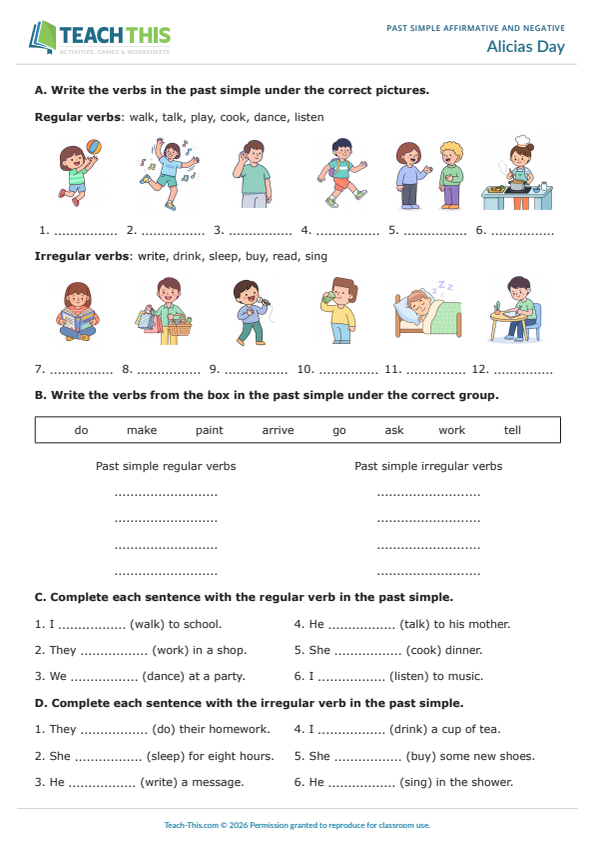
Use past simple worksheets and games to recount experiences and make clear what did or did not happen. Students develop fuller accounts of past events while building accuracy with familiar verbs.
Grammar focus: Affirmative and negative past simple statements with regular and irregular verbs.
Resource types: Worksheets, sentence-construction tasks, storytelling, role-plays, discussions and board games.
Levels: Elementary (A1/A2) to upper-intermediate (B2).
Explore inventions, historical events and news with the event itself in focus. Students exchange facts without always needing to name the person responsible.
Grammar focus: Past simple passive forms and their use to describe past events.
Resource types: Worksheets, information-gap tasks, sentence transformations, quizzes and discussions.
Levels: Intermediate (B1) to upper-intermediate (B2).
Make regular past forms easier to use in everyday accounts. Students connect the written form with how it sounds and apply familiar verbs in meaningful sentences.
Grammar focus: Regular past simple verbs, spelling rules and '-ed' pronunciation.
Resource types: Worksheets, categorising tasks, sentence formation, word searches, guessing games and board games.
Levels: Beginner (A1) to intermediate (B1).
Describe how people and situations were different in the past. Students exchange details and compare what they know about earlier times.
Grammar focus: Past simple forms of 'be' with 'was' and 'were'.
Resource types: Worksheets, board games, information-gap tasks and speaking activities.
Levels: Elementary (A1/A2) to pre-intermediate (A2).
Find out what happened by asking about past experiences and events. Students listen for relevant details and use the answers to build a clearer picture.
Grammar focus: Forming, asking and answering past simple 'Wh' questions.
Resource types: Worksheets, running dictations, role-plays, information-gap tasks and speaking activities.
Levels: Elementary (A1/A2) to upper-intermediate (B2).
Check whether an event happened and respond clearly to another person's enquiry. Students connect accurate question forms with information they want to discover.
Grammar focus: Past simple yes/no questions with 'did' and the verb 'be'.
Resource types: Worksheets, games and speaking activities.
Levels: Elementary (A1/A2) to pre-intermediate (A2).
Connect background actions with the events that interrupted them. Contexts such as murder mysteries and accidental inventions make the timing of events important to understanding the account.
Grammar focus: Past simple and past continuous contrasts, question formation, and clauses with 'when' and 'while'.
Resource types: Worksheets, sentence-completion tasks, role-plays and story-based activities.
Levels: Pre-intermediate (A2) to upper-intermediate (B2).
Show which event happened first when describing the past. Students organise short accounts so the relationship between earlier and later actions is clear.
Grammar focus: Past simple and past perfect contrasts; clauses with 'because', 'before', 'after' and 'when'.
Resource types: PDF and online resources, gap-fills, matching, labelling, sentence rewriting, dominoes and storytelling tasks.
Levels: Intermediate (B1) to upper-intermediate (B2).
Distinguish a finished past event from an experience connected with the present. Students consider the speaker's viewpoint and choose the meaning that suits the situation.
Grammar focus: Past simple and present perfect contrasts, sentence transformations and question formation.
Resource types: Worksheets, CV-analysis tasks, trivia, impromptu speeches and true-or-false activities.
Levels: Intermediate (B1) to upper-intermediate (B2).
Bring familiar past forms together in a purposeful review. Students decide how to present events clearly instead of choosing a tense solely from an isolated prompt.
Grammar focus: Past simple, past continuous, past perfect and past perfect continuous.
Resource types: Worksheets, speaking activities, drawing tasks, battleships and board games.
Levels: Intermediate (B1) to upper-intermediate (B2).
Bring present continuous practice into situations students can picture. They describe scenes as they unfold and exchange information about plans, communicating about people and their actions.
Grammar focus: Affirmative and negative statements and questions; current actions and future plans.
Resource types: Worksheets, drawing activities, memory games, miming and role-plays.
Levels: Elementary (A1/A2) to intermediate (B1).
Talk about travel, achievements and changes in life. Students develop conversations that connect experiences with the present and move beyond giving a single short answer.
Grammar focus: Present perfect forms and uses, from introductory practice to more demanding applications.
Resource types: Worksheets, miming, board games, information gaps and discussions.
Levels: Pre-intermediate (A2) to upper-intermediate (B2).
Discover shared experiences and unexpected differences between classmates. Students listen with a purpose and respond to what other people have or have not done.
Grammar focus: 'Ever' and 'never' with the present perfect to discuss life experiences.
Resource types: Worksheets, bingo, guessing games, true-or-false activities, surveys and speaking tasks.
Levels: Pre-intermediate (A2) to intermediate (B1).
Explain the history of a situation that continues now. Students distinguish the length of time involved from the point at which it began.
Grammar focus: Present perfect with 'for' and 'since', duration, starting points and 'How long' questions.
Resource types: Worksheets, written exercises and pair and group speaking activities.
Levels: Pre-intermediate (A2) to intermediate (B1).
Catch up on recent events and unfinished plans. Everyday experiences and bucket lists provide contexts for explaining what has happened and what is still outstanding.
Grammar focus: Present perfect statements and questions with 'just', 'yet' and 'already'.
Resource types: Worksheets, board games and speaking activities.
Levels: Pre-intermediate (A2) to intermediate (B1).
Find out more about experiences instead of stopping at a yes or no answer. Students seek the details needed to understand another person's account.
Grammar focus: Forming and answering present perfect 'Wh' questions.
Resource types: Worksheets, question-prompt tasks, interviews, grammar games and board games.
Levels: Pre-intermediate (A2) to intermediate (B1).
Discover information and check assumptions about other people's experiences. Students pay attention to responses and decide whether their original guesses were correct.
Grammar focus: Present perfect yes/no questions with 'Have' and 'Has'.
Resource types: Worksheets, bingo, snap, guessing games and information-gap activities.
Levels: Pre-intermediate (A2) to intermediate (B1).
Catch up on recent activities and develop conversations beyond a short answer. Students explain how they have been spending their time and what is still continuing.
Grammar focus: Present perfect continuous forms and use for recent or continuing activities.
Resource types: Worksheets, surveys, role-plays, miming, board games and speaking activities.
Levels: Intermediate (B1) to upper-intermediate (B2).
Explore present simple activities built around routines, hobbies, sport and neighbourhood life. Students compare familiar experiences and explain where their lives differ.
Grammar focus: Present simple affirmative and negative statements.
Resource types: Worksheets, information-gap tasks, speaking activities and board games.
Levels: Elementary (A1/A2) to pre-intermediate (A2).
Explain how things work and what happens to everyday objects. Students put the process in focus without needing to identify who performs every action.
Grammar focus: Present simple passive forms and process descriptions.
Resource types: Worksheets, sentence rewriting, error correction, comparison tasks and true-or-false activities.
Levels: Intermediate (B1) to upper-intermediate (B2).
Distinguish what normally happens from what is happening at a particular moment. Students use context to explain temporary situations and familiar routines clearly.
Grammar focus: Present simple and present continuous forms, uses and question patterns.
Resource types: Worksheets, information-gap activities, stories, speaking tasks and games.
Levels: Pre-intermediate (A2) to intermediate (B1).
Compare present situations with experiences that connect the past to now. Students think about the time perspective of a message before choosing how to express it.
Grammar focus: Contrasting the forms and uses of the present simple and present perfect.
Resource types: Worksheets, games and pair and group speaking activities.
Levels: Pre-intermediate (A2) to intermediate (B1).
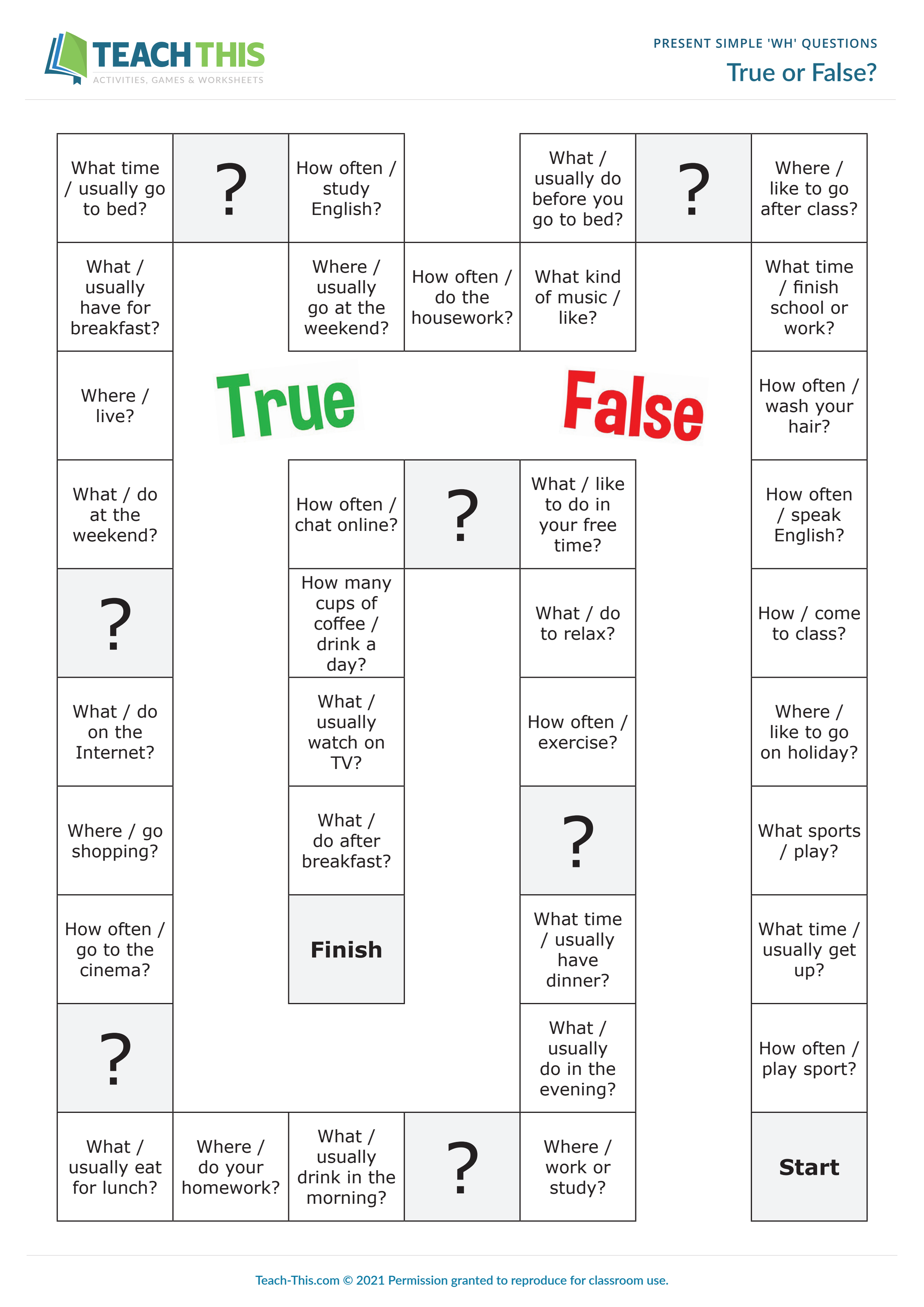
Get students asking present simple 'Wh' questions about routines, habits and personal interests. They listen for useful details and build a fuller picture of their classmates' lives.
Grammar focus: Present simple 'Wh' questions with 'do', 'does' and the verb 'be'.
Resource types: Worksheets, information gaps, board games, error-correction tasks and discussions.
Levels: Elementary (A1/A2) to intermediate (B1).
Discover shared habits and check personal details. Contexts involving flatmates and secret identities give students information to uncover and reasons to listen closely.
Grammar focus: Present simple yes/no questions with 'do', 'does' and the verb 'be'.
Resource types: Worksheets, role-plays, games and pair and group speaking activities.
Levels: Elementary (A1/A2) to intermediate (B1).
Revisit familiar present forms and consider how their meanings differ. Students choose language that fits the situation rather than treating each tense as a separate exercise.
Grammar focus: Present simple, present continuous, present perfect and present perfect continuous.
Resource types: Worksheets, sentence-building activities, Connect Four, battleships and board games.
Levels: Intermediate (B1) to upper-intermediate (B2).
Decide what information is missing before asking a question. Students connect the answer they need with the way they begin their enquiry.
Grammar focus: 'Who', 'what', 'where', 'when', 'why', 'how much' and 'how many'.
Resource types: Worksheets, interviews, role-plays and games.
Levels: Elementary (A1/A2) to intermediate (B1).
Make descriptions more informative without splitting every idea into a separate sentence. Students distinguish details needed to identify something from additional information about it.
Grammar focus: Defining and non-defining relative clauses, including clauses with 'who', 'which', 'where' and 'when'.
Resource types: Worksheets, bingo, storytelling, crosswords, bluffing and description games.
Levels: Intermediate (B1) to upper-intermediate (B2).
Pass on someone else's message clearly and accurately. Students consider what needs to change when the original speaker's words are communicated in a new context.
Grammar focus: Reported speech, including modal verbs, negative requests and infinitive clauses.
Resource types: Worksheets, guessing games, interviews, telephone relays and running dictations.
Levels: Pre-intermediate (A2) to upper-intermediate (B2).
Consider imaginary choices through second conditional games and activities. Students explain their reasons and compare how classmates would respond to the same situation.
Grammar focus: Second conditional statements and questions for hypothetical situations.
Resource types: Worksheets, dilemmas, problem-solving activities, speaking tasks and board games.
Levels: Intermediate (B1) to upper-intermediate (B2).
Make everyday sentences more accurate by checking how their parts fit together. Students apply agreement patterns while communicating their own ideas.
Grammar focus: Subject-verb agreement in the present simple and present continuous.
Resource types: Worksheets, board games, running dictations, matching tasks and speaking activities.
Levels: Elementary (A1/A2) to intermediate (B1).
Decide which people, places or things stand out and justify the choice. The collection offers both introductory practice and more demanding opportunities to explain opinions.
Grammar focus: Superlative forms and their use in descriptions and comparisons.
Resource types: Worksheets, surveys, discussions, TV-style games, board games and role-plays.
Levels: Elementary (A1/A2) to upper-intermediate (B2).
Invite a listener into the conversation instead of simply making a statement. Students explore how a short addition can make an exchange more interactive.
Grammar focus: Tag questions for confirming information, seeking agreement and softening imperatives.
Resource types: Worksheets, games and speaking activities.
Levels: Pre-intermediate (A2) to upper-intermediate (B2).
Practice 'there is' and 'there are' with resources about rooms, shops and other places. Students compare details and build a clearer picture of a location for someone else.
Grammar focus: Affirmative and negative statements, questions and short answers with 'there is' and 'there are'.
Resource types: Worksheets, picture dictations, matching, drawing, memory games and information gaps.
Levels: Beginner (A1) to intermediate (B1).
Reflect on choices and imagine how past events might have turned out differently. Students explore regrets and alternative outcomes without confusing them with real events.
Grammar focus: Third conditional forms for hypothetical past situations and their results.
Resource types: Worksheets, games, speaking activities and role-plays.
Levels: Upper-intermediate (B2).
Compare childhood habits with life today and explain what has changed. Personal experiences provide a starting point for reflecting on earlier routines and new situations.
Grammar focus: Affirmative, negative and question forms of 'used to'; separate practice with 'get used to'.
Resource types: Worksheets, surveys, board games, sentence-building activities and discussions.
Levels: Intermediate (B1) to upper-intermediate (B2).
Look back on familiar routines and describe how life was different. Students consider which expressions suit a past habit and where their meanings differ.
Grammar focus: Past habits with 'used to' and 'would'; additional uses of 'would' in reported speech and unreal situations.
Resource types: Worksheets, sentence completion, context-clue tasks, 'Would Bingo' and guessing games.
Levels: Intermediate (B1) to upper-intermediate (B2).
Exchange basic information about people and everyday situations. Students build clear, useful sentences that provide a foundation for further conversation.
Grammar focus: Affirmative and negative statements and questions with the verb 'be'.
Resource types: Worksheets, bingo, information-gap activities and role-plays.
Levels: Beginner (A1) to intermediate (B1).
Find out about classmates, uncover missing details and work towards explanations. Students ask purposeful questions rather than simply following a memorised pattern.
Grammar focus: Questions with 'who', 'what', 'when', 'where', 'why', 'which' and 'how'.
Resource types: Worksheets, error correction, information gaps, mystery interviews, guessing games and races.
Levels: Elementary (A1/A2) to upper-intermediate (B2).
Explain predictable relationships in everyday life. Students connect a condition with a result that applies generally rather than describing just one future possibility.
Grammar focus: Zero conditional forms and use for general truths and regular results.
Resource types: Worksheets, speaking activities, board games and quizzes.
Levels: Intermediate (B1) to upper-intermediate (B2).
Here’s What Our Members Are Saying


