
Cohesion & Coherence EAP Worksheets & Activities
Connecting Ideas
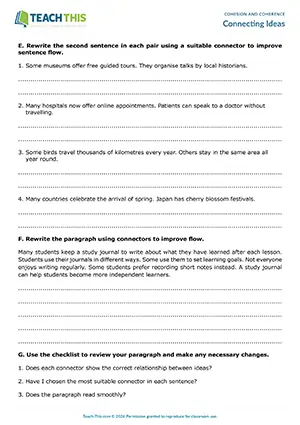
EAP Logical Connectors Worksheet - Vocabulary and Writing Exercises: Identifying, Categorising, Gap-fill, Rewriting Sentences and a Paragraph
In this logical connectors worksheet, students practice choosing the most appropriate logical connector so their writing is clearer and flows more smoothly, from single...
Creating Strong Lexical Chains
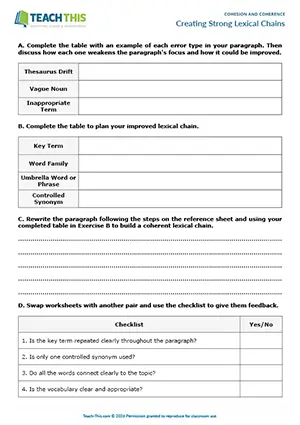
EAP Lexical Chains Activity - Reading, Vocabulary and Writing: Identifying, Table Completion, Rewriting a Paragraph, Peer Feedback - Pair Work
In this lexical chains activity, students explore how lexical chains create clearer focus and smoother flow in academic paragraphs, helping the reader track the main...
What Does 'It' Refer To?
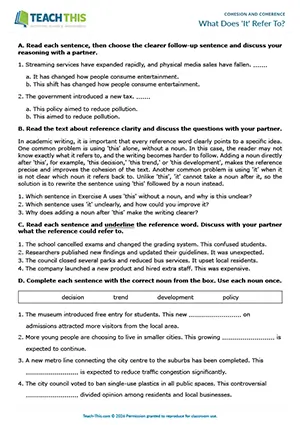
EAP Reference Words Worksheet - Reading, Vocabulary and Writing Exercises: Sentence Rewriting, Paragraph Rewriting - Speaking Activity: Discussion - Pair Work
In this reference words worksheet, students practice identifying unclear reference words and rewriting sentences and paragraphs to improve clarity in academic...
Writing Bridge Sentences
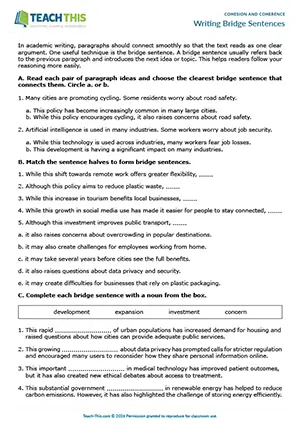
EAP Bridge Sentences Worksheet - Reading, Vocabulary and Writing Exercises: Binary Choice, Matching, Gap-fill, Sentence Completion, Writing Sentences
In this bridge sentences worksheet, students practice identifying, completing and writing bridge sentences that link paragraph ideas using reference nouns and...
Understanding Cohesion and Coherence
Cohesion concerns the language connections that link sentences and paragraphs, including reference words, connectors and related vocabulary. Coherence concerns whether the ideas form a clear, logical whole that the reader can follow.
This page contains four resources from intermediate (B1) to upper-intermediate (B2). The worksheets and activity cover logical connectors, lexical chains, reference clarity and bridge sentences between paragraphs. There are currently no free downloads on this page.
Use the examples below to distinguish a language connection from the relationship it needs to express. Adding connectors alone does not make unrelated ideas coherent.
| Focus | Purpose | Example or guidance |
|---|---|---|
| Logical connectors | Show the relationship between ideas | 'The course was demanding. However, most students completed it.' The connector signals a contrast. |
| Clear reference | Identify the person, thing or idea being discussed | 'Students received detailed feedback. This feedback helped them revise their work.' |
| Lexical chains | Maintain a recognisable topic through related vocabulary | 'public transport', 'buses', 'trains' and 'these services' can connect a discussion of transport. |
| Bridge sentences | Connect a previous point with the next paragraph's focus | 'Although the scheme reduced costs, its effect on service quality requires separate consideration.' |
| Coherent development | Arrange relevant ideas in an order the reader can understand | State a point, explain it and develop it with relevant support before moving to a new point. |
How to Develop Cohesion and Coherence
Identify the relationship before choosing a connector: Ask whether the next sentence adds information, contrasts with a point or describes a result. Students should be able to explain the connection in simple language before selecting a linking expression.
Make references easy to trace: Ask students to draw a line from a reference word to what it refers to. Where several interpretations are possible, use a more specific noun phrase. Repeating a key term can be clearer than replacing it with an ambiguous pronoun.
Review the paragraph's direction: Have students summarise the purpose of each sentence and explain how it contributes to the main point. Check relevance and order before polishing vocabulary links or adding transitions.
3-Step Framework for Teaching Cohesion and Coherence
For upper-intermediate students, move from clear references to sustained vocabulary connections and whole-paragraph revision. The final two stages develop the same lexical-chain activity, allowing students to apply and review the changes they have planned.
1. Clarify what reference words mean: Students compare possible follow-up sentences, discuss which is clearest and identify ambiguous references. They then rewrite sentence pairs and a paragraph with clearer alternatives. This establishes the habit of checking what the reader can identify from the text.
2. Build a consistent vocabulary chain: Working in pairs, students identify a paragraph's key term and its broader umbrella expression. They locate problems using a reference sheet, discuss how those problems weaken the connection between ideas and plan an improved lexical chain in a table.
3. Revise and test the paragraph: Students rewrite the paragraph using their planned vocabulary chain. Another pair reads the revision, completes a checklist and gives feedback. Use that response to check whether the topic remains recognisable and references are clear throughout the paragraph.
Common Mistakes with Cohesion and Coherence
Choosing a connector that misrepresents the relationship: A connector needs to express the intended link between the ideas. Mismatched contrast: 'The library extended its opening hours. However, students could study there for longer.' Clear result: 'The library extended its opening hours. As a result, students could study there for longer.'
Leaving a pronoun's reference unclear: When two possible referents appear together, a pronoun may leave the reader guessing. Ambiguous: 'The tutor discussed the report with the student before she revised it.' Clearer, if the student made the revision: 'The tutor discussed the report with the student before the student revised it.' Clarify the intended meaning before choosing the replacement.
Common Questions About Teaching Cohesion and Coherence
How can I teach students to link paragraphs?
The worksheet Writing Bridge Sentences helps students connect paragraph ideas using reference nouns and contrast linkers. Students compare possible bridges, match sentence halves and complete missing language. They then build and write their own bridge sentences, moving from recognising a clear connection to expressing the relationship between two paragraph ideas.
What worksheet helps with teaching logical connectors?
The worksheet Connecting Ideas asks students to identify connectors that do not match the relationship between ideas. They categorise expressions, choose suitable alternatives and rewrite sentences before revising a paragraph. A final checklist encourages students to review their choices, focusing on logical meaning rather than simply adding more linking words.
Become a Teach This Member
Get unlimited access to the full library, plus new resources added every week.
Unlimited Resource Access
Download from 3000+ worksheets, activities, and games.
Save 5+ Hours Weekly
Cut lesson prep time with ready-to-use resources, plus teacher notes and answer keys.
Trusted Professional Quality
Classroom-tested, editable resources created by experienced ESL professionals.
Fresh Content Weekly
Get 5 new resources added to the library each week.
Here's what our members are saying...


