
Academic Style & Tone EAP Worksheets & Games
From General to Precise
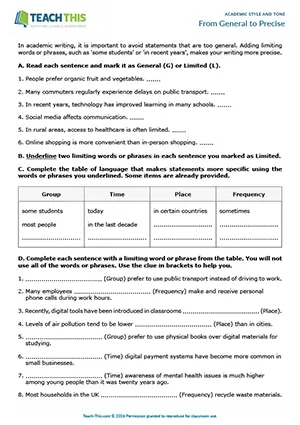
EAP Limiting Generalisations Worksheet - Reading, Vocabulary and Writing Exercises: Categorising, Table Completion, Gap-fill, Rewriting Sentences and a Paragraph
In this limiting generalisations worksheet, students learn how to avoid very general statements by adding time, place, frequency, and group words and phrases...
Hedge Your Claims
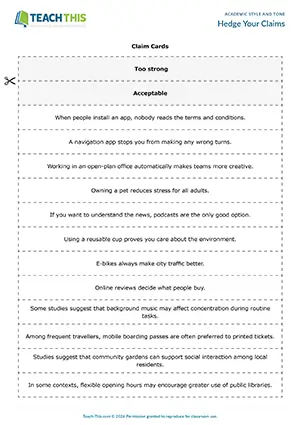
EAP Hedging Language Game - Speaking, Reading, Vocabulary and Writing: Categorising, Rewriting Sentences - Group Work
In this hedging language game, students compete to spot claims that sound too strong and rewrite them using common hedging language. First, in groups...
From Strong Claims to Neutral Language
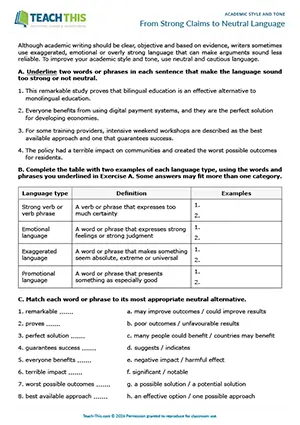
EAP Neutral Academic Tone Worksheet - Reading, Vocabulary and Writing Exercises: Table Completion, Matching, Gap-fill, Writing and Rewriting Sentences
In this free neutral academic tone worksheet, students identify exaggerated, emotional and promotional language in short academic-style statements and rewrite the...
From Vague to Precise
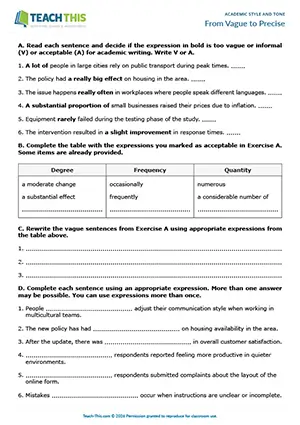
EAP Academic Qualifiers Worksheet - Reading, Vocabulary and Writing Exercises: Categorising, Table Completion, Rewriting Sentences, Gap-fill, Paragraph Writing
In this academic qualifiers worksheet, students learn to make statements more precise by choosing academic expressions of degree, frequency, and...
From Wordy to Concise
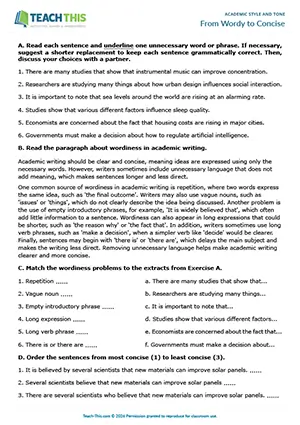
EAP Concise Writing Worksheet - Reading and Writing Exercises: Identifying, Matching, Ordering, Rewriting Sentences and a Paragraph
In this concise writing worksheet, students identify common sources of wordiness and then practice tightening sentences and editing a paragraph to meet a word...
Guiding the Reader
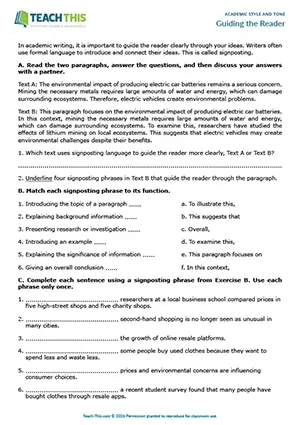
EAP Signposting Language Worksheet - Reading, Vocabulary and Writing Exercises: Identifying, Matching, Gap-fill, Rewriting Sentences and a Paragraph
In this signposting language worksheet, students analyse a short model text to see how signposting phrases guide the reader through an argument and...
Making Claims More Cautious
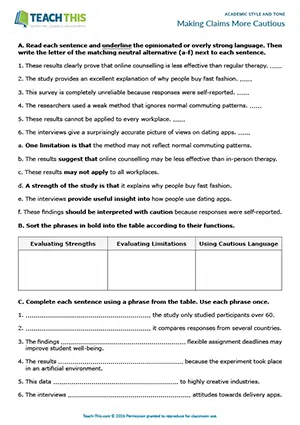
EAP Cautious Language Worksheet - Vocabulary, Reading and Writing Exercises: Identifying, Matching, Categorising, Gap-fill, Rewriting Sentences and a Paragraph
In this cautious language worksheet, students practise spotting overly strong claims and rewriting them in a more cautious, neutral academic style. First, students...
Nominalisation Basics
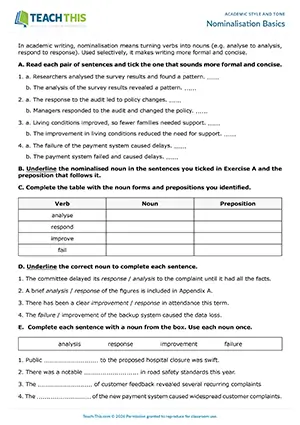
EAP Nominalisation Worksheet - Reading, Vocabulary and Writing Exercises: Binary Choice, Table Completion, Gap-fill, Rewriting Sentences and a Paragraph
In this nominalisation worksheet, students compare informal and more academic sentence options and then use a small set of common nominalisations to...
Raising the Register
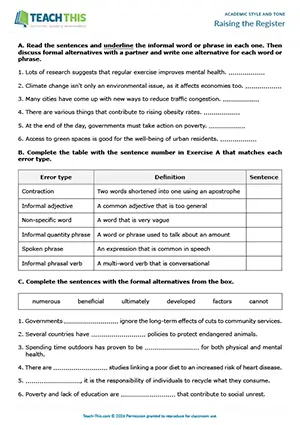
EAP Academic Register Worksheet - Reading, Vocabulary and Writing Exercises: Identifying, Matching, Gap-fill, Table Completion, Rewriting a Paragraph
In this academic register worksheet, students identify informal language in sentences and a paragraph, then practise replacing it with more formal, academic...
Understanding Academic Style and Tone
Academic style concerns how writers organise and express ideas clearly, precisely and appropriately for their readers. Academic tone communicates the writer's stance, including how cautiously they present claims and how neutrally they discuss a topic.
This page contains eight worksheets from intermediate (B1) to upper-intermediate (B2), including one free download. The materials cover limiting generalisations, neutral language, qualifiers, concise writing, signposting, cautious claims, nominalisation and academic register.
The illustrative examples below show how a revision can serve a particular purpose. Appropriate choices depend on the assignment, discipline and available evidence; academic writing does not simply mean using longer words.
| Purpose | Writing choice | Example and guidance |
|---|---|---|
| Limit a generalisation | Identify the relevant group or context | Use 'Students in this class...' rather than 'All students...' when the evidence concerns only that class. |
| Express appropriate caution | Match the strength of the claim to the evidence | 'The results suggest...' may fit tentative evidence better than 'The results prove...'. |
| Remove unnecessary wording | Replace a lengthy phrase without changing its meaning | 'Because' can replace 'due to the fact that'. |
| Use neutral language | Describe an effect instead of praising it | Replace 'an amazing improvement' with a description of what improved, supported by the actual results. |
| Guide the reader | Signal a genuine relationship between ideas | Use 'However' for a contrast and 'For example' to introduce an illustration. |
| Choose an appropriate register | Select wording suited to the task | 'Investigate the causes' may be more suitable than 'look into the causes' in a formal report. |
How to Develop Academic Style and Tone
Start with purpose and audience: Compare short examples written for different readers. Ask students which wording suits the assignment and why. Avoid treating first-person writing, active voice or familiar words as automatically unsuitable for academic work.
Check meaning before polishing language: Ask what a sentence claims and what evidence would support it. When students add qualifiers or remove words, check that the revision preserves the intended meaning and does not introduce unsupported details.
Separate editing decisions: Review precision, tone and organisation in distinct passes. Students should explain the purpose of each change, rather than replace words with formal alternatives without considering the sentence or paragraph.
3-Step Framework for Teaching Academic Style and Tone
For upper-intermediate students, develop precision at sentence level before revising claims and organising a paragraph. Use selected stages from the page's worksheets across lessons, checking that students can explain their choices before moving to independent writing.
1. Make statements more precise: Students distinguish vague or informal sentences from acceptable examples and organise expressions of degree, frequency and quantity in a table. They then revise sentences and develop their own topic ideas. Require each qualifier to express an intended meaning rather than simply make the sentence sound academic.
2. Adjust the strength of claims: Students identify overly strong wording, match neutral alternatives and group expressions by function. They apply the language in sentences before revising a paragraph. Discuss whether each revision communicates suitable caution without making the claim unnecessarily vague.
3. Make the argument easier to follow: Students compare model paragraphs and match signposting phrases with their functions. After revising short passages, they use notes to write a paragraph with signposting. Check that each phrase reflects the relationship between the ideas, rather than merely adding a formal transition.
Common Mistakes with Academic Style and Tone
Extending a claim beyond its evidence: A statement about one group should not automatically become a claim about everyone. In a hypothetical report based on one class, Too broad: 'All students preferred the new timetable.' Limited to the evidence: 'All students surveyed in this class preferred the new timetable.' The revised claim is appropriate only if every surveyed student actually expressed that preference.
Making writing longer to sound formal: Extra words can obscure a clear relationship without adding meaning. Wordy: 'Due to the fact that the instructions were unclear, participants asked questions.' More concise: 'Because the instructions were unclear, participants asked questions.' The original is grammatical; the revision expresses the same point more directly.
Common Questions About Teaching Academic Style and Tone
What worksheet can I use for teaching academic style?
The worksheet Raising the Register helps students recognise informal wording and replace it with academic alternatives. Students identify expressions, discuss replacements and sort examples by error type. They then analyse and rewrite a paragraph, applying the language choices in connected writing rather than only changing isolated words.
How can I teach students to write more concisely?
The worksheet From Wordy to Concise focuses on removing unnecessary language while preserving meaning. Students identify redundant wording, match examples to types of wordiness and compare sentences for concision. They then edit sentences and a paragraph, moving from spotting a problem to making their own decisions about what to cut.
What free worksheet helps with teaching academic tone?
The worksheet From Strong Claims to Neutral Language helps students identify exaggerated, emotional and promotional wording. They match expressions with neutral alternatives, complete sentences and rewrite claims. Finally, partners exchange deliberately exaggerated sentences and revise each other's wording, giving them practice recognising and adjusting tone in another person's writing.
Become a Teach This Member
Get unlimited access to the full library, plus new resources added every week.
Unlimited Resource Access
Download from 3000+ worksheets, activities, and games.
Save 5+ Hours Weekly
Cut lesson prep time with ready-to-use resources, plus teacher notes and answer keys.
Trusted Professional Quality
Classroom-tested, editable resources created by experienced ESL professionals.
Fresh Content Weekly
Get 5 new resources added to the library each week.
Here's what our members are saying...


