
Too & Enough ESL Activities, Games & Worksheets
A Weekend by the Sea

ESL Too and Enough Activity - Grammar and Speaking: Information Gap, Asking and Answering Questions, Gap-fill, Writing Sentences - Pair Work
This productive too and enough speaking activity helps students to practice too, too much, too many and enough. In the activity, students complete a hotel...
Too vs. Enough

ESL Too vs. Enough Worksheet - Grammar Exercises: Identifying, Gap-fill, Writing Sentences
This free too and enough worksheet helps students to learn and practice too, too many, too much, and enough. Students start by underlining the correct form of enough in a set of sentences. Students...
Denny's Disgusting Diner

ESL Too and Enough Activity - Vocabulary and Speaking: Information Gap, Sentence Completion, Freer Practice - Group Work
In this useful too and enough speaking activity, students find out classmates' restaurant complaints and make sentences about them with too and enough. In groups, students take on the role...
Do you want to play baseball?
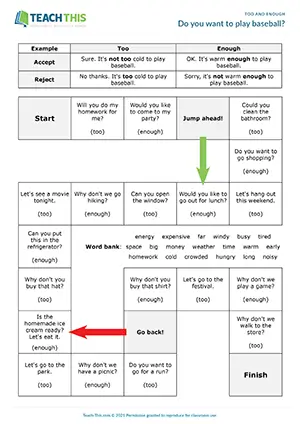
ESL Too and Enough Board Game - Grammar and Speaking: Forming Sentences - Group Work
Here is a fun too and enough board game to help students practice using too and enough in negative sentences. Players take it in turns to roll the dice and move their counter along the board. If a player rolls...
Too and Enough Question Time

ESL Too and Enough Questions Activity - Grammar and Speaking: Gap-fill, Asking and Answering Questions, Controlled and Freer Practice - Pair Work
In this insightful too and enough speaking activity, students complete a set of questions with 'too' or 'enough' and ask and answer the questions with a partner...
What's in your suitcase?

ESL Too and Enough Activity - Grammar and Speaking: Categorising, Information Gap, Asking and Answering Questions - Pair Work
This enjoyable too and enough information gap activity helps students practice too much, too many and enough. In two groups, students look at a chart that shows items they expect a friend to have packed for...
Understanding Too and Enough
'Too' and 'enough' both describe degree, but they pull in opposite directions. 'Too' signals that something exceeds an acceptable limit, so a result becomes negative: the coffee is too hot to drink, the bag is too heavy to carry. 'Enough' signals that something meets or reaches the required level, so a result becomes possible: the coffee is cool enough to drink, the bag is light enough to carry. Because the two words sit on opposite ends of the same scale, confusing them flips the meaning of a sentence entirely, a mistake that undermines clear communication in everyday situations such as giving reasons, making polite refusals, or explaining decisions.
This page provides six activities, games, and worksheets for teaching too and enough at Pre-intermediate (A2) and Intermediate (B1) level, including one free PDF download.
The table below shows the key forms of too and enough with their functions and example sentences.
| Form | Function | Example |
|---|---|---|
| Too + adjective | Shows excess before an adjective | 'The soup is too salty to eat.' |
| Too + adverb | Shows excess before an adverb | 'She spoke too quickly for us to follow.' |
| Too much + uncountable noun | Shows excess with uncountable nouns | 'There is too much sugar in this recipe.' |
| Too many + countable noun | Shows excess with countable nouns | 'There are too many people in the room.' |
| Adjective + enough | Shows sufficiency after an adjective | 'The ladder is tall enough to reach the shelf.' |
| Adverb + enough | Shows sufficiency after an adverb | 'He drove slowly enough to stop in time.' |
| Enough + noun | Shows sufficiency before a noun | 'We have enough time to finish the task.' |
| Not enough + noun | Shows insufficiency before a noun | 'There is not enough space for another desk.' |
When to Use Too and Enough
Polite Refusals: Explaining why you cannot accept an invitation sounds more natural when you give a reason based on degree rather than a flat no. For example, 'I'm sorry, I'm too tired to come to the party tonight' sounds more considerate than simply declining.
Giving Reasons for Decisions: Too and enough allow speakers to explain cause and effect concisely in everyday situations. For example, 'She got the job because she was experienced enough to manage the team' connects the outcome directly to the degree of experience without needing extra clauses.
Describing Suitable Conditions: Checking whether conditions meet a required standard is a common real-world task, from choosing a hotel room to planning an event. For example, 'The conference room isn't big enough for 50 guests' states the problem and implies the need for action in a single clear sentence.
3-Step Framework for Teaching Too and Enough
1. Build Accuracy with Controlled Question Practice: A gap-fill task gives students a clear grammatical anchor before they move into speaking. Working alone, students choose 'too' or 'enough' and select a suitable word from a box to complete each question correctly, for example 'Are you old enough to stay up late on school nights?' Once every question is grammatically correct, students take turns asking and answering the questions with a partner, note down their partner's answers, and ask follow-up questions to find out more. This takes 30 minutes and suits Intermediate (B1) learners.
2. Develop Reading and Speaking Through an Information-Gap Task: Information-gap tasks create genuine communication because each student holds details the other needs. In a hotel-review task, students ask their partner questions to find out the missing problems in a table. The partner reads out a gap-fill sentence using the word 'blank' for the missing information, for example 'The hotel was BLANK from the beach,' and the student listens, then completes the sentence with too, too much, too many, or enough and a word from the box on their worksheet. This takes 25 minutes and suits Pre-intermediate (A2) learners.
3. Extend Fluency Through a Negotiation Task: Open tasks push students to apply grammar spontaneously in a real-world context. In a suitcase-packing task, students look at a chart of items a friend has packed for them, identify which items are countable and which are uncountable, and then talk about what is in and missing from their suitcase using too and enough. Students then pair up and ask their partner about what is in their suitcase using 'How much' or 'How many,' note down the answers, and offer or request items depending on whether they have too much, too many, or not enough of each. This takes 25 minutes and suits Intermediate (B1) learners.
Common Mistakes with Too and Enough
Misplacing 'enough' with nouns: Students often place 'enough' after a noun instead of before it, applying the adjective rule where it does not belong. Unlike adjectives, nouns require 'enough' to come before them. Wrong: 'We have time enough to finish the task.' Correct: 'We have enough time to finish the task.'
Confusing 'too' with 'very': Students often use 'too' when the intended meaning is simply 'very,' not realizing that 'too' implies a negative result or an unacceptable degree. 'Very' is the correct choice when no negative consequence is implied. Wrong: 'The view from the hotel was too beautiful.' Correct: 'The view from the hotel was very beautiful.'
Common Questions About Teaching Too and Enough
What is a fun board game for practicing too and enough?
The board game Do you want to play baseball? keeps players on their toes: a dice roll decides whether they accept or reject an invitation, so they never know which way to answer. Either way, they form a sentence with 'too' or 'enough' and a word from the word bank. A wrong or repeated answer sends them back two squares.
What is a good worksheet for teaching too and enough?
The worksheet Too vs. Enough covers all four forms: students underline the correct form of enough, complete sentences with too, too many, or too much, then rewrite sentences to express the same meaning. A final section asks students to write sentences with the opposite meaning, which pushes them to think carefully about the contrast between excess and sufficiency.
What is a useful speaking activity for practicing too and enough?
Character cards make the activity Denny's Disgusting Diner feel real: each student plays someone with a complaint about a horrible restaurant they visited, and their task is to find out everyone else's complaints by asking questions and completing a chart. Once the chart is complete, students form sentences using too and enough with words in brackets.
Become a Teach This Member
Get unlimited access to the full library, plus new resources added every week.
Unlimited Resource Access
Download from 3000+ worksheets, activities, and games.
Save 5+ Hours Weekly
Cut lesson prep time with ready-to-use resources, plus teacher notes and answer keys.
Trusted Professional Quality
Classroom-tested, editable resources created by experienced ESL professionals.
Fresh Content Weekly
Get 5 new resources added to the library each week.
Here's what our members are saying...


