
Modal Verbs of Possibility & Certainty ESL Games, Activities & Worksheets
Don't leave home without it!
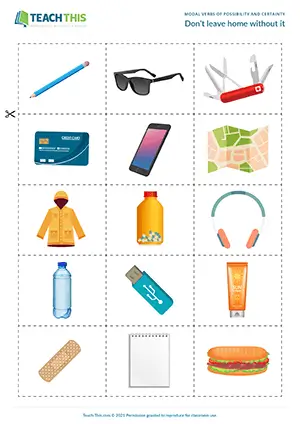
ESL May and Might Game - Speaking: Forming Sentences, Guessing - Group Work
Here is a fun modal verbs of possibility game to help students practice the modal verbs of possibility 'may' and 'might' and the demonstrative pronouns 'this' and 'these'. In the activity, students play a guessing game where they describe objects...
Holiday Possibilities
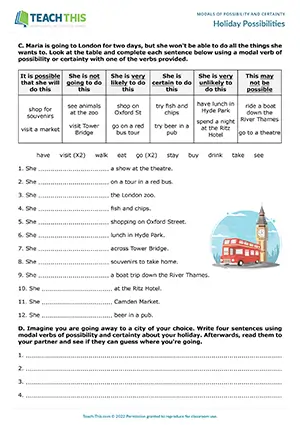
ESL Modal Verbs of Possibility and Certainty Worksheet - Grammar Exercises: Table Completion, Matching, Unscrambling, Gap-fill - Speaking Activity - Pair Work
This comprehensive modal verbs of possibility and certainty worksheet helps students practice will, won't, probably will, probably won't, may and might...
Life in the Year 2050
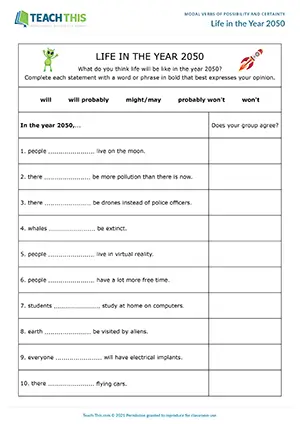
ESL Modal Verbs of Possibility and Certainty Activity - Speaking: Sentence Completion, Discussion, Freer Practice - Group Work
In this free modal verbs of possibility and certainty speaking activity, students make predictions and express possibility and degrees of certainty for statements about life in the year 2050 using will...
The Day Trip

ESL May and Might Game - Vocabulary and Speaking: Forming Sentences, Freer Practice - Group Work
In this engaging may and might game, students use modal verbs of possibility to make sentences about things they are going to take on a day trip. First, students imagine that they are going on a day...
The Realms of Possibility

ESL May and Might Activity - Speaking: Asking and Answering Questions, Freer Practice - Group Work
In this insightful may and might speaking activity, students practice asking and answering questions about the future using 'will' and 'won't' for predictions and the modal verbs of possibility 'may' and...
Guess the Place or Situation
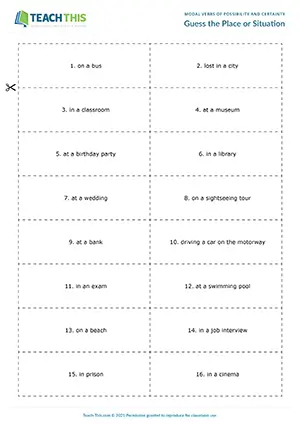
ESL Modal Verbs of Possibility Game - Writing and Speaking: Describing, Writing Clues, Guessing - Pair Work
In this creative may, might and could game, students describe places and situations using modal verbs of possibility for other students to guess. In pairs, students describe the place or situation on their card...
In the next 30 years...
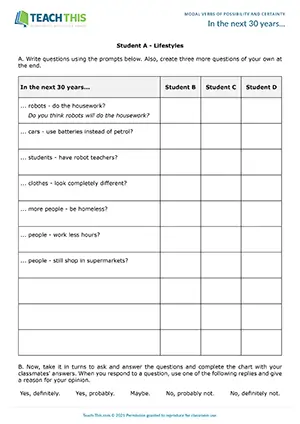
ESL Modal Verbs of Possibility Activity - Speaking: Asking and Answering Questions, Summarising - Group Work
In this thought-provoking modal verbs of possibility speaking activity, students ask and answer questions about what changes they think will take place in the next 30 years. This activity covers making...
It might rain tomorrow
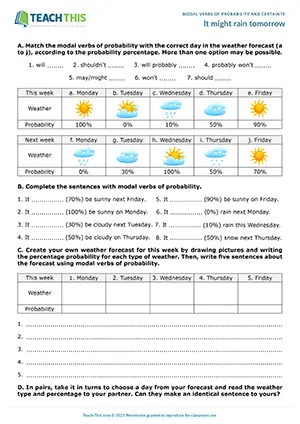
ESL Modal Verbs of Probability Worksheet - Grammar Exercises: Matching, Gap-fill, Writing Sentences - Speaking Activity: Forming Sentences - Pair Work
In this useful modal verbs of probability worksheet, students learn and practice modal verbs of probability by talking about the weather. Students start by...
It's Possible

ESL Modal Verbs of Possibility and Certainty Activity - Speaking: Asking and Answering Questions, Presenting - Pair and Group Work - Writing: Summarising
This free modal verbs of possibility and certainty speaking activity can be used to help teach students modal verbs of possibility, adverbs of probability...
Jon's Story

ESL Could, May and Might Activity - Reading and Speaking: Writing Sentences, Discussion, Freer Practice - Group Work
In this memorable could, may and might activity, students read a short story and write sentences with modal verbs of possibility about what they think the people in the story might do or say next. To begin...
Modal Mania
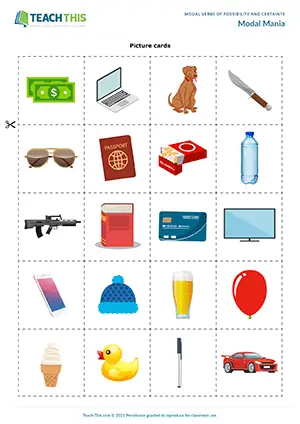
ESL Modal Verbs of Possibility Game - Speaking: Matching, Explaining - Group Work
In this entertaining modal verbs of possibility game, students practice explaining how something is possible. Players take it in turns to pick up a possibility card and read the item on the card to the other...
Will it happen?
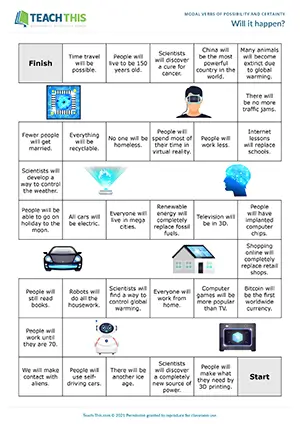
ESL Modal Verbs of Possibility and Certainty Board Game - Speaking: Forming Sentences, Freer Practice - Group Work
In this enjoyable modal verbs of possibility and certainty board game, students express possibility and degrees of certainty for statements about the future. Players take it in turns to roll the dice and...
Understanding Modal Verbs of Possibility and Certainty
Modal verbs of possibility and certainty are words like 'might', 'may', 'could', and 'must' that tell a listener or reader how likely a speaker thinks something is. When students mix up 'will' and 'might', for example, they accidentally turn an uncertain prediction into a firm commitment, which can mislead a listener or create an impression of overconfidence the speaker never intended.
This page covers modal verbs of possibility and certainty across three levels from Pre-intermediate (A2) to Upper-intermediate (B2), with 13 activities including speaking games, worksheets, board games, and discussion tasks, with two available as free downloads.
Each modal verb of possibility and certainty sits at a different point on the scale from logical impossibility through to near-certain prediction, and matching the right modal to the right level of confidence shapes how a speaker comes across.
| Modal Verb | Degree of Certainty or Possibility | Example Sentence | Negative Form |
|---|---|---|---|
| will | near-certain prediction (positive) | 'It will rain this afternoon.' | won't (near-certain negative prediction) |
| must | logical certainty based on evidence (present deduction) | 'She must be at home, the lights are on.' | can't (logical impossibility) |
| should | strong expectation | 'The package should arrive by Friday.' | shouldn't (expectation not met) |
| may | moderate possibility | 'He may come to the party.' | may not (moderate possibility negated) |
| might | weaker possibility | 'I might take the day off tomorrow.' | might not (weaker possibility negated) |
| could | open possibility or deduction | 'That noise could be a bird.' | couldn't (open possibility negated) |
| can't | logical impossibility based on evidence | 'That can't be right, I checked twice.' | n/a (already a negative form) |
When to Use Modal Verbs of Possibility and Certainty
Speculating about present situations: Speakers use 'must', 'could', 'may', or 'might' when they draw a conclusion from evidence rather than direct knowledge, making their reasoning transparent to a listener, as in 'The lights are off, so everyone must have left for the day.'
Softening predictions to avoid commitment: A speaker or writer reaches for 'might' or 'may' instead of 'will' when they want to signal that a prediction is genuinely uncertain, protecting themselves from being held to a firm claim, as in 'The project may take longer than we expected.'
Expressing logical impossibility: 'Can't' functions as the confident negative equivalent of 'must' and signals that the speaker finds something logically impossible based on what they know, as in 'That can't be the right address, this is a car park.'
3-Step Framework for Teaching Modal Verbs of Possibility and Certainty
1. Build the Form Through Structured Practice: Before students produce modal verbs of possibility and certainty freely, they need to see the relationship between each modal and the degree of certainty it carries. A worksheet that anchors modals to concrete probability percentages does this efficiently: students match each modal to the correct level of certainty, complete gap-fill sentences using the key they have just built, and then create their own weather forecast with percentage probabilities attached. The final accuracy check is built into the task itself, with one student reading a weather type and percentage aloud while their partner tries to make an identical sentence to the one the student wrote. Matching an exact sentence removes ambiguity and makes right and wrong immediately visible to both students.
2. Move to Semi-Controlled Production with a Story: Once students can select the right modal for a given level of certainty, give them a context that shapes what they can plausibly say without dictating the answer. A short story works well here because the narrative creates genuine constraints: students read about a character facing a dilemma and write two sentences about what they think the people in the story might do or say next using the modal verbs of possibility: could, may and might. Because the story provides a shared context, students can challenge each other's suggestions and the discussion that follows generates natural, purposeful use of all three modals without the teacher needing to prompt it.
3. Extend to Freer Production with a Board Game: At upper-intermediate level, push students to use the full spectrum from open possibility through to near-certain prediction in quick succession. A board game format sustains this over an extended period because every turn generates a new topic: when a player lands on a square, they read a statement about the future aloud and say whether they agree or disagree with the prediction by expressing possibility or degrees of certainty and explaining their opinion. Other group members judge the response, and any player who expresses themselves inadequately moves back two squares. The combination of personal opinion and peer judgment keeps the language authentic and the pace high.
Common Mistakes with Modal Verbs of Possibility and Certainty
Using 'must' for future prediction instead of deduction: Students often use 'must' to make a future prediction, confusing the deduction use of 'must' with prediction about future events, when 'will' or 'might' is needed instead. Wrong: 'It must rain tomorrow because the sky is cloudy.' Correct: 'It might rain tomorrow because the sky is cloudy.'
Using 'can' instead of 'could' for present possibility: Students often write 'can' when they mean to express a present possibility or speculation, not realising that 'can' expresses general ability or permission while 'could' signals possibility in the context of deduction. Wrong: 'That noise can be a dog barking next door.' Correct: 'That noise could be a dog barking next door.'
Common Questions About Teaching Modal Verbs of Possibility and Certainty
What is a fun game for practicing 'may' and 'might'?
The game The Day Trip gives each student a random picture card and challenges them to explain why they would pack that object on a day trip using 'may' or 'might', for example 'I'm going to take a camera because I might want to take some photos.' A suitable sentence wins the card; the student with the most cards wins.
What is a good worksheet for teaching modal verbs of probability?
The worksheet It might rain tomorrow makes modal probability concrete by linking each modal to a percentage. Students match modals to the right certainty level, complete gap-fill sentences using the key they built, then write five sentences about their own weather forecast. A partner reads a weather type and percentage aloud and tries to produce an identical sentence.
What is a free activity for practicing modal verbs of possibility and certainty?
Life in the Year 2050 is a free activity where students complete prediction statements using 'will', 'will probably', 'might', 'probably won't', and 'won't', for example 'In the year 2050, people might live on the moon.' Because every student has a different opinion, the group discussion that follows generates natural, unscripted use of all the modals.
Become a Teach This Member
Get unlimited access to the full library, plus new resources added every week.
Unlimited Resource Access
Download from 3000+ worksheets, activities, and games.
Save 5+ Hours Weekly
Cut lesson prep time with ready-to-use resources, plus teacher notes and answer keys.
Trusted Professional Quality
Classroom-tested, editable resources created by experienced ESL professionals.
Fresh Content Weekly
Get 5 new resources added to the library each week.
Here's what our members are saying...


