
Second Conditional ESL Activities, Games & Worksheets
20 Questions in the Second Conditional
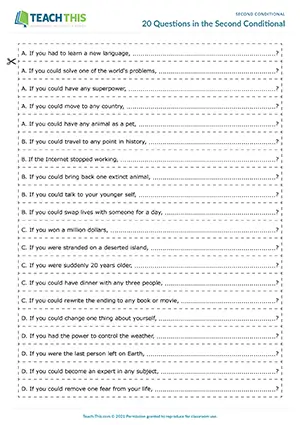
ESL Second Conditional Game - Grammar and Speaking: Forming, Asking and Answering Questions, Freer Practice - Group Work
In this free second conditional game, students students write, ask and answer questions using the second conditional. First, students complete each if-clause...
Going Away
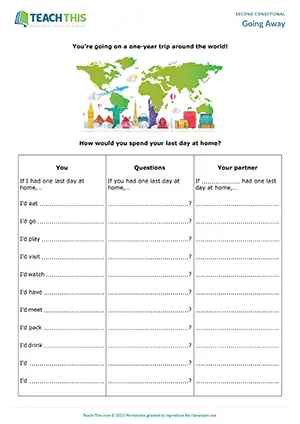
ESL Second Conditional Activity - Speaking: Sentence and Question Completion, Asking and Answering Questions, Controlled Practice - Pair Work
In this intriguing second conditional speaking activity, students ask and answer questions about how they would spend their last day at home if they were going away...
I think you would...
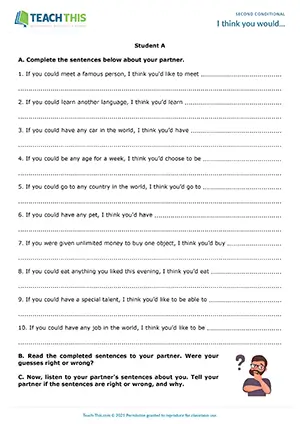
ESL Second Conditional Game - Grammar: Sentence Completion, Guessing - Pair Work
In this fun second conditional game, students complete sentences by guessing what a classmate would do in various hypothetical situations and then check whether their guesses were right or wrong. To begin, students complete ten...
Second Conditional Board Game
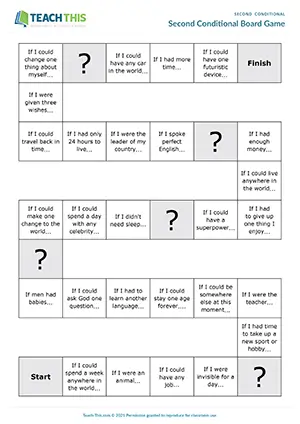
ESL Second Conditional Board Game - Grammar and Speaking: Sentence Completion, Forming Sentences, Impromptu Speech, Freer Practice - Group Work
Here is an engaging second conditional board game to help students practice the second conditional by completing prompts and speaking about imaginary...
Second Conditional Exercises
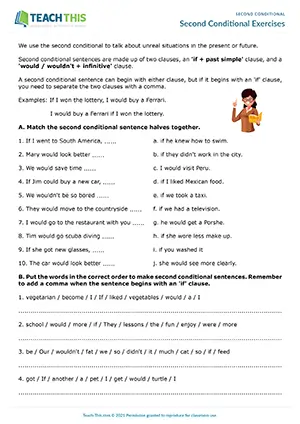
ESL Second Conditional Worksheet - Grammar Exercises: Matching, Gap-fill, Sentence Completion - Speaking Activity: Asking and Answering Questions
This free second conditional worksheet helps students learn and practice how to form and use the second conditional. Students begin by reading how the second...
Stranded on a Desert Island
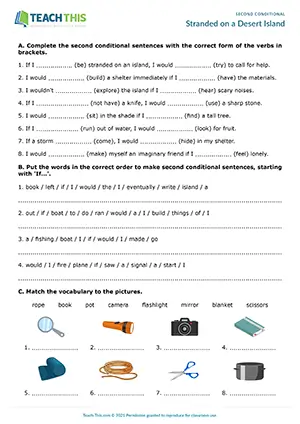
ESL Second Conditional Worksheet - Grammar Exercises: Gap-fill, Unscrambling, Matching, Writing Sentences
In this useful second conditional worksheet, students practice the second conditional by completing controlled tasks and writing about how to use survival items on a desert island. Students start by completing...
What would you do?
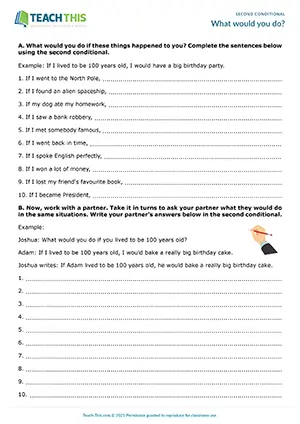
ESL Second Conditional Activity - Grammar and Speaking: Sentence Completion, Asking and Answering Questions, Freer Practice - Pair Work
In this insightful second conditional activity, students complete second conditional sentences about hypothetical situations and use them to ask and answer...
What would you do if...?
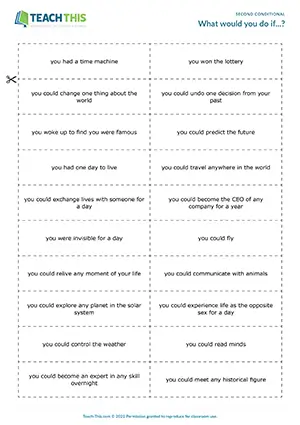
ESL Second Conditional Activity - Grammar and Speaking: Forming, Asking and Answering Questions, Writing Sentences
In this interesting second conditional activity, activity, students ask classmates what they would do in various hypothetical situations and then write a sentence reporting each person's answer using the...
If we didn't have...
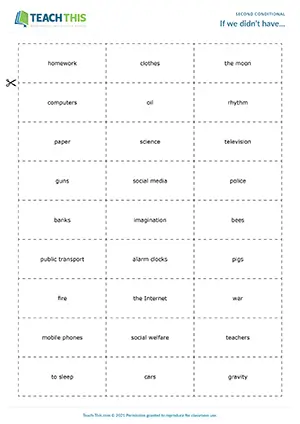
ESL Second Conditional Game - Grammar and Speaking: Describing, Forming Sentences, Guessing - Group Work
In this second conditional guessing game, students describe life without different items or concepts and classmates guess what they are. In groups, students take turns picking up a card and making second...
Metaphorical Madness
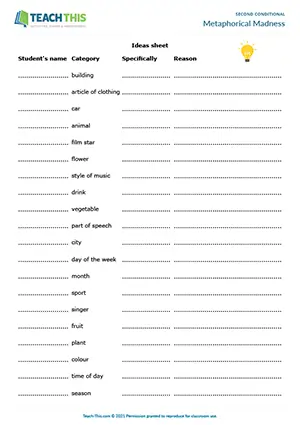
ESL Second Conditional Game - Grammar: Matching, Writing Sentences, Guessing - Group Work
In this imaginative second conditional game, students create metaphors using the second conditional and then play a team guessing game based on their metaphors. First, teams match 20 classmates to...
Second Conditional Election
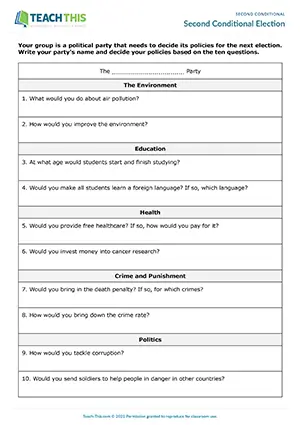
ESL Second Conditional Activity - Grammar, Writing and Speaking: Writing Sentences, Making and Responding to Statements, Freer Practice - Group Work
In this memorable second conditional activity, students form a political party, develop policy proposals, and present what they would do if elected, then respond to...
Would you...?
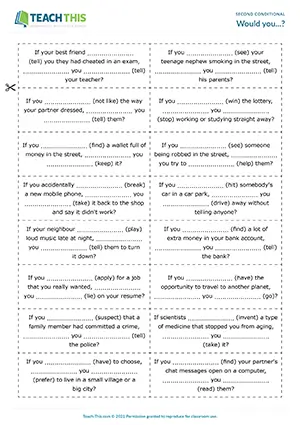
ESL Second Conditional Activity - Grammar and Speaking: Completing, Asking and Answering Questions, Discussion, Freer and Communicative Practice - Group Work
In this free second conditional speaking activity, students complete and ask second conditional questions about hypothetical situations and moral dilemmas...
Understanding the Second Conditional
The second conditional uses 'if' + past simple in the condition clause and 'would' + base verb in the result clause. It describes imaginary or unlikely situations in the present or future, so students who write 'If it rains tomorrow, I would stay home' are mixing first and second conditional structures, which changes the meaning from hypothetical to genuinely possible.
This page covers the second conditional across B1 and B2 levels, with twelve resources including games, worksheets, and speaking activities, three of which are available as free downloads.
The table below shows the core structural forms of the second conditional across common sentence types.
| Form | If Clause | Main Clause | Example |
|---|---|---|---|
| Positive statement | if + subject + past simple | subject + would + base verb | 'If I had more time, I would learn Spanish.' |
| Negative if-clause | if + subject + didn't + base verb | subject + would + base verb | 'If she didn't work so much, she would travel more.' |
| Negative main clause | if + subject + past simple | subject + wouldn't + base verb | 'If he called, I wouldn't answer.' |
| Yes/No question | if + subject + past simple | would + subject + base verb...? | 'If you won the lottery, would you quit your job?' |
| Wh-question | if + subject + past simple | wh-word + would + subject + base verb? | 'If you could live anywhere, where would you live?' |
| Alternative modal | if + subject + past simple | subject + could/might + base verb | 'If I had a car, I could drive you to the airport.' |
When to Use the Second Conditional
Softening a Request: Writers and speakers choose the second conditional when they want to make a request sound less direct or demanding, as the hypothetical framing creates polite distance, for example 'If you had a moment, would you mind checking this for me?'
Giving Personal Advice: When someone wants to offer advice without sounding like they are telling another person what to do, the second conditional frames the suggestion as a personal perspective rather than a command, for example 'If I were you, I would talk to your manager about it.'
Exploring Hypothetical Possibilities: Speakers use the second conditional to open up speculative conversations about things that are unlikely or currently impossible, making it a natural choice in creative or philosophical discussions, for example 'If humans could breathe underwater, how would our cities be different?'
3-Step Framework for Teaching the Second Conditional
1. Ground the Form with Controlled Practice: Start with a structured worksheet that takes students through the full range of exercise types: matching sentence halves, unscrambling words into correct order, gap-fill, and sentence completion using their own ideas. Finish with something that makes the grammar personal: students secretly pick an animal, imagine they are that animal, and use the second conditional to answer questions about their animal life before a partner tries to guess what they are.
2. Build Fluency with a Board Game: Move students into freer production by putting the grammar into a board game format. The moment that sharpens output is the blank 'If' square: when a student lands on it, they create their own second conditional sentence from scratch, then sustain a response for 20 seconds to earn the extra point. That time pressure is what pushes students past safe, one-clause answers.
3. Push into Extended Production with a Role-Play: Take students to upper-intermediate level by giving them a genuine purpose for producing the second conditional at length. Groups form a political party and draft policy proposals by answering ten questions in the second conditional, including 'If we were elected, we would...' When they present to the class, other students may offer up to two counterarguments, also phrased as second conditional statements, before a class vote decides which group made the stronger case.
Common Mistakes with the Second Conditional
Using 'would' in the If Clause: Students often put 'would' in the if-clause as well as the main clause, perhaps because it seems logical to use the conditional word in both parts of the sentence. Wrong: 'If I would have more money, I would travel the world.' Correct: 'If I had more money, I would travel the world.'
Using 'was' Instead of 'were': Students often use 'was' with all subjects in the if-clause, including I, he, she, and it, because it follows normal past tense rules, but formal and written English requires 'were' for all persons in the second conditional. Wrong: 'If she was the president, she would change the law.' Correct: 'If she were the president, she would change the law.'
Common Questions About Teaching the Second Conditional
What is a fun game for practicing the second conditional?
The game 20 Questions in the Second Conditional gives students a structured warm-up for speaking. Students complete each if-clause on question strips and form a second conditional question with would + subject + base verb. In groups, they read the question aloud and give the strip to whoever gave the best answer. The student with the most strips wins.
What is a good second conditional activity for moral dilemmas?
The free activity Would you...? is a strong choice for exploring moral dilemmas through the second conditional. Students complete questions about hypothetical situations, discuss their answers, and agree on a shared group response. The student who drew the card writes the group's agreed answer on the back.
What is a useful worksheet for teaching the second conditional?
A survival scenario makes the second conditional feel purposeful. The worksheet Stranded on a Desert Island has students write what they would do with eight objects to survive, for example, 'If I had a mirror, I would use it to reflect the sun and make a fire.' Controlled gap-fill exercises build the correct form first.
Become a Teach This Member
Get unlimited access to the full library, plus new resources added every week.
Unlimited Resource Access
Download from 3000+ worksheets, activities, and games.
Save 5+ Hours Weekly
Cut lesson prep time with ready-to-use resources, plus teacher notes and answer keys.
Trusted Professional Quality
Classroom-tested, editable resources created by experienced ESL professionals.
Fresh Content Weekly
Get 5 new resources added to the library each week.
Here's what our members are saying...


