
Closing a Presentation Worksheets & Activities
Closing a Business Presentation
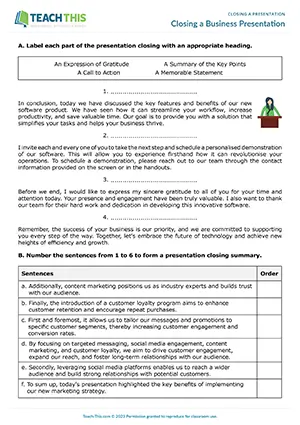
Business English Closing a Presentation Worksheet - Reading, Vocabulary and Writing Exercises: Ordering, Gap-fill, Writing Sentences - Speaking Activity: Presenting
In this comprehensive closing a presentation worksheet, students practice useful language, techniques, and steps for closing a business presentation. First, students...
Closing Call
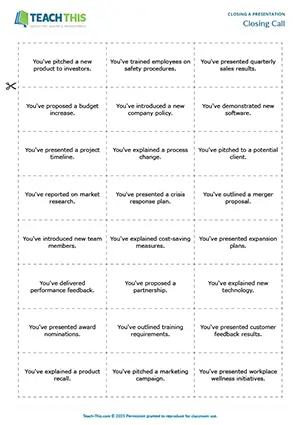
Business English Closing a Presentation Game - Speaking: Preparing and Delivering Part of a Presentation, Freer Practice - Group Work
This challenging closing a presentation game helps students practice professional closing techniques for business presentations across various business situations. In...
Presentation Closers

Business English Ending a Presentation Activity - Listening: Matching - Writing Exercises: Writing Sentences, Guided Writing - Speaking: Delivering a Presentation
Here is a useful presentation closers activity and worksheet to help students practice different ways to end a presentation. First, students do a group...
Tailoring the Close
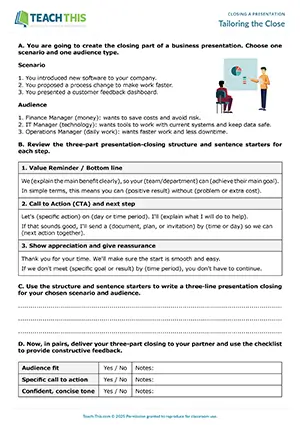
Business English Closing a Presentation Activity - Speaking: Preparing and Delivering Part of a Presentation, Peer Feedback, Freer Practice - Pair Work
In this useful presentation-closing activity, students practice planning, writing, and delivering concise three-line closings tailored to a scenario and a single...
Closing a Business Presentation
Closing a business presentation involves bringing the main message together and making the ending clear to the audience. Depending on the purpose, speakers may summarise key points, recommend a next step, thank listeners or finish with a memorable statement.
This page contains four B2 resources, including worksheets, presentation activities and one free game.
The table connects closing functions with example language. The examples are hypothetical and should be adapted to the presentation and audience.
| Closing function | Purpose | Example language |
|---|---|---|
| Signal the ending | Let listeners know that the presentation is drawing to a close. | 'To finish, let me return to our main recommendation.' |
| Summarise key points | Bring together the points already developed. | 'We have considered the current process, the proposed changes and the next steps.' |
| Reinforce the main message | Leave listeners with a clear takeaway. | 'The key message is that the next stage needs a clear owner.' |
| Propose an action | State a relevant next step when the presentation calls for a decision. | 'Could you approve the pilot by Friday so we can begin planning?' |
| Express gratitude | Acknowledge the audience's time and attention. | 'Thank you for your time and for considering this proposal.' |
| Make the ending memorable | Reinforce an established idea with a concise final statement. | 'A clear plan today gives tomorrow's team a starting point.' |
How to Close a Presentation Clearly
Choose an ending that serves the purpose: An informative update may need a clear takeaway, while a proposal may need a request for a decision. Students do not need to include every closing technique in every presentation.
Match the request to the audience: Before writing a call to action, identify what listeners can realistically decide or do. Keep the request specific and use a tone suited to the relationship and situation.
Keep the final message focused: Select the points listeners most need to remember rather than repeat the whole talk. Rehearse the closing aloud to check whether the final sentence sounds complete and the intended takeaway is easy to identify.
3-Step Framework for Teaching Presentation Closings
This B2 sequence uses a closing-techniques activity followed by an audience-focused planning and delivery activity. The final two steps develop different stages of that second activity.
1. Recognise and Compare Closing Techniques: Students read closing examples aloud, match them to descriptions and group phrases by closing type. They then prepare three possible closers for a supplied conclusion. Comparing alternatives helps them see how the same presentation can end in different ways.
2. Prepare an Audience-Specific Closing: Students review a model, choose a business scenario and audience, and use a three-part structure with sentence starters to write a three-line closing. This provides a concise practice format for connecting the message to a particular decision-maker, rather than a rule for all presentations.
3. Deliver and Respond to Feedback: Students present their closing to a partner, who checks audience fit, the specificity of the call to action and tone. Use the feedback to guide another delivery, with a new partner where appropriate. This shifts attention from completing the written structure to communicating the intended ending clearly.
Common Mistakes with Presentation Closings
Using a base verb after thank you for: Use a noun or an -ing form after for. Incorrect: 'Thank you for listen to my presentation.' Correct: 'Thank you for listening to my presentation.'
Leaving a required next step unclear: When a proposal needs a decision, a vague ending can leave listeners unsure what is being requested. Unclear request: 'Please do something about this soon.' Clearer request to a decision-maker: 'Could you confirm approval for the pilot by Friday?'
Common Questions About Teaching Presentation Closings
What worksheet helps teach closing a presentation?
The worksheet Closing a Business Presentation introduces the parts of a closing and language for summaries, calls to action, gratitude and memorable statements. Students organise and complete examples before creating their own closing. They then deliver it to a partner and receive feedback, moving from recognising the structure to using it aloud.
What free game helps students practice ending a presentation?
The game Closing Call combines business situation cards with dice-selected closing challenges. Students prepare a short closing that includes the required element, then deliver it to their group. Other players evaluate whether it fits the situation and sounds professional. This gives students practice adapting their closing language to different business contexts.
Become a Teach This Member
Get unlimited access to the full library, plus new resources added every week.
Unlimited Resource Access
Download from 3000+ worksheets, activities, and games.
Save 5+ Hours Weekly
Cut lesson prep time with ready-to-use resources, plus teacher notes and answer keys.
Trusted Professional Quality
Classroom-tested, editable resources created by experienced ESL professionals.
Fresh Content Weekly
Get 5 new resources added to the library each week.
Here's what our members are saying...
Become a Teach This Member
Get unlimited access to the full library, plus new resources added every week.
Unlimited Resource Access
Download from 3000+ worksheets, activities, and games.
Save 5+ Hours Weekly
Cut lesson prep time with ready-to-use resources, plus teacher notes and answer keys.
Trusted Professional Quality
Classroom-tested, editable resources created by experienced ESL professionals.
Fresh Content Weekly
Get 5 new resources added to the library each week.
Here's what our members are saying...


