Active People

Elementary (A1-A2) 25 minutes
ESL verb-noun collocations activity for elementary A1-A2, information gap, matching, miming, and present continuous

ESL Verb-Noun Collocations Activity - Vocabulary and Grammar: Matching, Gap-fill, Information Gap, Asking Questions, Miming, Guessing

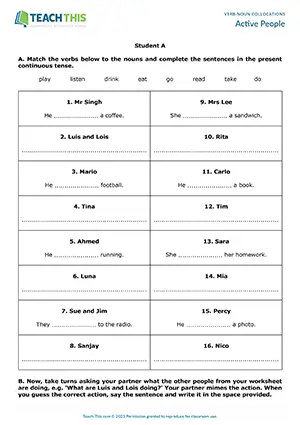
Here is an enjoyable verb-noun collocations information gap activity to help students practice common verb-noun collocations and the present continuous. First...

ESL Verb-Noun Collocations Activity - Vocabulary and Grammar: Matching, Gap-fill, Information Gap, Asking Questions, Miming, Guessing Here is an enjoyable verb-noun collocations information gap activity to help students practice common verb-noun collocations and the present continuous. First, in two groups, students complete sentences by matching verbs to nouns and forming sentences in the present continuous tense. Next, students pair up with someone from the other group and take turns asking their partner what the other people from their worksheet are doing, e.g. 'What is Lucy doing?' or 'What are Peter and Paul doing?' Their partner mimes the action, and the other student tries to guess what they are doing. When the student guesses the correct action, they make a present continuous sentence and write it in the space provided, e.g. 'She is eating pizza.' or 'They are playing basketball.' The first pair to finish wins.

Collocation Dominoes

Elementary (A1-A2) 20 minutes
ESL have, take, go collocations dominoes game for elementary A1-A2, vocabulary, matching, and present simple practice

ESL Have, Take, Go Collocations Game - Vocabulary and Speaking: Matching, Forming Sentences, Freer Practice

In this productive verb-noun collocations game, students play dominoes by making present simple sentences with have, take and go collocations. The first player makes a verb-noun collocation by placing...

ESL Have, Take, Go Collocations Game - Vocabulary and Speaking: Matching, Forming Sentences, Freer Practice In this productive verb-noun collocations game, students play dominoes by making present simple sentences with have, take and go collocations. The first player makes a verb-noun collocation by placing one of their dominoes at either end of the domino on the table. If the player successfully makes a verb-noun collocation, they say a true present simple sentence with the collocation, e.g. 'I have a shower every morning'. The other group members judge the player's sentence. If the sentence is grammatically correct, the student leaves the domino where it is. If the sentence is wrong, the player picks up the domino and keeps it. The next player then tries to put down one of their dominoes at either end of the domino chain and so on. The first player to get rid of all their dominoes wins the game.

Verb-Noun Collocations Practice

Elementary (A1-A2) 30 minutes
ESL verb-noun collocations worksheet for elementary A1-A2, categorising, matching, gap-fill, and conversation practice

ESL Verb-Noun Collocations Worksheet - Vocabulary Exercises: Matching, Gap-fill - Speaking Activity: Asking and Answering Questions, Freer Practice

This useful verb-noun collocations worksheet helps students practice common collocations with have, go, take, do, watch and make. First, students categorise nouns...

ESL Verb-Noun Collocations Worksheet - Vocabulary Exercises: Categorising, Matching, Gap-fill - Speaking Activity: Asking and Answering Questions, Freer Practice This useful verb-noun collocations worksheet helps students practice common collocations with have, go, take, do, watch and make. First, students categorise nouns according to the verbs they can be used with. Students then underline the correct verb in each sentence. Next, students match halves to make sentences. After that, students complete sentences with verbs in the present or past simple. Students then complete conversation questions with nouns from a box. Lastly, students take turns asking and answering the questions with a partner.

Verb-Noun Match-Up

Elementary (A1-A2) 35 minutes
ESL verb-noun collocations game for elementary A1-A2, pelmanism, brainstorming, sentence writing, and pair work

ESL Verb-Noun Collocations Game - Vocabulary, Speaking and Writing: Matching, Forming Sentences, Brainstorming, Collaborative Writing

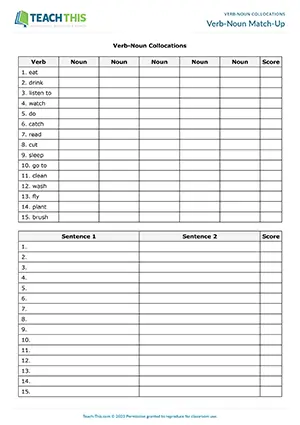
This two-part verb-noun collocations game helps students practice 15 verbs and their possible verb-noun collocations. First, in pairs, students play a...

ESL Verb-Noun Collocations Game - Vocabulary, Speaking and Writing: Matching, Forming Sentences, Brainstorming, Collaborative Writing This two-part verb-noun collocations game helps students practice 15 verbs and their possible verb-noun collocations. First, in pairs, students play a pelmanism game where they take turns turning over one verb card and one noun card. If the verb and noun match to form a logical verb-noun collocation, the student scores a point and keeps the cards. For an extra point, the student then tries to make a sentence with the verb-noun collocation. If the cards don't match, the student turns them back over, keeping them in the same place. The student with the most points at the end of the game wins. Next, pairs have ten minutes to brainstorm and write up to five other nouns that can be used with each verb from the first game, scoring one point for each suitable verb-noun collocation. After that, pairs have another ten minutes to choose two nouns for each verb and write two sentences using the verb-noun collocations. Pairs score one point for each sentence that uses the collocation correctly and one point for a grammatically correct sentence. The pair with the most points at the end of the game is the winner.

Collocation Challenge

Pre-intermediate (A2) 30 minutes
ESL verb-noun collocations board game for pre-intermediate A2, gap-fill, listening, and group activity

ESL Verb-Noun Collocations Board Game - Vocabulary: Listening, Gap-fill - Group Work

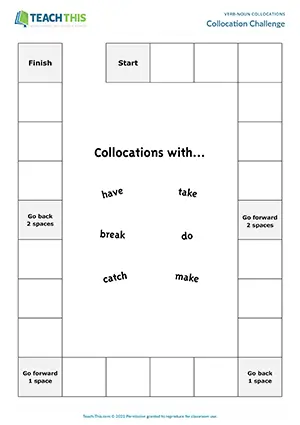
This fun verb-noun collocations board game helps students to practice verb-noun collocations with have, take, break, do, catch and make. Students take it in turns to pick up a card and read the gap-fill sentence on the card to the other students...

ESL Verb-Noun Collocations Board Game - Vocabulary: Listening, Gap-fill - Group Work This fun verb-noun collocations board game helps students to practice verb-noun collocations with have, take, break, do, catch and make. Students take it in turns to pick up a card and read the gap-fill sentence on the card to the other students, e.g. 'If you're sick, you should BLANK some medicine'. The other students then race to repeat the sentence back to the reader, adding in the correct verb to complete the verb-noun collocation in the sentence. The first student to complete the sentence correctly wins. The winner then rolls the dice and moves their counter along the board accordingly. The first student to reach the finish wins the game.

Guess the Truth

Pre-intermediate (A2) 20 minutes
ESL verb-noun collocations game for pre-intermediate A2, gap-fill, guessing, pair work

ESL Verb-Noun Collocations Game - Vocabulary and Grammar: Gap-fill, Guessing - Pair Work

In this amusing verb-noun collocations game, students complete verb-noun collocations in sentences and then guess which sentences are true for their partner. Working alone, students complete the verb...

ESL Verb-Noun Collocations Game - Vocabulary and Grammar: Gap-fill, Guessing - Pair Work In this amusing verb-noun collocations game, students complete verb-noun collocations in sentences and then guess which sentences are true for their partner. Working alone, students complete the verb-noun collocation in each sentence on their worksheet with a verb in its correct form. Students then put a tick next to the sentences that are true for them. Next, students take turns reading their sentences to their partner who guesses if they are true or not. For each correct guess their partner makes, students put a tick in the last column. The student with the most correct guesses at the end wins.

Let's have a talk

Pre-intermediate (A2) 30 minutes
ESL verb-noun collocations speaking activity for pre-intermediate A2, gap-fill, questions, pair and group work

ESL Verb-Noun Collocations Activity - Vocabulary and Speaking: Gap-fill, Asking and Answering Questions, Controlled and Freer Practice

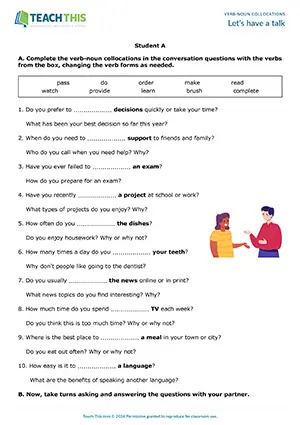
In this insightful verb-noun collocations speaking activity, students complete, ask and answer conversation questions containing useful verb-noun collocations...

ESL Verb-Noun Collocations Activity - Vocabulary and Speaking: Gap-fill, Asking and Answering Questions from Prompts, Controlled and Freer Practice In this insightful verb-noun collocations speaking activity, students complete, ask and answer conversation questions containing useful verb-noun collocations. First, in two groups, students complete verb-noun collocations in conversation questions with verbs from a box in their correct forms. Students then pair up with someone from the other group and take turns asking the conversation questions to their partner, who responds accordingly. For the first question in each set, students include the corresponding verb-noun collocation in their response. Afterwards, students share what they learned about their partner with the class.

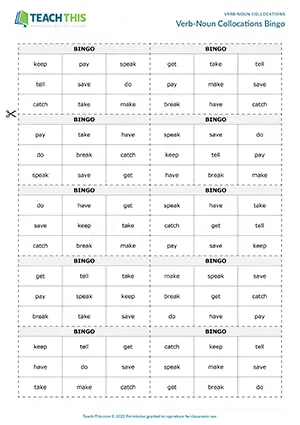
Verb-Noun Collocations Bingo

Pre-intermediate (A2) 25 minutes
ESL verb-noun collocations bingo for pre-intermediate A2, listening, gap-fill, group game

ESL Verb-Noun Collocations Game - Vocabulary Game: Listening, Gap-fill - Group Work

In this free verb-noun collocations game, students play bingo by listening to gap-fill sentences and matching verbs with collocating nouns in sentences. Read a sentence at random from...

ESL Verb-Noun Collocations Game - Vocabulary Game: Listening, Gap-fill - Group Work In this free verb-noun collocations game, students play bingo by listening to gap-fill sentences and matching verbs with collocating nouns in sentences. Read a sentence at random from the caller's sheet, saying the word 'blank' for the missing collocating verb. Students listen and look at the verbs on their bingo cards to see if they have a verb that completes the verb-noun collocation in the sentence. If they do, they cross it off. The game continues until a student has crossed off three verbs in a row. When this happens, the student shouts 'Bingo!' and reads out the verbs they crossed off. If they match the sentences that were ticked on the caller's sheet, the student wins the round. Students then start a new round or continue to see who can cross off all nine verbs. Play several rounds, making sure students receive a different bingo card each time. If you have a large class or you want to give the students more practice with verb-noun collocations, have the students play the game in groups of six with students taking it in turns to be the bingo caller.

Unique Nouns

Intermediate (B1) 35 minutes
ESL verb-noun collocations game for intermediate B1, brainstorming, unique nouns, and sentence writing

ESL Verb-Noun Collocations Game - Vocabulary: Brainstorming, Matching, Writing Sentences

This creative verb-noun collocations game helps students practice using a variety of different nouns with transitive verbs. Begin by assigning the class a transitive verb, e.g. play. In teams, students choose...

ESL Verb-Noun Collocations Game - Vocabulary: Brainstorming, Matching, Writing Sentences from Prompts This creative verb-noun collocations game helps students practice using a variety of different nouns with transitive verbs. Begin by assigning the class a transitive verb, e.g. play. In teams, students choose two nouns that can be used with the verb to make a collocation, such as 'play the trombone' and 'play snooker'. Teams should try to think of nouns that they think other teams won't choose. Teams then write a sentence that illustrates each verb-noun collocation, e.g. 'I play the trombone in the school band'. Teams score one point for each grammatically correct sentence that includes a unique noun that no other team has used. In other words, if two teams use 'play football', those teams don't score a point for that sentence. Play several rounds using a different transitive verb each time. The team with the most points at the end of the game wins.

Collocations Gamble

Upper-intermediate (B2) 30 minutes
ESL verb-noun collocations activity for upper-intermediate B2, gap-fill, grammar, and betting game

ESL Verb-Noun Collocations Activity - Grammar: Gap-fill, Betting

In this engaging verb-noun collocations activity, students complete verb-noun collocations in sentences with verbs and then place bets on their answers. To start, students complete verb-noun collocations in sentences with the verbs provided in...

ESL Verb-Noun Collocations Activity - Grammar: Gap-fill, Betting In this engaging verb-noun collocations activity, students complete verb-noun collocations in sentences with verbs and then place bets on their answers. To start, students complete verb-noun collocations in sentences with the verbs provided in their correct forms. Students then bet between 1 to 5 points depending on how sure they are of their answers. 5 is very sure and 1 is not very sure. Next, elicit the correct answers from the students. For each correct answer, students put a tick and write the number they bet in the 'points' column. For each incorrect answer, students put a cross. In the 'points' column, they write a minus sign with the number they bet. Finally, students add up their points. The student with the most points is the winner.

Create Collocations

Upper-intermediate (B2) 30 minutes
ESL verb-noun collocations worksheet for upper-intermediate B2, matching, gap-fill, and sentence building

ESL Verb-Noun Collocations Worksheet - Vocabulary Exercises: Matching, Gap-fill

This comprehensive verb-noun collocations worksheet helps students practice verb-noun collocations with get, break, catch, do, take, waste, pay, say, lose, keep, make, have, give, tell and save. To start, students match nouns to verbs with which they...

ESL Verb-Noun Collocations Worksheet - Vocabulary Exercises: Matching, Gap-fill This comprehensive verb-noun collocations worksheet helps students practice verb-noun collocations with get, break, catch, do, take, waste, pay, say, lose, keep, make, have, give, tell and save. To start, students match nouns to verbs with which they are usually collocated. Next, students complete sentences using the nouns. After that, students complete sentences with the verbs in their correct form. Students then match sentence halves to make sentences, adding a suitable verb in the correct form to each one. Lastly, students complete sentences with verb-noun collocations from the first exercise.

Understanding Verb-Noun Collocations

Verb-noun collocations are fixed or strongly preferred pairings of a verb and a noun that native speakers use together naturally, such as 'make a decision,' 'take a break,' or 'do homework.' When students substitute a plausible but wrong verb, such as 'do a decision' or 'make homework,' they are immediately understood but sound unnatural, which limits how fluent and confident they come across in both speech and writing.

This page covers verb-noun collocations across Elementary (A1-A2), Pre-intermediate (A2), Intermediate (B1), and Upper-intermediate (B2) levels, with 11 resources including dominoes, bingo, board games, speaking activities, and worksheets, and one free PDF download.

The table below shows common verb-noun collocations grouped by key verb, with examples.

VerbCommon Collocating NounsExample Sentence
have a shower, a break, a conversation, a look 'I have a shower every morning.'
take a break, a risk, a photo, notes 'She always takes notes in meetings.'
go shopping, swimming, for a walk, on holiday 'They go shopping every Saturday.'
do homework, research, exercise, the dishes 'He does his homework after school.'
make a decision, an effort, a mistake, progress 'She made a great effort to finish on time.'
break a record, a promise, the rules, a habit 'He broke a record at the competition.'
get a job, permission, advice, a degree 'She got a job at a local company.'
give a speech, advice, a presentation, permission 'He gave a speech at the conference.'

When to Use Verb-Noun Collocations

Sounding Natural Rather Than Just Correct: A speaker or writer reaches for a collocation because the conventional pairing is what a native speaker uses instinctively, and choosing the right verb tells listeners the language has been genuinely learned rather than constructed, as in 'make an effort' rather than 'do an effort.'

Covering a Wide Range of Everyday Situations: Verb-noun collocations appear in almost every communicative context, from casual conversation to professional writing, so learning them in sets around a key verb such as 'take' gives a speaker or writer instant access to phrases like 'take a break,' 'take a risk,' and 'take responsibility' all at once.

Building Precision in Professional and Academic Contexts: In formal speech and writing, collocations carry precise meaning that a paraphrase cannot always replicate, so a speaker presenting to colleagues or a writer drafting a report reaches for 'reach a conclusion' rather than 'get to a conclusion' because the collocation signals register as well as meaning.

3-Step Framework for Teaching Verb-Noun Collocations

1. Start with Form: Get Students Matching Verbs to Nouns: The first priority is getting students to see which verbs and nouns belong together before asking them to produce anything. A dominoes format works well at this stage because each play forces a decision about whether a pairing is a real collocation. Crucially, a correct play is only accepted if the student can also say a true sentence with that collocation, such as 'I have a shower every morning,' which ties recognition to meaningful use from the very start.

2. Move to Spoken Production Through Real Questions: Once students can identify collocations, push them to use those pairings naturally in conversation. A structured speaking activity where students first complete verb-noun collocations in conversation questions with verbs from a box, then ask and answer those questions with a partner, builds the bridge between knowing a collocation and reaching for it in speech. Requiring students to include the corresponding verb-noun collocation in their response to the first question in each set adds a controlled production layer before freer exchange.

3. Reward Range and Risk-Taking: The final step shifts the goal from accuracy to breadth. Challenge teams to brainstorm nouns that go with a given verb, but score only for nouns that no other team has chosen. This rule, where teams score one point for each grammatically correct sentence that includes a unique noun that no other team has used, pushes students beyond obvious pairings and into less common collocations they actually know.

Common Mistakes with Verb-Noun Collocations

Swapping a Verb for a Near Synonym: Students often replace the correct verb in a collocation with a near synonym that seems logical, not realizing the collocation is fixed and the substitution sounds unnatural to a native speaker. Wrong: 'She did a great effort to finish the project on time.' Correct: 'She made a great effort to finish the project on time.'

Confusing Do and Make: Students often use 'do' where 'make' is required, or vice versa, because the two verbs share a single translation in many languages and their collocations follow no rule that can be easily predicted. Wrong: 'She always does an excuse when she's late.' Correct: 'She always makes an excuse when she's late.'

Common Questions About Teaching Verb-Noun Collocations

What is a good game for practicing verb-noun collocations?

Bingo keeps every student listening because each sentence is a potential card match. In the free game Verb-Noun Collocations Bingo, the caller reads a sentence saying 'blank' for the missing verb, and students check their cards to see if they have a verb that completes the collocation. The first student to cross off three verbs in a row wins.

What is an effective worksheet for teaching verb-noun collocations?

The worksheet Create Collocations covers 15 verbs including get, break, catch, lose, waste, pay, and save. Students start by matching nouns to the verbs with which they are usually collocated, then complete sentences using those nouns, work through gap-fill exercises with verbs in their correct forms, match sentence halves, and finish by completing sentences with collocations from the first exercise.

What is an engaging activity for reviewing verb-noun collocations?

Betting on their own answers forces students to assess how confident they actually are with each collocation. In the activity Collocations Gamble, students complete verb-noun collocations with verbs, then bet between 1 and 5 points per answer, with 5 meaning very sure and 1 meaning not very sure. Correct answers earn the points bet; wrong answers lose them.

Become a Teach This Member

Get unlimited access to the full library, plus new resources added every week.

Unlimited Resource Access

Download from 3000+ worksheets, activities, and games.

Save 5+ Hours Weekly

Cut lesson prep time with ready-to-use resources, plus teacher notes and answer keys.

Trusted Professional Quality

Classroom-tested, editable resources created by experienced ESL professionals.

Fresh Content Weekly

Get 5 new resources added to the library each week.

Join Now Just $29.99 quarterly