
Past Simple vs. Present Perfect ESL Games, Activities & Worksheets
Believe it or not!
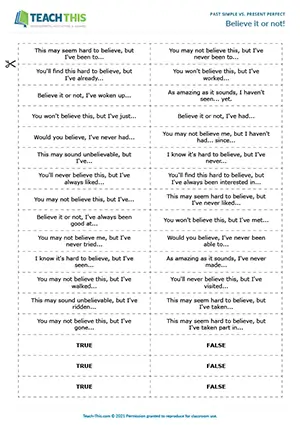
ESL Past Simple vs. Present Perfect Game - Grammar and Speaking: True or False, Sentence Completion, Asking and Answering Questions - Group Work
In this amusing past simple and present perfect game, students make surprising true or false present perfect statements about themselves and their...
How well do you know your partner?
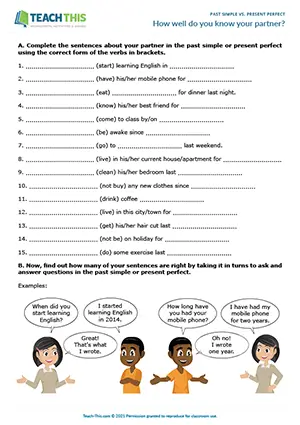
ESL Past Simple vs. Present Perfect Game - Grammar and Speaking: Guessing, Sentence Completion, Asking and Answering Questions - Pair Work
In this free past simple vs. present perfect game, students see how well they know their partner by completing sentences about them in the past simple and...
I Know What You'll Say
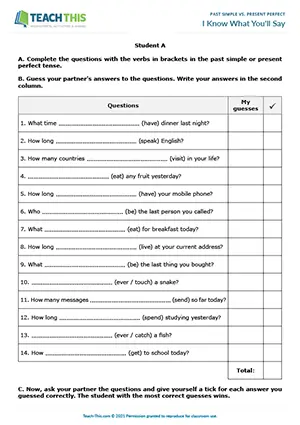
ESL Past Simple and Present Perfect Game - Grammar and Speaking: Forming, Asking and Answering Questions, Guessing - Pair Work
In this fun past simple vs. present perfect game, students practice forming, asking and answering questions in the past simple and the present perfect by...
I've done that!
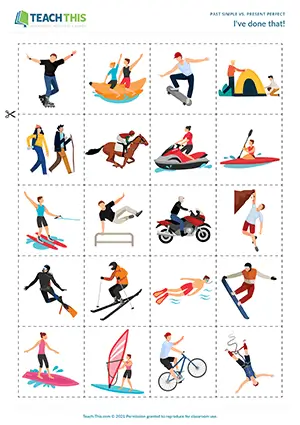
ESL Past Simple and Present Perfect Game - Speaking: Forming Sentences, True or False, Asking and Answering Questions, Guessing, Freer Practice - Group Work
In this engaging past simple and present perfect game, students make true or false present perfect statements and ask past simple Wh questions to find...
Molly's CV
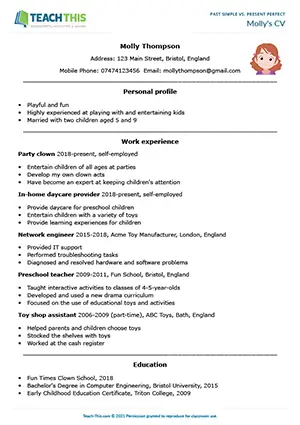
ESL Past Simple vs. Present Perfect Worksheet - Reading and Grammar Exercises: True or False, Gap-fill, Writing Questions
In this useful past simple and present perfect worksheet, students practice using the past simple and the present perfect to describe work experience and...
Paraphrase Pursuit
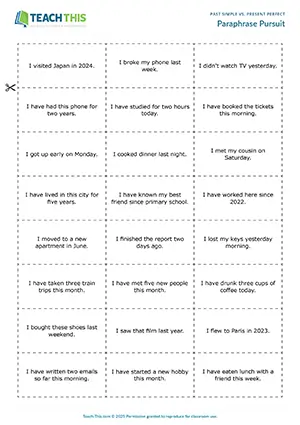
ESL Past Simple vs. Present Perfect Game - Grammar and Speaking: Paraphrasing, Guessing - Group Work
In this rewarding past simple vs. present perfect game, students paraphrase short sentences using the same tense and different wording, and where possible an equivalent time reference, while...
Past Simple or Present Perfect?
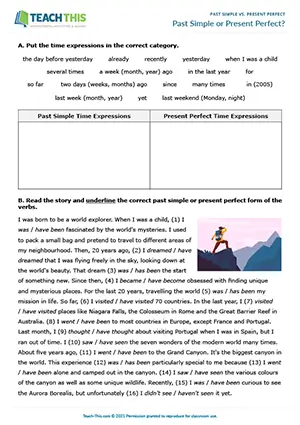
ESL Past Simple or Present Perfect Worksheet - Grammar Exercises: Categorising, Gap-fill, Sentence Completion - Speaking Activity: Discussion - Pair Work
In this comprehensive past simple or present perfect worksheet, students develop accuracy with the past simple and the present perfect by focusing on the time...
Past Simple vs. Present Perfect Parley
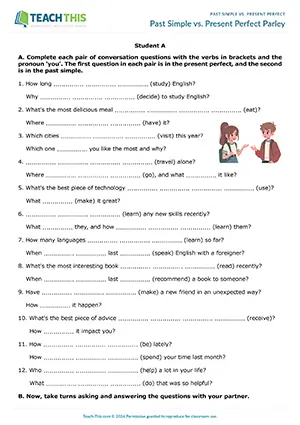
ESL Past Simple vs. Present Perfect Activity - Grammar and Speaking: Forming, Asking and Answering Questions, Controlled and Freer Practice - Group and Pair Work
In this insightful past simple vs. present perfect speaking activity, students practice forming accurate conversation questions in both tenses and using them to...
Switch It
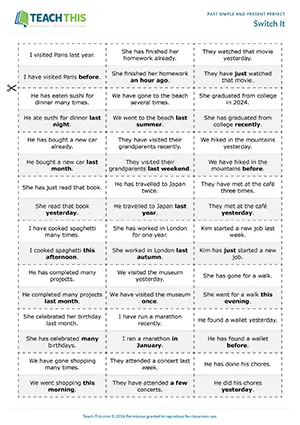
ESL Past Simple vs. Present Perfect Game - Grammar and Speaking: Forming Sentences, Controlled Practice - Group Work
In this productive past simple vs. present perfect game, students race to change sentences from one tense to the other using an adverb or time expression. In groups, students take turns being...
Two Tenses Talk
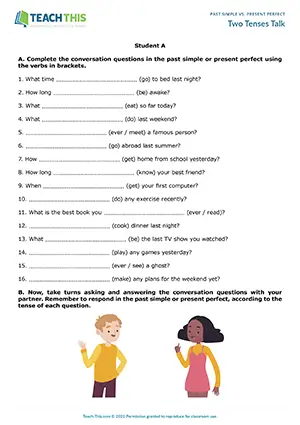
ESL Past Simple vs. Present Perfect Activity - Grammar and Speaking: Forming, Asking and Answering Questions - Pair Work
In this enjoyable past simple and present perfect speaking activity, students use prompts to form past simple and present perfect conversation questions and then discuss them with a partner...
Have you just lied?
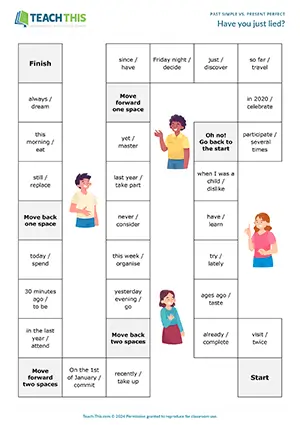
ESL Past Simple vs. Present Perfect Game - Speaking and Grammar: Forming Sentences, Impromptu Speech, True or False, Guessing, Communicative Practice - Group Work
In this fun past simple vs. present perfect board game, students practice choosing the correct tense to make personal statements, add brief supporting details...
Simply Perfect Quiz
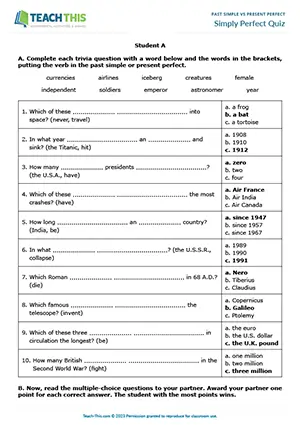
ESL Past Simple vs. Present Perfect Activity - Grammar and Vocabulary: Gap-fill, Quiz, Guessing - Group and Pair Work
In this interesting past simple vs. present perfect activity, students use prompts to write trivia questions in the past simple or present perfect and then take part in a head-to-head quiz with a partner. First...
What have I done?
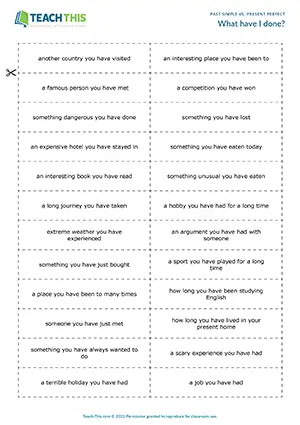
ESL Past Simple vs. Present Perfect Game - Grammar and Speaking: True or False, Forming Sentences, Asking and Answering Questions, Guessing - Group Work
In this entertaining past simple vs. present perfect game, students review the contrast between the present perfect and the past simple by stating experiences...
Understanding the Past Simple vs. Present Perfect
The past simple describes a completed action at a specific, finished point in time: 'She called me last night.' The present perfect connects a past action or experience to the present moment without saying exactly when it happened: 'She has called me.' Students who confuse these tenses often produce sentences like 'I have seen him yesterday,' which sounds wrong because 'yesterday' pins the action to a closed time slot, making the past simple the only correct choice.
This page covers past simple vs. present perfect at B1 and B2 levels, with 13 resources spanning games, worksheets, speaking activities, and a board game, including one free download.
Use this table to match the most common time signals to the correct tense when deciding between the past simple and the present perfect.
| Time Signal | Correct Tense | Notes | Example |
|---|---|---|---|
| yesterday, last week, last year, in [year], at [time], [number] ago | Past Simple | Signal locks the action to a finished time | 'She graduated in 2020.' |
| ever, never (life experience question or statement) | Present Perfect | No specific time is given or implied | 'Have you ever been to Brazil?' |
| already, yet, just | Present Perfect | Action is complete relative to now | 'I have just finished the report.' |
| for [length of time], since [point in time] (situation still continuing) | Present Perfect | Use past simple only if the situation is over | 'He has worked here since March.' |
| recently, lately | Present Perfect | Period is still connected to the present | 'She has been very busy lately.' |
| when, where, how (specific question about a known past event) | Past Simple | Speaker knows the event is in the past | 'When did you arrive?' |
| today, this week, this year (period still open) | Present Perfect | Switch to past simple if the period is closed | 'I have sent three emails this morning.' |
When to Use the Past Simple vs. Present Perfect
Breaking News and Announcements: A writer or broadcaster uses the present perfect to announce a new development because it feels immediate and current, then switches to the past simple to deliver the specific details, as in 'Scientists have discovered a new planet: they found it using a telescope in Chile last week.'
Counting Up to Now: A speaker chooses the present perfect when expressing how many times something has happened within a period that still includes the present moment, as in 'I have been to that restaurant three times this month.'
Talking About Ongoing States: When a situation started in the past and still continues now, a speaker uses the present perfect with 'for' or 'since' rather than the past simple, as in 'She has worked at that company for fifteen years' to show the job is ongoing, not finished.
3-Step Framework for Teaching the Past Simple vs. Present Perfect
1. Anchor to Time Signals: Start with time expressions, because they give students the clearest decision-making tool before they attempt any sentence-level production. Have students sort a set of time expressions into two categories: those that typically signal the past simple and those that typically signal the present perfect. Once they can do this confidently, choosing the right tense in context becomes a far more deliberate process.
2. Race to Switch Tenses: Move into a fast-paced group game where students hear a sentence in one tense alongside a new time expression and race to say the same sentence correctly in the other tense. The competitive edge sharpens accuracy fast: students hear a sentence like 'He has eaten sushi for dinner many times' together with the time expression 'last night' and must produce 'He ate sushi for dinner last night' before their classmates do. Time pressure means students apply the rule instinctively rather than overthinking it.
3. Use Both Tenses Together in Real Talk: Finish with a speaking game that pushes students to use the two tenses in exactly the way they interact in real conversation. Students use the present perfect to introduce an experience and the past simple to give supporting details, while their classmates ask past simple follow-up questions to decide whether the speaker is telling the truth or lying. This is where grammar becomes communication, because every tense choice suddenly has genuine consequences.
Common Mistakes with the Past Simple vs. Present Perfect
Past Simple for Life Experience Questions: Students often use the past simple instead of the present perfect when asking about life experiences, forgetting that 'ever' signals an unspecified past time that connects to the present. Wrong: 'Did you ever visit New York?' Correct: 'Have you ever visited New York?'
Past Simple with For or Since for Ongoing States: Students often use the past simple with 'for' or 'since' to describe a situation that started in the past and still continues, treating an ongoing state as if it were a finished event. Wrong: 'I lived in this city for five years.' Correct: 'I have lived in this city for five years.'
Common Questions About Teaching the Past Simple vs. Present Perfect
What is a good game for practicing past simple and present perfect?
A good option is the free game How well do you know your partner?, where students complete sentences about a partner using the past simple or present perfect, for example 'James started learning English in 1990' or 'James has had his mobile phone for six months,' then ask questions to verify each guess.
What is an effective speaking activity for past simple and present perfect?
For practicing past simple and present perfect, the activity Past Simple vs. Present Perfect Parley has students complete conversation question pairs in both tenses using verbs in brackets, then interview a partner with those questions, responding in the correct tense. Afterwards, students report back what they found out about their partner to the class.
What is a fun past simple and present perfect board game?
Have you just lied? is a board game where players land on a square, make a personal statement in the correct tense, and add supporting details while classmates decide if they are lying. Grammar mistakes and missing details both carry a penalty: the player moves back to their previous square.
Become a Teach This Member
Get unlimited access to the full library, plus new resources added every week.
Unlimited Resource Access
Download from 3000+ worksheets, activities, and games.
Save 5+ Hours Weekly
Cut lesson prep time with ready-to-use resources, plus teacher notes and answer keys.
Trusted Professional Quality
Classroom-tested, editable resources created by experienced ESL professionals.
Fresh Content Weekly
Get 5 new resources added to the library each week.
Here's what our members are saying...


