
Valentine's Day ESL Activities & Games
Valentine's Day Survey
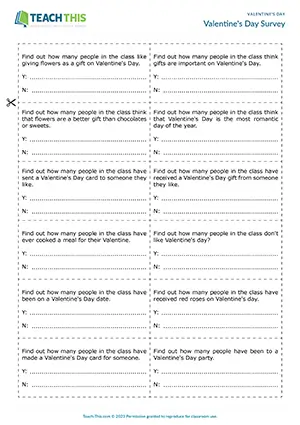
ESL Valentine's Day Activity - Speaking: Forming, Asking and Answering Questions, Freer Practice - Group Work
In this insightful Valentine's Day activity, students conduct a survey where they ask and answer yes/no questions about Valentine's Day. In groups, each student begins by forming the yes/no...
Valentine's Day Trivia Quiz

ESL Valentine's Day Game - Vocabulary: Gap-fill, Multiple-Choice Quiz, Guessing - Group and Pair Work
Here is an enjoyable Valentine's Day quiz game to help students practice Valentine's Day vocabulary and prepositions. In two groups, students begin by completing Valentine's Day trivia...
Messy Valentine's Day Mystery
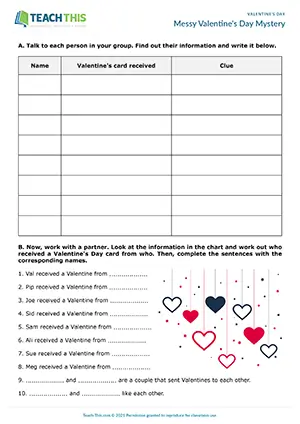
ESL Valentine's Day Activity - Speaking: Asking and Answering Questions - Group Work - Reading: Matching, Gap-fill - Pair Work
In this fun Valentine's Day speaking activity, students talk to one another to solve a mystery about who received a Valentine's Day card from who. In groups...
Valentine's Day Crossword
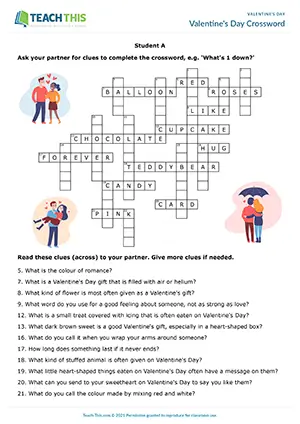
ESL Valentine's Day Activity - Vocabulary: Reading Clues, Describing, Guessing - Pair Work
In this useful Valentine's Day vocabulary activity, students complete a crossword by listening to clues and guessing Valentine's Day vocabulary. In pairs, students take it in turns to ask their partner...
Valentine's Day Race

ESL Valentine's Day Activity - Vocabulary and Speaking: Matching, Gap-fill - Pair Work
In this free Valentine's Day speaking activity, students match Valentine's Day words to definitions and then race to complete sentences with the vocabulary. In two groups, students start by matching 10 Valentine's Day words to their correct...
Valentine's Day Board Game

ESL Valentine's Day Board Game - Vocabulary and Speaking: Impromptu Speech, Multiple-Choice Questions, Guessing, Freer Practice - Group Work
In this productive Valentine's Day board game, students practice vocabulary related to Valentine's Day and talk in response to topic-related prompts. Players take...
Valentine's Day Vocabulary
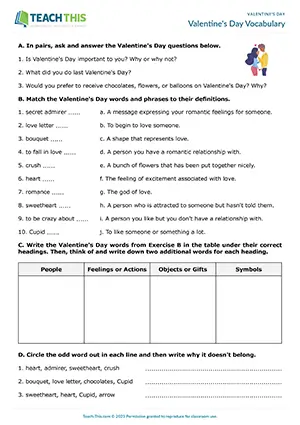
ESL Valentine's Day Worksheet - Vocabulary Exercises: Matching, Categorising, Sentence Completion - Speaking Activity: Answering Questions, Freer Practice - Pair Work
In this comprehensive Valentine's Day worksheet, students practice Valentine's Day vocabulary and discuss topic-related questions. First, students...
Would you do that on Valentine's Day?
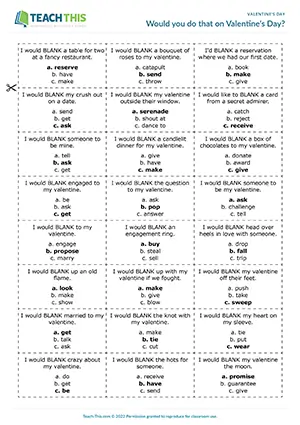
ESL Valentine's Day Game - Speaking and Vocabulary: Multiple Choice, Gap-fill, Discussion - Group Work
In this engaging Valentine's Day game, students race to choose the best verb to complete would sentences and idioms related to Valentine's Day. In groups, students take it in turns to pick up a card...
Using Valentine's Day Vocabulary
Valentine's Day vocabulary helps students describe gifts, express feelings and discuss celebrations. Learning words in phrases gives them the language to explain preferences, exchange information and talk about what people give or receive.
This page contains eight resources from pre-intermediate (A2) to upper-intermediate (B2), including one free download. The materials combine vocabulary practice with surveys, quizzes, a mystery, partner tasks and discussions.
Use the examples below to connect individual words with the phrases students need when speaking about Valentine's Day.
| Purpose | Vocabulary and phrases | Example |
|---|---|---|
| Name gifts | a card, flowers, a box of chocolates | 'She received a box of chocolates.' |
| Describe giving | give someone a gift, send a card to someone | 'He sent a card to his friend.' |
| Identify the sender | receive something from someone | 'The flowers were from her partner.' |
| Express preferences | like giving, prefer receiving | 'I like giving handmade cards.' |
| Discuss plans | make a reservation, go out for dinner | 'They made a reservation at a restaurant.' |
| Give the occasion | on Valentine's Day, for Valentine's Day | 'They went out on Valentine's Day.' 'She bought flowers for Valentine's Day.' |
How to Use Valentine's Day Vocabulary
Teach phrases alongside nouns: Introduce 'send a card', 'give flowers' and 'receive a gift' together with the objects. Ask students to change the giver or recipient so they practice how the words fit into a complete sentence.
Give speaking a clear purpose: Use questions to discover preferences or exchange missing information. Model one question and response before students begin, then ask them to listen for information they will need to record or report.
Allow different perspectives: Students can discuss fictional people or explain that they do not celebrate Valentine's Day. Keep the focus on language and choices without requiring anyone to share personal romantic experiences.
3-Step Framework for Teaching Valentine's Day Vocabulary
For pre-intermediate students, move from supported quiz questions to a group survey and a short report. The final two steps develop the same survey, allowing students to use the information they have collected.
1. Practice language in prepared questions: Students complete trivia questions with prepositions, then take turns asking a partner the questions and offering three possible answers. Review the completed phrases so students understand the language as well as the quiz answers.
2. Ask about preferences: Students form a yes/no question from a prompt on a card. They ask everyone in their group and record the number of positive and negative responses. Check question formation before the exchanges so students can concentrate on listening and answering.
3. Report the findings: Students use their survey totals to tell the class what they discovered. Provide a reporting frame such as 'Three people in our group like giving flowers.' This turns question practice into a short statement summarising real information.
Common Mistakes with Valentine's Day Vocabulary
Choosing the preposition for the occasion: Use 'on' to say when something happens on Valentine's Day. Incorrect: 'We went out in Valentine's Day.' Correct: 'We went out on Valentine's Day.' Use 'for' when describing the purpose of a gift, as in 'flowers for Valentine's Day'.
Confusing the recipient pattern after 'give': Use 'give someone something' or 'give something to someone'. Incorrect: 'She gave to him a card.' Correct: 'She gave him a card.' Students can also say 'She gave a card to him.'
Common Questions About Teaching Valentine's Day Vocabulary
What speaking activity can I use for Valentine's Day?
The activity Messy Valentine's Day Mystery gives students fictional roles and a mystery to solve. They ask classmates about cards they sent and received, recording clues in a chart. Partners then work out who sent each card to whom, so successful discussion depends on exchanging and checking information.
What worksheet can I use for teaching Valentine's Day vocabulary?
The worksheet Valentine's Day Vocabulary builds understanding through definitions, categories and sentence completion. Students match words and phrases, add related vocabulary and explain which word does not belong in a group. Personalised sentences and partner questions then help them move from recognising meanings to expressing their own ideas.
What free activity helps students practice Valentine's Day vocabulary?
The free activity Valentine's Day Race starts with matching words to definitions. Partners then read incomplete sentences aloud and suggest missing words from their own sheets. They must agree on each answer before writing it down. The first pair to complete both sets correctly wins, combining vocabulary recall with careful listening.
Become a Teach This Member
Get unlimited access to the full library, plus new resources added every week.
Unlimited Resource Access
Download from 3000+ worksheets, activities, and games.
Save 5+ Hours Weekly
Cut lesson prep time with ready-to-use resources, plus teacher notes and answer keys.
Trusted Professional Quality
Classroom-tested, editable resources created by experienced ESL professionals.
Fresh Content Weekly
Get 5 new resources added to the library each week.
Here's what our members are saying...


