Express, Justify and Debate!

Intermediate (B1) 40 minutes
EAP speaking test preparation activity preview for Intermediate (B1) showing expressing and justifying opinions, discussion, and debate tasks

EAP Speaking Test Preparation Activity - Vocabulary and Speaking: Expressing and Justifying Opinions, Discussion, Communicative Practice - Group Work

This intriguing speaking test preparation activity helps students build their confidence in expressing and justifying opinions on various common speaking test...

EAP Speaking Test Preparation Activity - Vocabulary and Speaking: Expressing and Justifying Opinions, Discussion, Communicative Practice - Group Work This intriguing speaking test preparation activity helps students build their confidence in expressing and justifying opinions on various common speaking test topics. In groups, students take turns picking up a card, laying it on the table and reading the statement to the group. Each group member then decides whether they agree or disagree with the statement and why. Students then debate the topic for three minutes, starting with the reader, who shares and justifies their opinion. The other group members respond one at a time, either agreeing and adding additional reasons or disagreeing and providing counterarguments. When the time is up, the next student picks up a card, and so on. When the groups have finished, they discuss follow-up questions about their debates and then give feedback to the class on their answers.

Fluency Quest

Intermediate (B1) 30 minutes
Free EAP speaking fluency board game preview for Intermediate (B1) showing impromptu speech, answering questions, and freer practice

EAP Speaking Fluency Board Game - Speaking: Impromptu Speech, Answering Questions, Freer Practice - Group Work

This free speaking test preparation board game develops students' speaking fluency by answering questions similar to those commonly asked in speaking tests. Students take turns rolling the dice...

EAP Speaking Fluency Board Game - Speaking: Impromptu Speech, Answering Questions, Freer Practice - Group Work This free speaking test preparation board game develops students' speaking fluency by answering questions similar to those commonly asked in speaking tests. Students take turns rolling the dice and moving their counter along the board. When a student lands on a question square, they answer the speaking test question by talking for 30 seconds. If the student stops talking or can't think of anything to say, they go back two squares. If a student lands on an advantage card square, they take a card, read it and follow the instructions during their next answer. If an advantage card states 'Keep this card', the student keeps it face-up next to them and can use it anytime during the game. If a student lands on a challenge card square, they take a card, read it aloud, keep it and then attempt the challenge during their next answer. After answering, the group decides if the challenge has been completed successfully. If it hasn't, the student moves back two squares. The first student to reach the finish wins the game.

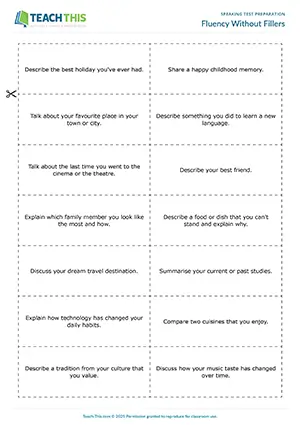
Fluency Without Fillers

Intermediate (B1) 40 minutes
EAP speaking fluency activity preview for Intermediate (B1) showing brainstorming, discussion, impromptu speech, and fluency practice

EAP Speaking Fluency Activity - Listening and Speaking: Brainstorming, Discussion, Identifying, Impromptu Speech, Fluency and Freer Practice - Pair Work

This engaging speaking test preparation activity helps students improve fluency by reducing hesitation and filler words while speaking about various topics...

EAP Speaking Fluency Activity - Listening and Speaking: Brainstorming, Discussion, Identifying, Impromptu Speech, Fluency and Freer Practice - Pair Work This engaging speaking test preparation activity helps students improve fluency by reducing hesitation and filler words while speaking about various topics. First, students brainstorm common filler words and discuss their use and impact on fluency. Students then listen to a text and count how often fillers are used. Next, students discuss strategies the speaker could use to reduce fillers. Next, in pairs, students take turns answering questions for 30 seconds without using fillers. If a filler is used, the student starts over. This continues until all the questions have been answered. After that, students play a game where they pick a card and speak for one minute on the topic without using fillers. If a student uses more than three fillers or pauses for over three seconds, they stop and hand the card to their partner, who attempts to talk for one minute. If a student successfully completes the task, they keep the card and play passes to the other student. The student with the most cards at the end of the game wins. Finally, students reflect on the activity and their performance in small groups.

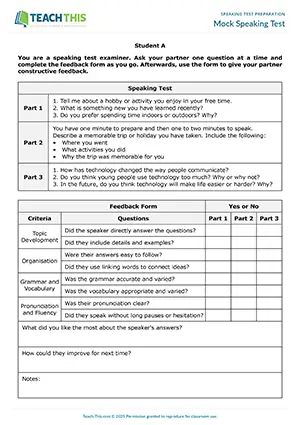
Mock Speaking Test

Intermediate (B1) 40 minutes
EAP mock speaking test activity preview for Intermediate (B1) showing guided discussion, Q&A, peer review, and feedback tasks

EAP Mock Speaking Test Activity - Speaking: Guided Discussion, Asking and Answering Questions, Peer Review and Feedback, Communicative Practice - Pair Work

Here is a useful speaking test preparation activity in which students learn and practice answering typical speaking test questions following certain criteria...

EAP Mock Speaking Test Activity - Speaking: Guided Discussion, Asking and Answering Questions, Peer Review and Feedback, Communicative Practice - Pair Work Here is a useful speaking test preparation activity in which students learn and practice answering typical speaking test questions following certain criteria. First, in pairs, students read responses to a typical speaking test question and then use three criteria (topic development, organisation, and grammar and vocabulary) to discuss the respective strengths and weaknesses of the responses. Next, students take part in a mock speaking test where one student is the examiner and the other is the candidate. The examiner's task is to ask the questions and complete a feedback form as they go to identify strengths and areas for improvement. The candidate's task is to provide full answers following the three criteria and speak clearly without pausing or hesitating. When the test is over, the examiner uses the feedback form to give their partner constructive feedback on how they did in the test. Afterwards, students swap roles and repeat the process.

Question Types and Linking Phrases

Intermediate (B1) 30 minutes
EAP speaking test question types worksheet preview for Intermediate (B1) showing categorising, gap-fill, and discussion activities

EAP Speaking Test Question Types Worksheet - Reading and Vocabulary Exercises: Categorising, Gap-fill - Speaking Activity: Discussion - Pair Work

In this productive speaking test preparation worksheet, students learn about speaking test question types and practice their related linking phrases. First...

EAP Speaking Test Question Types Worksheet - Reading and Vocabulary Exercises: Categorising, Gap-fill - Speaking Activity: Discussion - Pair Work In this productive speaking test preparation worksheet, students learn about speaking test question types and practice their related linking phrases. First, students read a text giving general tips for success in speaking tests. In pairs, students then discuss which tip they think is the most useful to them and why. Next, students match speaking test question types to questions. After that, students put each linking phrase in the correct category according to its question-type function. Students then read speaking test questions that cover the various question types and complete answers with the linking phrases. Following that, students take turns asking the test questions to a partner, who replies using the linking phrases. While students listen to their partner's answers, they complete a checklist and use it to give constructive feedback at the end. Finally, students discuss reflection questions in pairs.

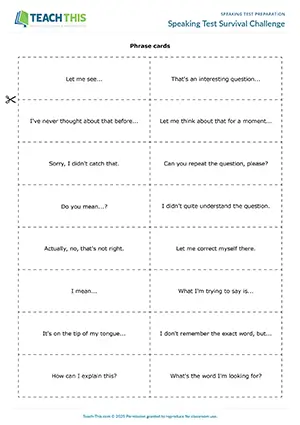
Speaking Test Survival Challenge

Intermediate (B1) 40 minutes
EAP speaking test preparation game preview for Intermediate (B1) showing categorising, multiple choice, and realistic speaking activities

EAP Speaking Test Preparation Worksheet and Game - Vocabulary and Speaking: Categorising, Multiple Choice, Matching, Forming Sentences - Group Work

This fun speaking test preparation worksheet and game introduces students to useful speaking test phrases that they can use to buy time, ask for clarification...

EAP Speaking Test Preparation Game - Vocabulary and Speaking: Categorising, Multiple Choice, Matching, Forming Sentences, Freer Practice - Group Work This fun speaking test preparation worksheet and game introduces students to useful speaking test phrases that they can use to buy time, ask for clarification, correct themselves, and keep speaking if they forget a word in a speaking test. First, students categorise useful speaking test phrases according to their function. Students then choose the correct option to complete each speaking test response. After that, students play a game to practice using the phrases in various speaking test scenarios. In groups, the first player turns over a speaking test situation card and reads it aloud. All the players then look at their phrase cards to find a suitable phrase to use for the situation. Next, players race to place one of their phrase cards face up on the table and form a natural sentence to respond to the situation. If the situation is about forgetting a word, players try to paraphrase the word on the card. If the situation card requires self-correction, players try to correct the mistake. If everyone in the group agrees that a player's phrase corresponds to the situation and the response sounds natural, that player wins and keeps the two cards. If a player's phrase doesn't match the situation or sounds unnatural, that player is out of the round and the other players try to respond. The next player then turns over a new situation card, and so on. The first player to get rid of all their phrase cards wins the game.

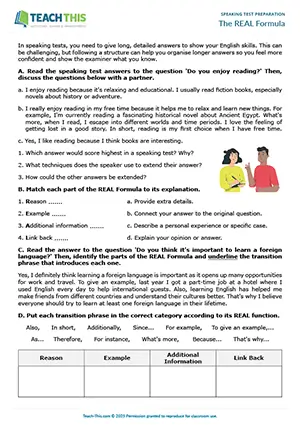
The REAL Formula

Intermediate (B1) 45 minutes
EAP speaking test preparation worksheet preview for Intermediate (B1) showing identifying, categorising, and impromptu speech activities

EAP Speaking Test Preparation Worksheet - Reading and Vocabulary Exercises: Identifying, Categorising - Speaking Activity: Impromptu Speech - Pair Work

In this comprehensive speaking test preparation worksheet, students learn about the REAL Formula and practice using it and related transition phrases to...

EAP Speaking Test Preparation Worksheet - Reading and Vocabulary Exercises: Identifying, Categorising - Speaking Activity: Impromptu Speech - Pair Work In this comprehensive speaking test preparation worksheet, students learn about the REAL Formula and practice using it and related transition phrases to extend answers. First, students read a short text about extending speaking test answers. Students then read three speaking test answers and discuss questions in pairs. Next, students match each part of the REAL Formula to its explanation. After that, students read an example speaking test answer and identify each part of the REAL Formula, underlining the transition phrase that introduces each one. Following that, students categorise each transition phrase according to its REAL function. Students then complete sentences with the transition phrases. Afterwards, students choose a question, plan an answer and say it to a partner using the REAL Formula. Next, students take turns asking speaking test questions to their partner, who replies using the REAL Formula and transition phrases to structure their answers. While students listen to their partner's answers, they complete a checklist and use it to give constructive feedback at the end. Finally, students discuss reflection questions with a new partner.

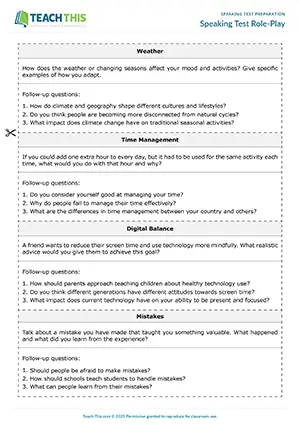
Speaking Test Role-Play

Upper-intermediate (B2) 45 minutes
EAP speaking test preparation activity preview for Upper-intermediate (B2) showing impromptu speech, peer feedback, freer practice activities

EAP Speaking Test Role-Play - Listening and Speaking Activity: Impromptu Speech, Peer Review and Feedback, Freer Practice - Pair Work

In this effective speaking test preparation activity, students take turns as examiner and candidate, respond to timed prompts, and give concise, criteria-based...

EAP Speaking Test Role-Play - Listening and Speaking Activity: Impromptu Speech, Peer Review and Feedback, Freer Practice - Pair Work In this effective speaking test preparation activity, students take turns as examiner and candidate, respond to timed prompts, and give concise, criteria-based feedback on each response. To begin, the examiner turns over the first speaking test card and reads the prompt to the candidate. The candidate then has 60 seconds to plan their answer. When the time is up, the candidate has 90 seconds to answer. The examiner listens carefully and scores the candidate using the criteria on the feedback sheet, writing down examples of effective language, significant mistakes, or other observations. Next, the examiner asks one of the follow-up questions on the card, and the candidate has 60 seconds to answer. Afterwards, the two students swap roles and repeat the process. This continues until both students have answered four cards. Afterwards, students write one positive feedback comment and one area for improvement on the feedback sheet. Students then compare scores and discuss their feedback. Next, each student identifies their weakest answer based on scores and self-reflection. Both students then retake their weakest topic. Finally, students provide feedback to the class on any improvements that were made in the second attempt.

Understanding Speaking Test Preparation

Speaking test preparation develops the ability to understand a prompt, organise a relevant response and express ideas clearly. Useful practice also gives students ways to explain their meaning, respond to follow-up questions and apply feedback in another attempt.

This page contains eight resources across B1 and B2, including worksheets, discussion activities, games and simulated speaking tests. They cover answer development, linking phrases, fluency and communication strategies, with one free board game available.

The table connects speaking demands with practical response strategies. Follow the target test's current instructions and assessment criteria; classroom timings and game penalties are practice conditions, not universal exam rules.

Speaking demandUseful approachExample language
Express an opinion State a view and give a relevant reason 'I would prefer this option because...'
Compare alternatives Explain a meaningful similarity or difference 'Both options offer flexibility, but they differ in...'
Develop a point Add an example or explanation 'For example, when I worked on a group project...'
Gain thinking time Pause briefly or signal that you are considering the question 'Let me think about that for a moment.'
Explain a forgotten word Describe its function or meaning 'It's a device used to measure temperature.'
Correct an error Make a brief correction and continue 'It happened last week, sorry, last month.'

How to Prepare Students for Speaking Tests

Match the answer to the question: Ask students to identify whether the prompt calls for a description, comparison, opinion or explanation before speaking. Useful preparation develops adaptable responses rather than memorised speeches that may not address the prompt.

Develop ideas without chasing length: Encourage a clear answer followed by relevant support. Additional speech helps only when it explains or illustrates the point; repetition and unrelated detail can make the response harder to follow.

Use feedback selectively: Choose one achievable focus for the next attempt, such as clearer organisation or more specific examples. Brief pauses and self-correction can be part of natural speech, so do not equate fluency with speaking continuously at any cost.

3-Step Framework for Teaching Speaking Test Skills

Use this B1 sequence across suitable lessons to connect question awareness, communication strategies and feedback on a simulated test.

1. Identify the task and organise a response: Students match speaking questions to question types, classify linking phrases by function and complete example answers. They then ask and answer questions in pairs while listeners use a checklist. Focus on whether each phrase expresses the relationship the answer needs rather than simply adding a connector.

2. Practice handling communication difficulties: Students classify phrases for gaining time, clarification, self-correction and explaining a forgotten word. In a scenario game, they select a suitable phrase and produce a natural response, including paraphrasing or correction where required. Discuss which strategies fit the target test's rules and help preserve a clear message.

3. Apply the skills in a simulated test: Pairs evaluate sample answers using topic development, organisation, and grammar and vocabulary criteria. They then alternate examiner and candidate roles, with the listener recording strengths and areas for improvement on a feedback form. Ask each student to identify one change to apply in their next practice response.

Common Mistakes with Speaking Test Preparation

Repeating an opinion instead of explaining it: Extra words do not necessarily develop an answer. Repetitive response: 'I prefer group work because I like working in a group.' Developed response: 'I prefer group work because comparing different ideas helps me notice possibilities I would miss on my own.'

Abandoning an answer after forgetting a word: Students can often communicate the meaning through a short description. Incomplete response: 'We used a... I don't know the word.' Communication strategy: 'We used a device that measures temperature to check the water.'

Common Questions About Teaching Speaking Test Skills

What worksheet helps teach speaking test preparation?

The worksheet The REAL Formula introduces a framework for extending answers and matching transition phrases to their functions. Students examine model responses, plan an answer and practice with a partner. A listening checklist supports feedback on their responses, giving students a structure for developing ideas rather than simply adding more words.

What activity helps students practice a speaking test?

The activity Speaking Test Role-Play gives students timed prompts and follow-up questions while a partner acts as examiner. They exchange roles, record examples of language use and discuss feedback against the provided criteria. Each student then repeats their weakest topic, creating an opportunity to apply feedback in a second attempt.

What free game helps students prepare for speaking tests?

The board game Fluency Quest asks students to answer speaking-test-style questions for thirty seconds. Advantage and challenge cards add different demands to later turns, and classmates decide whether challenges have been completed. Working towards the finish gives students repeated short speaking opportunities across questions, with the group checking the game's requirements.

Become a Teach This Member

Get unlimited access to the full library, plus new resources added every week.

Unlimited Resource Access

Download from 3000+ worksheets, activities, and games.

Save 5+ Hours Weekly

Cut lesson prep time with ready-to-use resources, plus teacher notes and answer keys.

Trusted Professional Quality

Classroom-tested, editable resources created by experienced ESL professionals.

Fresh Content Weekly

Get 5 new resources added to the library each week.

Join Now Just $29.99 quarterly