
Music ESL Games, Worksheets & Activities
Music Master
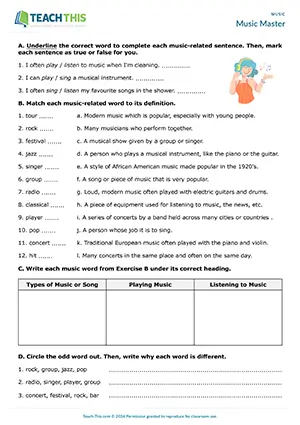
ESL Music Worksheet - Vocabulary Exercises: Matching, Categorising, Identifying, Gap-fill - Speaking Activity: Freer Practice - Pair Work
In this productive music vocabulary worksheet, students learn and practice a variety of words related to music. First, students underline the...
Musical Opinions

ESL Music Activity and Game - Speaking: Discussion, Asking and Answering Questions - Vocabulary: Gap-fill, Guessing - Group Work
In this interesting music discussion activity and game, students talk about music and practice topic-related vocabulary. First, students read music questions...
Musical Dominoes

ESL Music Game - Vocabulary: Matching - Group Work
In this useful music vocabulary game, students practice forming sentences containing music-related words. First, students turn over the top domino from the pile and place it face-up on the table. The first player then puts a domino...
Musical Mash-Up

ESL Music Board Game - Vocabulary and Speaking: Impromptu Speech, Multiple-Choice Questions, Communicative Practice - Pair Work
This free music vocabulary board game helps students practice talking about music and using related vocabulary. Players take turns rolling the dice and...
Tune Up Your Vocabulary

ESL Music Worksheet - Vocabulary Exercises: Matching, Multiple and Binary Choice, Gap-fill - Speaking Activity: Asking and Answering Questions - Pair Work
This comprehensive music vocabulary worksheet helps students practice various words related to music. First, students match sentence halves to form...
Music Mania

ESL Music Quiz Game - Vocabulary: Providing Vocabulary, Identifying - Pair and Group Work
Here is an engaging music quiz game to help students practice vocabulary related to music. Teams take turns picking up a card and reading the question to the other team. If a team hears a question...
Music Trivia Challenge

ESL Music Game - Vocabulary: Gap-fill, Multiple-Choice Quiz, Guessing - Group and Pair Work
In this free music quiz game, students complete trivia questions about music and then take part in a quiz using the questions. In two groups, students begin by completing music trivia questions...
Words That Rock!

ESL Music Worksheet - Vocabulary Exercises: Matching, Categorising, Gap-fill - Speaking Activity: Asking and Answering Questions, Freer Practice - Pair Work
Here is an informative music vocabulary worksheet to help students learn and practice words related to music. To begin, students complete collocations...
Let's Talk about Music

ESL Music Activity - Vocabulary and Speaking: Word Search, Gap-fill, Asking and Answering Questions - Pair Work
In this enjoyable music vocabulary activity, students find words related to music in a word search and then use them to complete and ask music conversation questions to a partner. Working alone, students...
Musical Lingo

ESL Music Worksheet - Vocabulary Exercises: Matching, Gap-fill - Speaking Activity: Asking and Answering Questions, Freer Practice - Pair Work
This insightful music vocabulary worksheet helps students practice various words related to music. Students begin by matching music words from a box to...
Music Taboo
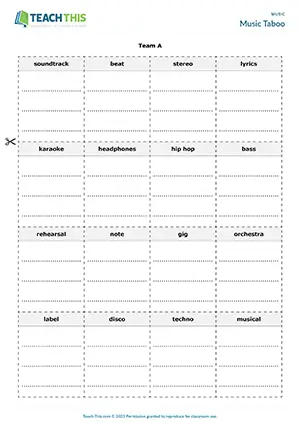
ESL Music Game - Vocabulary and Speaking: Word Association, Describing, Guessing, Freer Practice - Group Work
In this fun music vocabulary game, students describe and guess nouns related to music. First, in two teams, students look at each card and discuss how they would describe the music noun on the card...
Using Music Vocabulary
Music vocabulary helps students name musical styles, describe performers and talk about listening habits. Using these words with suitable verbs lets them explain preferences and discuss musical experiences clearly.
This page contains 11 resources from elementary (A1-A2) to upper-intermediate (B2), including two free downloads. The materials cover music words, genres, collocations, opinions and conversation practice.
Use these examples to connect vocabulary with things students can say about music.
| Purpose | Useful language | Example |
|---|---|---|
| Name musical styles | jazz, rock, classical music | 'She enjoys jazz and classical music.' |
| Describe performers | singer, guitarist, band | 'The band's guitarist also sings.' |
| Discuss listening habits | listen to music, make a playlist | 'I listen to music on my way to work.' |
| Talk about making music | play the piano, write a song | 'He plays the piano and writes songs.' |
| Describe musical experiences | go to a concert, perform live | 'We saw the band perform live.' |
| Explain preferences | prefer, enjoy, because | 'I prefer this song because I like the lyrics.' |
How to Use Music Vocabulary
Separate styles, people and actions: Ask students to sort words into categories before using them in sentences. This helps distinguish a genre such as 'rock' from a performer such as 'guitarist' and an action such as 'perform'.
Build phrases around familiar music: Let students choose a song or artist they know and describe it using a few target phrases. Accept different musical tastes and focus feedback on whether the language communicates their meaning.
Develop opinions with reasons: Move beyond asking whether students like a song. Model a reason about the voice, lyrics or instruments, then encourage students to explain their own choices and ask a partner a follow-up question.
3-Step Framework for Teaching Music Vocabulary
For intermediate students, move from understanding collocations to recalling vocabulary and exchanging questions. The following sequence uses the page's intermediate resources.
1. Connect words with musical roles: Students match verbs with endings to form music collocations, then identify which actions belong to performers or creators and which belong to listeners. Categorising further music words gives them a set of meanings and phrases to draw on in the next stage.
2. Recall and distinguish vocabulary: Teams answer cards that ask them to name music-related words or identify the word that does not belong in a set. Correct answers earn cards. This moves students from recognising supplied combinations to retrieving vocabulary and distinguishing meanings.
3. Use vocabulary in question exchanges: Groups complete music trivia questions with supplied words before students pair up with someone from the other group. Partners read the questions and answer options aloud, taking turns answering and scoring points. Completing and exchanging the questions gives the vocabulary a practical role in a spoken task.
Common Mistakes with Music Vocabulary
Leaving out 'to' after 'listen': Use 'listen to' before the thing a person listens to. Incorrect: 'I listen music every evening.' Correct: 'I listen to music every evening.'
Using 'music' as a countable noun: Use 'song', 'track' or 'piece of music' when counting individual items, depending on what you mean. Incorrect: 'There are ten musics on my playlist.' Correct: 'There are ten tracks on my playlist.'
Common Questions About Teaching Music Vocabulary
How can students practice giving opinions about music?
The activity Musical Opinions gives students time to prepare answers before discussing music questions and explaining their views in groups. They then reuse vocabulary from the discussion in a team guessing game. A ten-second limit encourages quick recall, while the other team can answer if the first team cannot.
What worksheet helps with teaching music vocabulary?
The worksheet Tune Up Your Vocabulary connects music words with meanings, verbs and musical styles. Students match sentence halves and definitions, choose suitable verbs, and complete a text about the Beatles. They finish by completing and discussing music questions, putting the vocabulary into use after the written exercises.
What free game can students play to practice music vocabulary?
The free board game Musical Mash-Up combines music discussion with trivia. Students move around the board, speaking about music topics for 20 seconds or answering multiple-choice questions. Unsuccessful attempts send them back two squares, so progressing towards the finish involves both sustained speaking and answering music questions correctly.
Become a Teach This Member
Get unlimited access to the full library, plus new resources added every week.
Unlimited Resource Access
Download from 3000+ worksheets, activities, and games.
Save 5+ Hours Weekly
Cut lesson prep time with ready-to-use resources, plus teacher notes and answer keys.
Trusted Professional Quality
Classroom-tested, editable resources created by experienced ESL professionals.
Fresh Content Weekly
Get 5 new resources added to the library each week.
Here's what our members are saying...


