
Social Media ESL Activities, Worksheets & Games
Follow Me
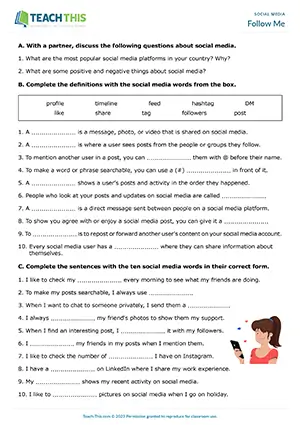
ESL Social Media Worksheet - Speaking Activity: Discussion - Vocabulary, Reading and Writing Exercises: Matching, Gap-fill, Unscrambling, Writing Posts
In this comprehensive social media worksheet, students learn social media vocabulary and practice writing social media posts that include hashtags...
Hashtag Dominoes
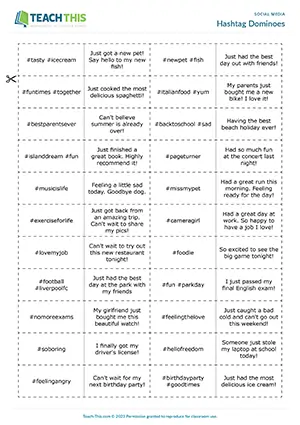
ESL Social Media Game - Vocabulary: Matching - Group Work
In this enjoyable social media game, students play dominoes by matching social media posts to hashtags. The first player puts a domino down either before or after the domino on the table, making sure the social media post matches...
Posts and Replies
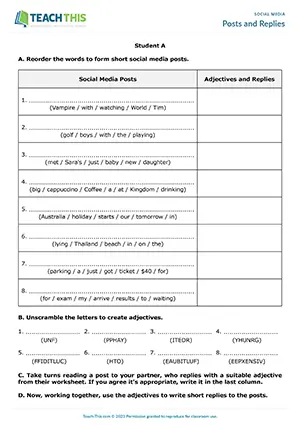
ESL Social Media Posts Activity - Vocabulary, Grammar and Writing: Unscrambling, Matching, Writing Short Replies - Group and Pair Work
In this productive social media posts activity, students practice forming and replying to short posts on social media. In two groups, students reorder words to...
Find Someone Who...

ESL Social Media Activity - Speaking: Gap-fill, Asking and Answering Questions, Controlled and Freer Practice
In this free social media speaking activity, students ask and answer questions about social media. First, students complete 'Find someone who...' prompts with verbs related to social media in their...
Social Media Fan

ESL Social Media Activity - Vocabulary: Writing and Giving Clues, Guessing - Group and Pair Work
In this creative social media activity, students practice vocabulary related to social media culture by writing clues and guessing words to complete a collaborative crossword. First, in two groups, students create...
Social Media Vocabulary
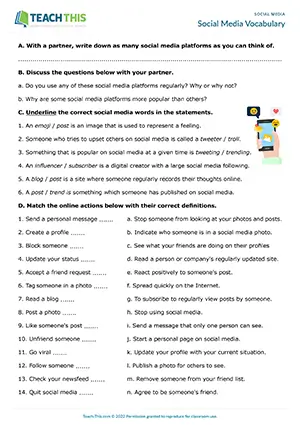
ESL Social Media Worksheet - Vocabulary Exercises: Binary Choice, Matching, Gap-fill - Speaking Activities: Asking and Answering Questions, Freer Practice - Pair Work
Here is an insightful social media vocabulary worksheet to help students practice words associated with social media. To begin, students list all the social...
What Is Social Media Vocabulary?
Social media, as a functional language topic, covers the words, actions, and short interaction patterns learners need to discuss online platforms and create posts, replies, and hashtags. When learners misuse social media vocabulary, their posts or comments can sound unclear, unnatural, or too informal for the audience.
This page covers social media across A2 and B1 levels, with six resources ranging from worksheets and speaking activities to vocabulary games, including one free download.
Social media vocabulary helps learners choose short, audience-aware phrases for posting, replying, reacting, and asking questions online.
| Situation | Speaker | Example Phrase |
|---|---|---|
| Sharing an update | User | 'I finally finished my project!' |
| Commenting on a post | Friend or follower | 'That looks amazing!' |
| Asking about a post | Friend or follower | 'Where did you take this photo?' |
| Reacting to news | Friend or follower | 'Congratulations, that's great news!' |
| Adding context with hashtags | User | '#firstday #newjob' |
| Inviting opinions | User | 'What do you think about this app?' |
How to Use Social Media Vocabulary
Match tone to audience: Choose more neutral wording for public or mixed-audience posts, as in 'Thanks for sharing this update.'
React with the right strength: Use short reactions that fit the size of the news, as in 'That's great news!'
Make posts easy to understand: Add enough context so readers know what the post refers to, as in 'First day at my new job today!'
3-Step Framework for Teaching Social Media Vocabulary
1. Build the Platform Vocabulary: Start with social media words in context, then move learners toward creating short posts and adding at least two hashtags to each post so they link meaning, wording, and audience.
2. Practice Short Public Replies: Have students form posts, choose suitable adjectives for replies, and check whether each response fits before they write their own short replies.
3. Turn Vocabulary into Interaction: Push students from prompts into real questions, such as 'Have you accepted a friend request from someone this week?', then add follow-up questions so the exchange does not stop at yes or no.
Common Mistakes with Social Media Vocabulary
Wrong Verb for Online Actions: Students often use general verbs like make or do when English needs a specific social media verb. Wrong: 'I made a photo on Instagram.' Correct: 'I posted a photo on Instagram.'
Mixing Up Posts and Comments: Students often use post when they mean comment or reply, so the listener cannot tell whether they created new content or responded to someone else. Wrong: 'I posted on Anna's photo, "Great picture!"' Correct: 'I commented on Anna's photo, "Great picture!"'
Common Questions About Teaching Social Media Vocabulary
What is a fun game for practicing social media vocabulary?
The game Hashtag Dominoes has students race to match social media posts to their correct hashtags in a domino format. Players take turns placing dominoes at either end of the chain and draw from the pile if they cannot go. The first player to get rid of all their dominoes wins.
What is a good speaking activity for teaching social media vocabulary?
The activity Social Media Fan builds spoken interaction around vocabulary. Students write clues for social media words using a definition, example, or synonym, then pair up with someone who has the other half of a collaborative crossword. They take turns asking for clues and guessing missing words until the crossword is complete.
What is a useful worksheet for teaching social media vocabulary?
Staged practice is what makes the worksheet Social Media Vocabulary work well for vocabulary building. Students move from underlining correct words and matching online actions to their definitions, through gap-fill sentences, and finally to conversation questions they ask each other using the target vocabulary.
Become a Teach This Member
Get unlimited access to the full library, plus new resources added every week.
Unlimited Resource Access
Download from 3000+ worksheets, activities, and games.
Save 5+ Hours Weekly
Cut lesson prep time with ready-to-use resources, plus teacher notes and answer keys.
Trusted Professional Quality
Classroom-tested, editable resources created by experienced ESL professionals.
Fresh Content Weekly
Get 5 new resources added to the library each week.
Here's what our members are saying...


