
Past Simple Was & Were ESL Games, Activities & Worksheets
Sentences and Questions
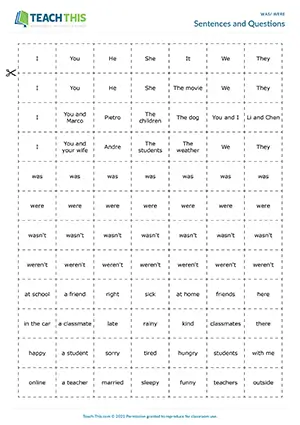
ESL Was Were Game - Grammar and Speaking: Forming Sentences and Questions, Freer Practice - Group Work
In this engaging was and were game, students practice making affirmative and negative sentences and yes/no questions with 'was' and 'were' by combining subject, 'be', and complement cards. The first...
Was and Were Race
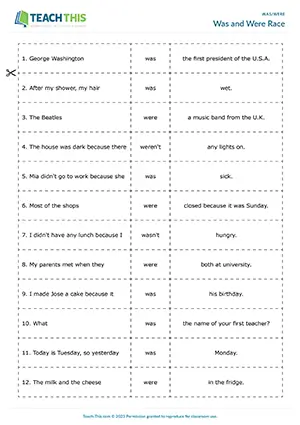
ESL Was or Were Game - Grammar: Matching, Forming Sentences
In this enjoyable was or were game, students race to choose the correct past form of 'be' (was, were, wasn't, weren't) in affirmative and negative sentences. When you say 'go', pairs race to line up sentence frame cards in order and place the correct...
Was or Were?
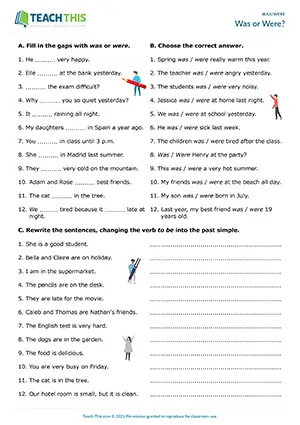
ESL Was or Were Worksheet - Grammar Exercises: Gap-fill, Binary Choice, Rewriting Sentences
In this useful was and were worksheet, students practice the past simple of 'be' by completing a gap-fill, choosing the correct form, and rewriting present-tense sentences in the past. Students begin by...
Were You...?
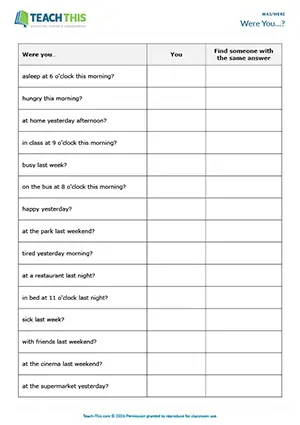
ESL Were You Questions Activity - Grammar and Speaking: Asking and Answering Questions, Controlled and Freer Practice
In this free 'Were you...?' questions activity, students practice 'Were you…?' questions and short answers by writing their own responses and then mingling to find classmates who responded in the same way...
Change the Subject

ESL Was Were Board Game - Grammar and Speaking: Forming Sentences, Freer Practice - Group Work
In this fun was and were board game, students practice was, wasn't, were, and weren't by making believable past simple affirmative or negative sentences from subject prompts. Players take turns...
How was your holiday?
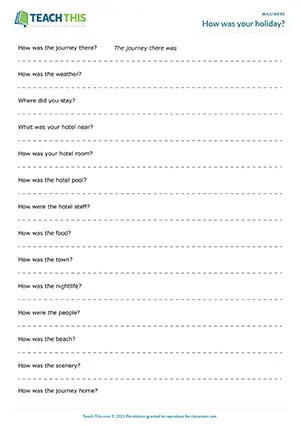
ESL Was Were Activity - Grammar and Speaking: Writing Sentences, Discussion, Communicative Practice - Group Work
In this inventive past simple was and were activity, students practice the past simple of the verb 'to be' by writing short descriptions of a holiday in a collaborative fold-and-pass writing activity. To begin...
Sightseeing in Washington, D.C.

ESL Was and Were Activity - Speaking: Information Gap - Pair Work - Grammar Exercises: True or False, Error Correction, Writing Sentences
In this productive was and were activity, students communicate about where people were at different times in the past, using was, wasn't, were, and weren't to...
Was Were Board Game

ESL Was Were Board Game - Grammar and Speaking: Asking and Answering Questions, True or False, Guessing - Group Work
In this free was and were board game, students review the verb 'to be' in the past simple by playing a game where they give true or false answers to questions. Players take turns rolling the dice and...
Was and Were Question Time
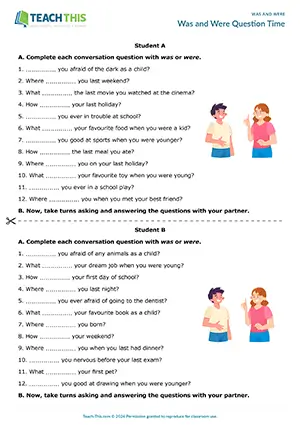
ESL Was Were Activity - Grammar and Speaking: Gap-fill, Asking and Answering Questions, Controlled and Freer Practice - Group and Pair Work
In this interesting was and were speaking activity, students complete, ask and answer conversation questions with 'was' and 'were' about past feelings, places...
Where were you...?
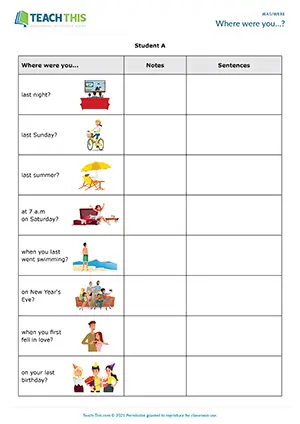
ESL Was Were Activity - Speaking: Asking and Answering Question, Writing Sentences - Pair Work
In this insightful was and were speaking activity, students interview each other about their whereabouts at certain times in the past using past simple Wh questions with the verb 'to be'. In pairs, students take...
Who were they?
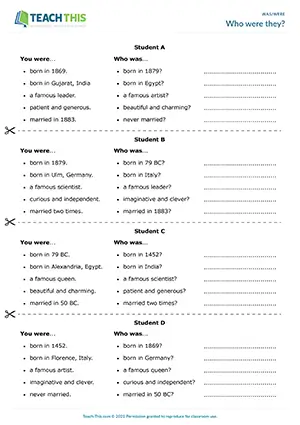
ESL Was Were Game - Grammar and Speaking: Asking and Answering Questions, Freer Practice, Guessing - Group Work
In this entertaining was and were game, each student takes on the role of an unnamed famous person in history and tries to establish the identities of other famous people by asking and answering questions...
Understanding Past Simple Was and Were
'Was' is the past simple of 'to be' for I, he, she, and it, as in 'She was tired.' 'Were' is the past simple for you, we, and they, as in 'They were late.' Students who use 'was' with plural subjects, producing sentences like 'We was at the beach', mark themselves immediately as beginners to any English speaker, and the error can undermine the clarity of everything else they say or write.
This page covers past simple was and were at A1-A2 and A2 levels, with 11 resources including games, a worksheet, and speaking activities, with two available as free downloads.
The table below shows the full set of past simple was and were forms, covering affirmative, negative, question, and short answer structures.
| Form | Subject | Structure | Example |
|---|---|---|---|
| Affirmative | I / he / she / it | subject + was + complement | 'It was cold.' |
| Affirmative | you / we / they | subject + were + complement | 'We were at the beach.' |
| Negative | I / he / she / it | subject + wasn't + complement | 'He wasn't ready.' |
| Negative | you / we / they | subject + weren't + complement | 'You weren't at school.' |
| Yes/No Question | I / he / she / it | Was + subject + complement? | 'Was it cold?' |
| Yes/No Question | you / we / they | Were + subject + complement? | 'Were you at school?' |
| Short Answer (yes) | I / he / she / it | Yes, + subject + was. | 'Yes, it was.' |
| Short Answer (yes) | you / we / they | Yes, + subject + were. | 'Yes, we were.' |
| Short Answer (no) | I / he / she / it | No, + subject + wasn't. | 'No, he wasn't.' |
| Short Answer (no) | you / we / they | No, + subject + weren't. | 'No, you weren't.' |
| Wh Question | all subjects | Wh word + was/were + subject? | 'Where were you last night?' |
When to Use Past Simple Was and Were
Describing Past States and Conditions: Speakers use 'was' and 'were' to describe how things or people existed at a specific moment in the past, making them the natural choice for setting the scene in a story or account, as in 'The room was small, the walls were bare, and the light was very dim.'
Asking About Someone's Past Experience: 'Was' and 'were' form the backbone of personal questions about past feelings, places, and situations, appearing naturally in everyday conversation about holidays, events, or childhood, as in 'Was the concert good?' or 'Were you nervous before your exam?'
Making Factual Statements About the Past: Writers use 'was' and 'were' in historical or factual texts to state what existed or held true at a particular point in time, as in 'Marie Curie was the first woman to win a Nobel Prize.'
3-Step Framework for Teaching Past Simple Was and Were
1. Establish the Form on the Page: Start with a worksheet that builds confidence through three short, graded exercises. Students complete gap-fill sentences, choose between was and were in binary-choice items, and then rewrite present-tense sentences by changing 'am', 'is', and 'are' into the correct past simple form. That final rewriting task is where the subject-verb link clicks into place, because students must check the subject of every sentence before they can choose.
2. Get Students Using the Form With Each Other: Move into a mingle activity built around personal yes/no questions. Students write their own short answers to a set of 'Were you...?' questions, for example 'Were you asleep at 6 o'clock this morning?', using 'Yes, I was' or 'No, I wasn't', then go around the class asking classmates the same questions to find people with matching answers. The search structure means every student asks and answers the same questions multiple times, giving the short answer forms plenty of natural repetition.
3. Push Into Freer Question Use: Finish with a game that gives students a real communicative reason to keep asking questions with was and were. Each student secretly takes on the identity of an unnamed famous person from history and reads their 'You were...' profile card to find out who they are. They then ask and answer questions like 'Were you born in 1869?' to gather clues about other students' identities, before the group discusses what they found out and tries to name all four famous people.
Common Mistakes with Past Simple Was and Were
Using 'were' with a Singular Third-Person Subject: Students often use 'were' instead of 'was' with singular third-person subjects such as 'he', 'she', or 'it', applying the plural form incorrectly because they have not fully mapped the subject-verb agreement pattern. Wrong: 'She were happy about the news.' Correct: 'She was happy about the news.'
Using Present Simple 'Is' or 'Are' Instead of the Past Form: Students often default to the present simple 'is' or 'are' when describing past states, particularly in writing, because the switch to the past form of 'to be' is not yet automatic. Wrong: 'The film is really good last night.' Correct: 'The film was really good last night.'
Common Questions About Teaching Past Simple Was and Were
What is a fun game for practicing was and were?
A board game works well for getting students to use was and were naturally. In the free board game Was Were Board Game, players land on a square and answer the question using 'was' or 'were', giving true or false information as shown on a card. Other students then ask follow-up questions and guess whether the player is lying or telling the truth.
What is a good activity for practicing was and were questions and answers?
An information gap activity gives students structured practice with was and were in question-and-answer exchanges. In the activity Sightseeing in Washington, D.C., pairs ask and answer questions with 'was' and 'were' to complete a chart about four people who went sightseeing, then check sentences for accuracy and correct any that are false by changing was, wasn't, were, or weren't.
What is an effective speaking activity for practicing was and were?
The activity Was and Were Question Time gives students speaking practice with was and were through conversation questions about past feelings, places, and experiences. Students complete each question with was or were, then ask and answer the questions with a partner. Afterwards, students share what they found out about their partner with the class.
Become a Teach This Member
Get unlimited access to the full library, plus new resources added every week.
Unlimited Resource Access
Download from 3000+ worksheets, activities, and games.
Save 5+ Hours Weekly
Cut lesson prep time with ready-to-use resources, plus teacher notes and answer keys.
Trusted Professional Quality
Classroom-tested, editable resources created by experienced ESL professionals.
Fresh Content Weekly
Get 5 new resources added to the library each week.
Here's what our members are saying...


