
Indirect Questions ESL Worksheets, Activities, Role-Plays & Games
Ask Politely
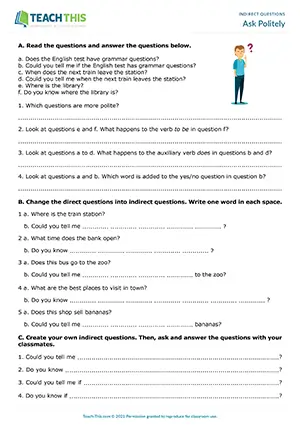
ESL Indirect Questions Worksheet - Grammar Exercises: Answering, Reforming and Completing Questions - Speaking Activity: Freer Practice
This productive indirect questions worksheet helps students learn how to form indirect questions. First, students examine three direct questions and their indirect...
Direct and Indirect Questions

ESL Direct vs. Indirect Questions Worksheet - Grammar Exercises: Writing and Rewriting Questions - Speaking Activity: Asking and Answering Questions
In this free direct and indirect questions worksheet, students learn and practice three rules for changing direct questions into indirect questions. First...
I was wondering...

ESL Indirect Questions Activity - Speaking: Asking and Answering Questions, Communicative Practice
In this communicative indirect questions activity, students practice using indirect question phrases to make polite requests and respond by politely accepting or declining them. Each student receives...
Indirect Questions Practice

ESL Indirect Questions Worksheet - Grammar Exercises: Gap-fill, Unscrambling, Error Correction, Rewriting Questions
Here is a comprehensive indirect questions worksheet to help students learn and practice how to ask questions politely. First, students complete indirect questions with words and phrases from a box. Next...
Street Interviews
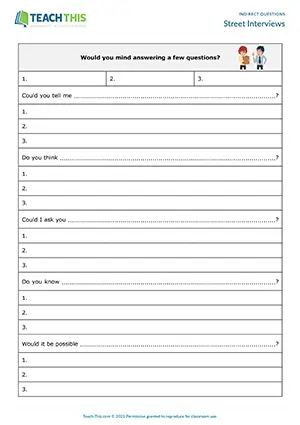
ESL Indirect Questions Role-Play - Speaking Activity: Forming, Asking and Answering Questions, Communicative Practice
In this engaging indirect questions speaking activity, students ask and answer indirect questions in a street interview. Students imagine that they are reporters for a local radio or TV station and...
Super Polite

ESL Indirect Questions Role-Play - Speaking Activity: Asking and Answering Questions, Communicative Practice - Pair Work
In this free indirect questions speaking activity, students role-play two situations where someone politely asks for information using indirect questions. In pairs, students begin by reading their role...
Would you mind telling me...?
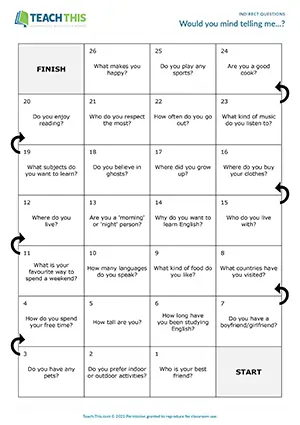
ESL Indirect Questions Board Game - Speaking: Forming, Asking and Answering Questions - Group Work
In this fun indirect questions board game, students change direct personal information questions into indirect questions and ask them to other students. In groups, players take turns rolling the dice and...
Celebrity Interviews
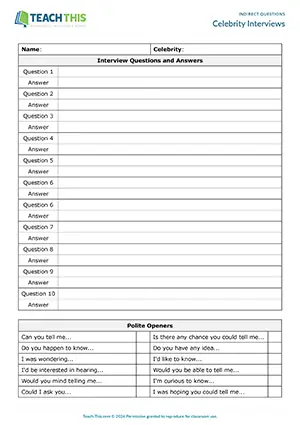
ESL Indirect Questions Activity - Writing, Grammar, and Speaking: Writing, Reforming, Asking, and Answering Questions, Role-Play, Freer Practice - Pair Work
In this imaginative indirect questions role-play activity, students practice forming, asking, and answering indirect questions in celebrity interviews. First, students...
Indirect Questions Race

ESL Indirect Questions Game - Grammar: Rewriting Questions - Pair Work
In this enjoyable indirect questions game, students race to rewrite direct questions as indirect questions using different polite phrases. One student from each pair runs to your desk, picks up the first question strip, and takes it back to their...
Using Indirect Questions
Indirect questions are a polite, softened way to ask for information, using openers like 'Could you tell me...?' or 'Do you know...?' rather than asking directly. When students skip indirect question forms in formal or professional settings, they risk coming across as blunt or rude, even when they intend to be polite.
This page covers indirect questions across A2, B1, and B2 levels, with nine resources including worksheets, speaking activities, role-plays, and a board game, with two available as free downloads. When a direct question becomes indirect, the helping verb do, does, or did is removed and the verb changes form to match the subject; for yes/no questions, 'if' or 'whether' replaces the yes/no structure entirely.
The table below shows how direct questions change form when converted to indirect questions across the main sentence types.
| Sentence Type | Direct Question | Indirect Question | Polite Opener Used |
|---|---|---|---|
| Wh- question (with do/does/did) | 'Where do you live?' | 'Could you tell me where you live?' | Could you tell me...? |
| Wh- question (with auxiliary) | 'Where has she gone?' | 'Do you know where she has gone?' | Do you know...? |
| Wh- question (with be) | 'What is the time?' | 'Could you tell me what the time is?' | Could you tell me...? |
| Wh- question (no auxiliary) | 'Who is your manager?' | 'Could you tell me who your manager is?' | Could you tell me...? |
| Yes/No question (with do/does) | 'Does she speak French?' | 'Could you tell me if she speaks French?' | Could you tell me if...? |
| Yes/No question (with auxiliary) | 'Have they arrived?' | 'Do you know if they have arrived?' | Do you know if...? |
| Yes/No question (with be) | 'Is the meeting today?' | 'Could you tell me if the meeting is today?' | Could you tell me if...? |
When to Use Indirect Questions
Approaching a stranger in public: When you need directions or help from someone you don't know, indirect questions signal that you respect their time and aren't demanding a response, for example softening 'Where is the nearest pharmacy?' to 'Could you tell me where the nearest pharmacy is?'
Formal written communication: In emails to managers, clients, or people in positions of authority, indirect questions keep your tone respectful rather than blunt, for example writing 'I was wondering if you could let me know when the report will be ready' instead of 'When will the report be ready?'
Interviewing or researching opinions: When gathering information from members of the public or conducting any kind of survey, indirect questions make the request feel less intrusive and more conversational, for example opening with 'Would you mind telling me how you feel about this issue?'
3-Step Framework for Teaching Indirect Questions
1. Build the Rules: Start with the grammar foundation. Students need to understand what changes when a direct question becomes indirect: word order flips to statement order, helping verbs like do, does, and did drop out, and yes/no questions pick up a polite expression with 'if.' Getting all three rules clear before production saves a lot of correction later.
2. Add Competitive Production: Once students can form indirect questions in controlled practice, a board game format pushes them to produce quickly and accurately under light pressure. Players can only stay on their square if their indirect question is both grammatically correct and uses a different polite phrase from the previous player's question, which means students have to vary their openers throughout the game. If the question is wrong, they go back two squares.
3. Take It Into the Real World: Put students in an authentic communicative situation where indirect questions are the natural tool. Give each student a topic and ask them to build five indirect questions around it before going out to interview classmates, for instance framing their questions like 'Could you tell me how you feel about cryptocurrency?' This moves the language from drilled form to genuine use.
Common Mistakes with Indirect Questions
Keeping the auxiliary do/does/did inside the indirect question: Students often carry the helping verb do, does, or did into the indirect question, forgetting that it drops out and the main verb changes form instead. Wrong: 'Could you tell me where does she work?' Correct: 'Could you tell me where she works?'
Keeping inverted word order instead of switching to statement order: Students often leave the subject and verb in the inverted order of a direct question rather than switching to the normal subject-verb order that indirect questions require. Wrong: 'Do you know what time is it?' Correct: 'Do you know what time it is?'
Common Questions About Teaching Indirect Questions
What is a good worksheet for learning indirect questions?
The worksheet Direct and Indirect Questions walks students through all three key rules: how verb placement changes, how do, does, and did drop out, and how yes/no questions use 'if.' Each rule comes with a controlled practice exercise before students write and ask their own indirect questions. It is also available as a free download.
What is an engaging speaking activity for practicing indirect questions?
In the free activity Super Polite, students use indirect questions across two back-to-back role-plays: first at a ticket office, asking about a flight to London, then at a hotel, asking for information as a guest. The two contrasting scenarios give students immediate, repeated practice in realistic contexts, and pairs present both role-plays to the class at the end.
What is a fun game for practicing indirect questions?
One student from each pair runs to the teacher's desk, picks up a question strip, and races back to their partner in the game Indirect Questions Race. The pair rewrites the direct question as an indirect one using the given polite phrase and keeps going until all 20 are correct. The first pair to finish wins.
Become a Teach This Member
Get unlimited access to the full library, plus new resources added every week.
Unlimited Resource Access
Download from 3000+ worksheets, activities, and games.
Save 5+ Hours Weekly
Cut lesson prep time with ready-to-use resources, plus teacher notes and answer keys.
Trusted Professional Quality
Classroom-tested, editable resources created by experienced ESL professionals.
Fresh Content Weekly
Get 5 new resources added to the library each week.
Here's what our members are saying...


