
Making Requests ESL Games, Activities & Worksheets
Guess the Request

ESL Making Requests Game - Speaking: Drawing Pictures, Guessing, Forming Questions - Pair Work
In this creative making requests game, students draw pictures of 'Can you...?' requests and try to guess requests from pictures a partner has drawn. First, in two groups, students draw...
Requests Mingle
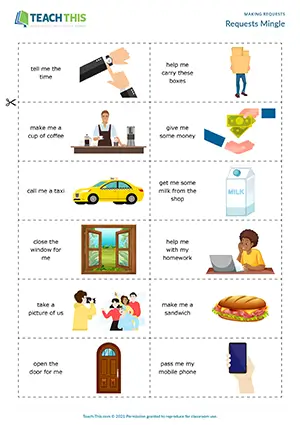
ESL Making, Accepting and Declining Requests Activity - Speaking: Asking and Answering Questions, Communicative Practice
In this free making requests speaking activity, students practice making, accepting and declining requests using prompts on cards. Give each student a request...
Could you...?
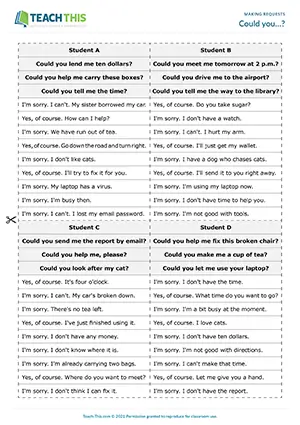
ESL Could You Requests Game - Speaking: Asking and Answering Questions, Controlled Practice - Group Work
In this engaging making requests game, students race to find someone to accept their requests. The aim of the game is for students to make requests and find the person in their group who has the 'Yes, of...
Help Me Out!

ESL Making Requests Game - Speaking: Asking and Answering Questions, Communicative Practice
In this communicative making requests game, students practice making, accepting and declining requests by racing to find classmates who are free to help them with five tasks. First, students write five...
Race to Respond
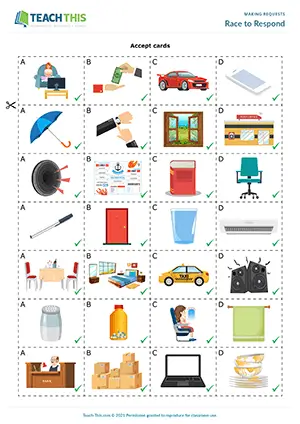
ESL Accepting and Declining Requests Game - Speaking: Asking and Answering Questions, Freer Practice - Group Work
In this fast-paced making requests game, students race to accept and decline requests. In groups, students take turns picking up a card, making an appropriate request based on the situation and placing the...
Special Requests

ESL Polite Requests Worksheet - Grammar Exercises: Binary Choice, Gap-fill, Matching, Unscrambling, Error Correction, Rewriting and Writing Sentences
In this comprehensive making requests worksheet, students learn and practice how to make polite requests with 'Could you...?' and 'Would you mind...?' Students...
Be Polite

ESL Polite Requests Worksheet - Vocabulary Exercises: Forming Questions, Word Completion - Speaking Activity: Asking and Answering Questions - Pair Work
Here is a polite requests worksheet to help students practice a variety of phrases for making, accepting and declining requests politely. First, students use...
Deal With It
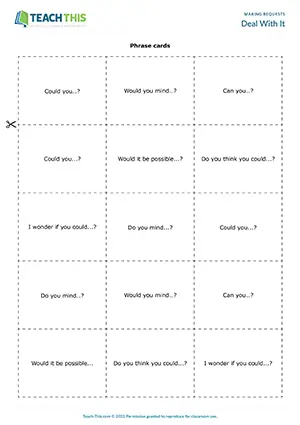
ESL Making Requests Game - Speaking: Forming Questions, Communicative Practice - Group Work
In this productive making requests game, students practice a variety of request phrases by racing to make suitable requests for common situations. In groups of three, one student picks up a situation...
Let's Practice Requests

ESL Requests Worksheet - Vocabulary Exercises: Gap-fill, Writing Sentences, Error Correction - Speaking Activity: Role-Play, Freer Practice - Pair Work
In this free making requests worksheet, students practice making, accepting and declining requests using various phrases. First, students read two...
Making Requests Board Game
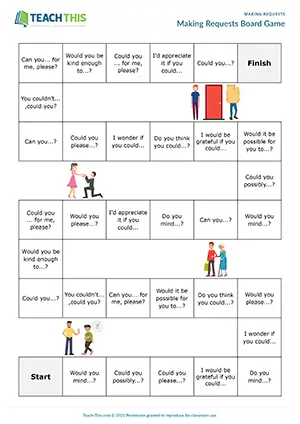
ESL Requests Board Game - Speaking: Forming Questions - Group Work
In this fun making requests board game, students practice making requests in everyday situations using various phrases. Players take turns rolling the dice and moving their counter along the board. When a player lands on a square, the...
Party Time
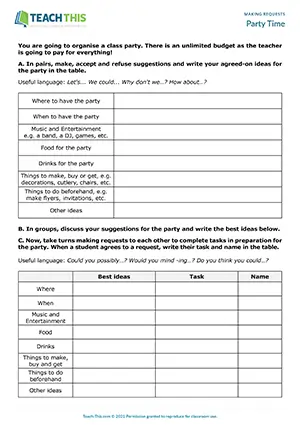
ESL Suggestions and Requests Activity - Speaking: Asking and Answering Questions, Table Completion, Discussion, Presenting - Pair and Group Work
In this imaginative making suggestions and requests activity, students plan and organise a class party by making, accepting and refusing suggestions and requests...
Would you mind...?
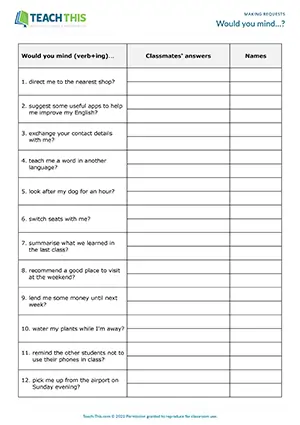
ESL Would You Mind Activity - Speaking: Asking and Answering Questions, Communicative Practice
In this communicative making requests activity, students practice making 'Would you mind -ing...?' requests and accepting and declining them. Students go around the class making requests for the...
Request Recall
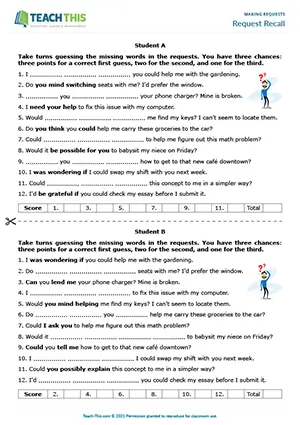
ESL Requests Game - Vocabulary, Gap-fill, Guessing - Pair Work
In this entertaining making requests game, students practice phrases for making requests. In pairs, one student begins by guessing the missing words in the first request. Their partner listens and tells them if they are correct or not...
Using Requests
English requests range from informal phrases like 'Can you...?' to more careful ones like 'Could you possibly...?' and 'Would you mind...?', and each one sends a different social signal. A learner who relies on just one phrase across all situations risks sounding too casual with a boss, too stiff with a friend, or unintentionally rude with a stranger.
This page covers making requests across A1 to B2 levels, with 13 activities ranging from drawing games and mingling activities to a board game and a party-planning discussion, including two free downloads.
This table maps the most common expressions for making requests to the situations where each one fits naturally.
| Expression | Situation | Example |
|---|---|---|
| 'Can you...?' | Asking a friend or family member for a small, easy favor | 'Can you grab me a coffee?' |
| 'Could you...?' | Asking a colleague or someone you don't know well | 'Could you send me that file?' |
| 'Could you possibly...?' | Making a request that needs a little more care or effort | 'Could you possibly stay late tonight?' |
| 'Would you mind...?' | Asking someone to do something that may inconvenience them | 'Would you mind moving your bag?' |
| 'Do you mind if I...?' | Asking for permission rather than action | 'Do you mind if I open the window?' |
| 'I was wondering if you could...' | Making a tentative or very polite request in writing or speech | 'I was wondering if you could take a look at this report.' |
When to Use Requests
Asking a friend or family member for help: When the listener is someone you know well and the task is minor, a short informal phrase like 'Can you...?' fits naturally because it matches the ease and closeness of the relationship, as in 'Can you give me a hand with this?'
Asking a colleague or someone you have just met: In a workplace or with a new acquaintance, expressions like 'Could you...?' or 'Could you possibly...?' signal respect and consideration without sounding distant or overly formal, as in 'Could you possibly send me those figures before lunch?'
Asking someone to do something that takes real effort: When a request involves a genuine imposition on the listener's time or comfort, a phrase like 'I was wondering if you could...' or 'Would you mind...?' shows that you recognize the effort involved and are not taking the other person for granted, as in 'I was wondering if you could cover my shift on Friday.'
3-Step Framework for Teaching Requests
1. Build the Phrase from the Start: Give students meaningful repetition with request phrases through a drawing-and-guessing game that rewards accuracy. Students draw pictures to represent 'Can you...?' requests, then swap drawings with a partner and take turns guessing what each picture shows. The scoring gives three points for a correct first guess, two for the second, and one for the third, keeping both students alert throughout.
2. Add Phrase Variety Under Pressure: Once students know the basic expressions, push them to produce a range of request phrases quickly. In a group of three, one student reads a situation aloud, such as 'The plants need watering.', while the other two race to form a suitable request using the phrase on their individual phrase card, so the same situation prompts two competing versions and students hear the contrast immediately.
3. Take Phrases into Real Communication: The final step moves students away from controlled practice and into a genuine communicative task where the language has to do real work. Students plan a class party, starting with suggestions and moving into requests, and they only agree to a request if they genuinely think they wouldn't mind doing it. The scenario, in which the teacher is going to pay for everything, provides just enough energy to keep the discussion lively.
Common Mistakes with Requests
Infinitive after 'Would you mind': Students often follow 'Would you mind' with an infinitive instead of a gerund, treating it like 'Could you' or 'Can you'. Wrong: 'Would you mind to close the window.' Correct: 'Would you mind closing the window.'
Saying 'Yes' to agree to a 'Would you mind' request: Students often say 'Yes' to signal agreement when responding to a 'Would you mind...?' request, not realizing that 'yes' means they do mind and are in fact refusing. Wrong: 'Would you mind opening the door?' 'Yes, of course.' Correct: 'Would you mind opening the door?' 'No, not at all.'
Common Questions About Teaching Requests
What is an engaging activity for practicing requests?
In the activity Requests Mingle, each student holds a card showing a request prompt on one side and a tick or cross on the other. Students move around the class making, accepting, and declining requests with different classmates. They then flip their cards and repeat, making a fresh request to each person they meet. It is free to download.
What is a good worksheet for making requests?
The worksheet Let's Practice Requests takes students from reading model dialogues through gap-fill, error correction, and sentence writing before they write and perform their own request conversation. It covers making, accepting, and declining requests and includes a section where students rewrite impolite exchanges to make them more polite. It is free to download.
What is a fun board game for making requests?
The board game Making Requests Board Game gives each player a different phrase on every turn and a situation to match it to. Get the request right and you stay put. Get it wrong and you go back two squares. It is the kind of game where one bad answer can change everything.
Become a Teach This Member
Get unlimited access to the full library, plus new resources added every week.
Unlimited Resource Access
Download from 3000+ worksheets, activities, and games.
Save 5+ Hours Weekly
Cut lesson prep time with ready-to-use resources, plus teacher notes and answer keys.
Trusted Professional Quality
Classroom-tested, editable resources created by experienced ESL professionals.
Fresh Content Weekly
Get 5 new resources added to the library each week.
Here's what our members are saying...


