
Transition Words ESL Worksheets & Games
Cause and Effect
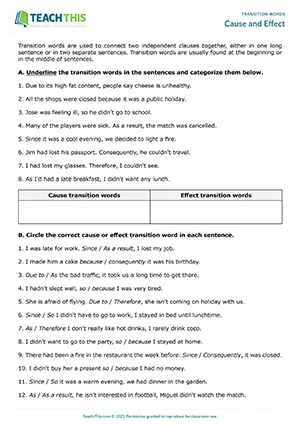
ESL Cause and Effect Worksheet - Vocabulary and Grammar Exercises: Identifying, Categorising, Binary Choice, Gap-fill, Unscrambling, Rewriting Sentences
In this comprehensive cause and effect worksheet, students practice transition words to show cause and effect. First, students identify cause and effect...
Link Up

ESL Transition Words Game - Vocabulary and Grammar: Matching, Sentence Completion - Group and Pair Work
In this free transition words game, students connect sentences together with transition words and phrases for giving additional information. Read the first sentence to the class. Students then take it...
Common Discourse Markers
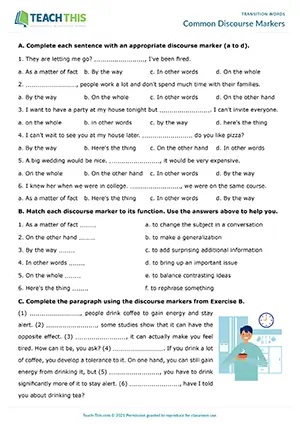
ESL Discourse Markers Worksheet - Vocabulary and Grammar Exercises: Gap-fill, Matching, Sentence Completion, Rewriting Sentences
In this useful discourse markers worksheet, students practice six discourse markers commonly used in everyday conversation. Students start by...
Comparing and Contrasting
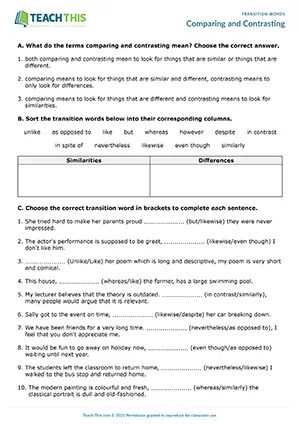
ESL Comparing and Contrasting Worksheet - Vocabulary and Grammar Exercises: Categorising, Binary Choice, Unscrambling, Writing Sentences
This productive comparing and contrasting worksheet helps students learn and practice transition words that are used to compare and contrast information. To begin...
Condition Words and Phrases

ESL Condition Words Worksheet - Vocabulary and Grammar Exercises: Matching, Gap-fill, Error Correction, Sentence Completion
This handy condition words worksheet helps students practice words and phrases that express conditions. First, students match condition sentences or...
Contrast, Cause and Effect
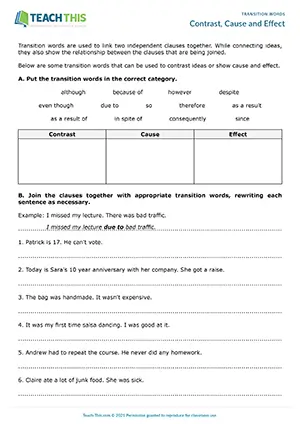
ESL Contrast, Cause and Effect Worksheet - Vocabulary and Grammar Exercises: Categorising, Rewriting Sentences, Gap-fill, Binary Choice
In this free transition words worksheet, students learn and practice transition words that show contrast, cause and effect. To start, students categorise transition...
Despite
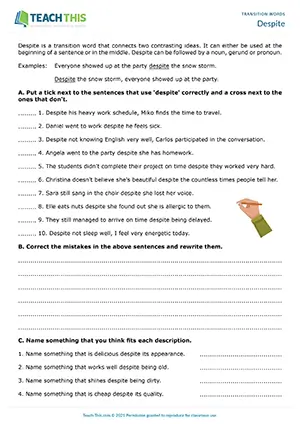
ESL Despite Worksheet - Grammar and Vocabulary Exercises: Identifying, Error Correction, Listing, Matching, Writing Sentences
This insightful contrasting ideas worksheet helps students learn how to use the transition word 'despite' in sentences to link contrasting ideas. Students begin by...
Generalization Race
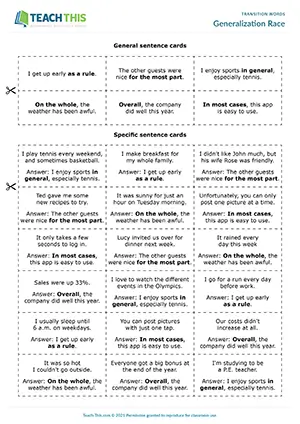
ESL Transition Words Game - Vocabulary: Matching - Group Work
In this fast-paced generalization words game, students race to match specific statements with general ones. Students take it in turns to pick up a specific sentence card and read it to the group. The other group members listen and then race to find and...
Illustration Words and Phrases
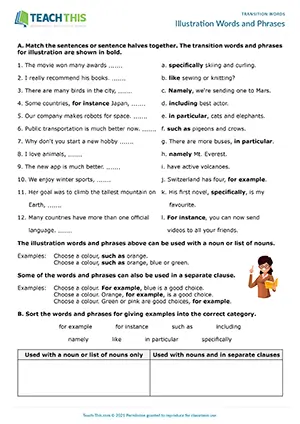
ESL Illustration Words Worksheet - Grammar and Vocabulary Exercises: Matching, Categorising, Error Correction, Rewriting Sentences
This rewarding illustration words worksheet helps students practice words and phrases that illustrate a point with examples. Students start by matching sentences...
Sequence Words

ESL Sequence Words Worksheet - Vocabulary, Grammar, Reading and Writing Exercises: Ordering, Categorising, Unscrambling, Sentence Completion
This engaging sequence words worksheet helps students learn and practice transition words that show order. First, students put instructions for making ice...
Summarising
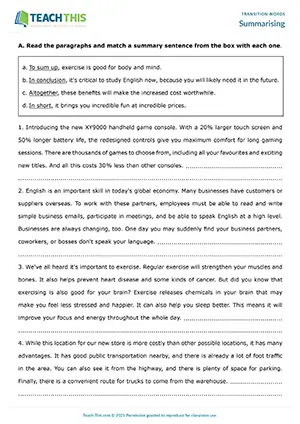
ESL Summarising Worksheet - Vocabulary, Reading and Writing Exercises: Matching, Writing Sentences
This enjoyable summarising worksheet helps students learn and practice transition words that are used to summarise. First, students read paragraphs and match a summary sentence from a box with...
Compare and Contrast Race
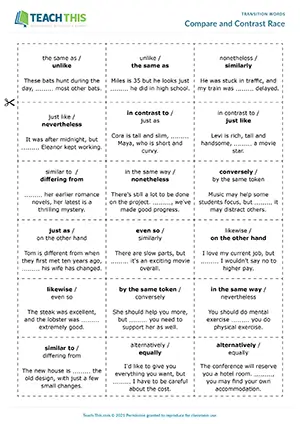
ESL Transition Words Game - Vocabulary: Sentence Completion - Group Work
In this fun transition words game, students race to complete sentences with transition words for comparing and contrasting. Students take it in turns to pick up a card and read the two transition words or phrases on the card to the other...
Concession Words and Phrases
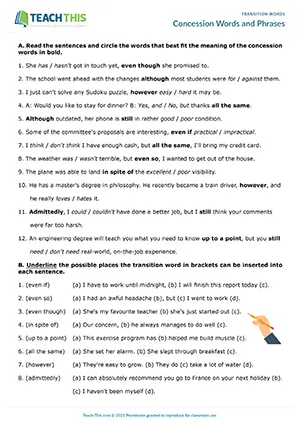
ESL Concession Words Worksheet - Grammar and Vocabulary Exercises: Binary Choice, Identifying, Rewriting Sentences, Sentence Completion
This in-depth concession words worksheet helps students practice transition words and phrases that concede a point. To begin, students read example...
Connected
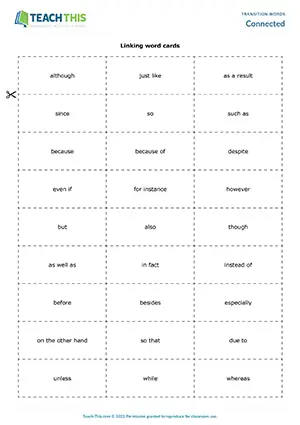
ESL Linking Words Game - Speaking and Vocabulary: Discussions - Group Work
In this free linking words game, students discuss various topics using specific linking words and phrases. Each student takes a linking word card and the first topic card is turned over for everyone to see, e.g. ambitions. Students then...
Emphasis Words and Phrases
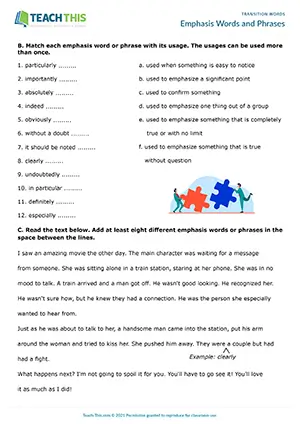
ESL Emphasis Words Worksheet - Grammar and Vocabulary Exercises: Gap-fill, Matching, Modifying Sentences
This memorable emphasis words worksheet helps students practice words and phrases that emphasise a point. Students start by completing sentences with emphasis transition words and...
Reason and Result Race
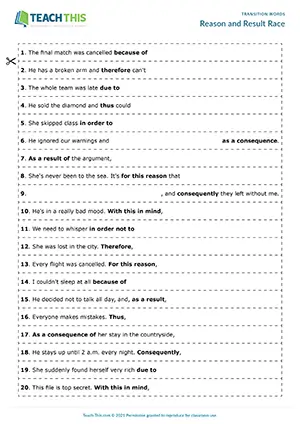
ESL Transition Words Game - Grammar and Vocabulary: Sentence Completion - Pair Work
In this entertaining transition words game, students race to complete sentences that use transition words for giving reasons and results. One student from each pair comes to your desk and picks up...
Understanding Transition Words
Transition words are words and phrases such as 'however,' 'therefore,' and 'in addition' that link ideas, sentences, and paragraphs by showing the logical relationship between them. When students speak or write without them, their ideas sit in isolation and a listener or reader has no way of knowing whether one point contrasts, follows from, or builds on the one before it.
This page covers transition words across A2, B1, and B2 levels, with 16 resources ranging from matching and gap-fill worksheets to fast-paced group games, including three free downloads.
The table below shows common transition words and phrases grouped by their communicative function, with an example sentence for each.
| Function | Transition Words / Phrases | Example Sentence |
|---|---|---|
| Addition | also, in addition, furthermore, moreover | 'The report was thorough; furthermore, it was delivered on time.' |
| Contrast | however, although, nevertheless, on the other hand | 'The price was high; however, the quality was excellent.' |
| Cause | because, since, as, due to | 'Sales dropped due to the economic slowdown.' |
| Effect / Result | therefore, as a result, consequently, so | 'He missed the deadline; as a result, the project was delayed.' |
| Comparison | similarly, likewise, in the same way | 'She works long hours; likewise, her colleague rarely leaves before seven.' |
| Concession | despite, even though, while, although | 'Despite the rain, the outdoor event went ahead.' |
| Sequence | first, then, next, finally, once | 'First, bring the water to a boil; then add the pasta.' |
| Illustration | for example, for instance, such as | 'Many factors affect learning, such as motivation and environment.' |
| Condition | if, unless, provided that, as long as | 'You can borrow the car as long as you return it by six.' |
| Summary | in conclusion, to summarize, overall, in short | 'Overall, the results exceeded expectations.' |
| Emphasis | in fact, indeed, above all, especially | 'Above all, students need consistent practice to improve.' |
| Generalization | in general, generally, as a rule, overall | 'In general, earlier practice sessions produce better retention.' |
When to Use Transition Words
Signaling a Shift in Direction: A speaker or writer uses a contrast transition word when the second idea contradicts or qualifies the first, making the turn in logic audible or visible rather than leaving the audience to guess, as in 'The project came in on budget; however, the timeline slipped by three weeks.'
Showing That One Thing Leads to Another: Cause and effect transition words signal that the second idea is a direct consequence of the first, giving a listener or reader the logical link they need to follow the argument, as in 'Staff turnover increased significantly; as a result, training costs rose sharply.'
Guiding an Audience Through Steps: Sequence transition words show the order in which actions or events occur, giving a listener following spoken instructions or a reader working through a procedure a clear path without needing to recount steps, as in 'Once the sauce has thickened, remove the pan from the heat.'
3-Step Framework for Teaching Transition Words
1. Build Recognition with a Matching Race: Start by getting students to recognize what transition words actually do before they try to produce them. In a matching race format, one student reads a specific sentence card aloud to the group, and the other students race to find and read out the general sentence card that would logically come before it. This pushes students to process the logical connection between ideas at speed, not just spot a familiar word.
2. Lock In Sequence with Authentic Context: Move students from recognition to controlled production using a sequencing task built around a real-world process. Have students order a set of instructions and underline the transition words at work in each step. Using instructions for making ice cream in the correct order 1 to 5 gives students a concrete, familiar context that makes the sequencing logic immediately clear.
3. Push for Spontaneous Use in Live Conversation: The final step puts transition words into real spoken use. Assign each student a linking word card, then reveal a topic card such as 'ambitions,' and give the group two minutes to discuss it. Each student tries to work their linking word naturally into the conversation, scores a point when they succeed, and draws a fresh card to keep going.
Common Mistakes with Transition Words
Confusing Despite with Although: Students often use 'despite' where 'although' is needed in speech and writing, because both express contrast, but 'despite' must be followed by a noun or gerund, not a subject and verb. Wrong: 'Despite she was tired, she finished the presentation.' Correct: 'Despite being tired, she finished the presentation.'
Choosing the Wrong Logical Signal: Students often select a transition word based on rough meaning rather than the precise logical relationship between ideas, producing statements that contradict themselves in speech or writing. Wrong: 'I studied hard for the exam. However, I passed.' Correct: 'I studied hard for the exam. As a result, I passed.'
Common Questions About Teaching Transition Words
What is a fun game for practicing transition words?
In the game Compare and Contrast Race, a student reads two transition word options aloud, then reads a sentence with 'blank' where the answer goes, and the others race to call out the correct word. Knowing the options in advance builds anticipation every round. The first to answer correctly wins the card, and the player with the most cards wins.
What is a useful worksheet for teaching transition words?
The worksheet Contrast, Cause and Effect covers three functions in one resource: students categorize contrast, cause, and effect words, then join clause pairs using the correct transition word, rewriting where necessary, and finish with a gap-fill story. Recognition and production tasks in the same worksheet make it easy to use as a complete lesson. It is a free download.
What is a good game for practicing linking words?
As a free game, Link Up has students build a conversation chain by connecting sentences with transition words for adding information. Each student picks a sentence from their worksheet and adds it to the chain using 'too' or a transition word such as 'additionally.' The student who uses the most transition words across the chain wins.
Become a Teach This Member
Get unlimited access to the full library, plus new resources added every week.
Unlimited Resource Access
Download from 3000+ worksheets, activities, and games.
Save 5+ Hours Weekly
Cut lesson prep time with ready-to-use resources, plus teacher notes and answer keys.
Trusted Professional Quality
Classroom-tested, editable resources created by experienced ESL professionals.
Fresh Content Weekly
Get 5 new resources added to the library each week.
Here's what our members are saying...


