
Business Email Requests & Clarifying Questions Worksheets
Responding to an Email Enquiry
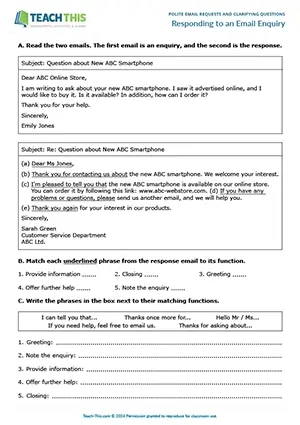
Business English Email Enquiries Worksheet - Reading, Vocabulary and Writing Exercises: Matching, Sentence Completion, Writing Emails - Pair Work
In this email enquiries worksheet, students learn and practice how to write an email that responds to a customer enquiry. First, students read an enquiry email...
Writing an Invitation Email
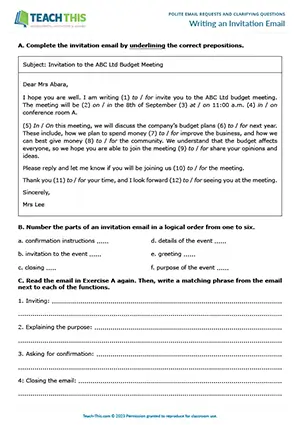
Business English Invitation Emails Worksheet - Reading and Writing Exercises: Binary Choice, Ordering, Identifying, Matching, Email Writing
In this useful business invitation emails worksheet, students learn and practice how to write emails issuing work-related invitations. First, students complete an...
Polite Replacement Requests
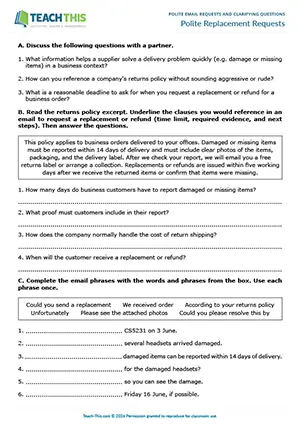
Business English Email Requests Worksheet - Reading, Vocabulary and Writing Exercises: Gap-fill, Ordering, Email Writing - Speaking Activity: Discussion - Pair Work
In this comprehensive request emails worksheet, students practice writing polite replacement or refund request emails and asking clarifying questions...
Clarifying Invoice Discrepancies
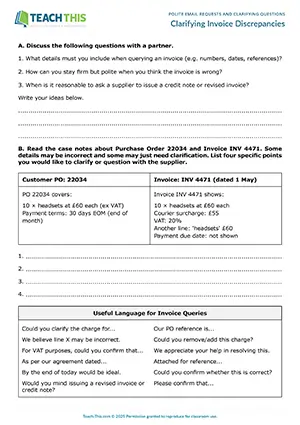
Business English Email Requests and Clarifying Questions Worksheet - Reading and Writing Exercises: Identifying, Email Writing - Speaking Activity - Pair Work
In this Business English worksheet on email requests and clarifying questions, students practice clarifying invoice discrepancies and requesting revised invoices or...
Diplomatic Clarifying Questions
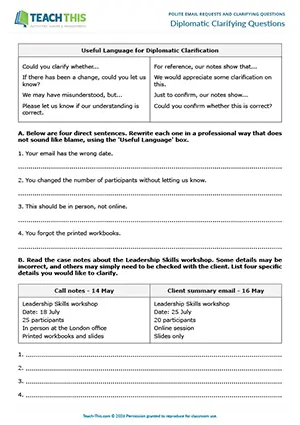
Business English Email Clarifying Questions Worksheet - Reading and Writing Exercises: Writing Clarifying Questions, Email Writing, Peer Feedback
In this clarifying questions worksheet, students practice using tactful language to check details, avoid blame and resolve possible misunderstandings in...
From Vague to Clear
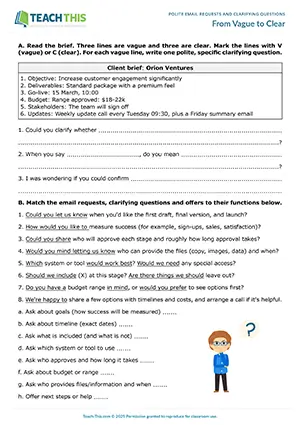
Business English Email Clarifying Questions Worksheet - Reading, Vocabulary and Writing Exercises: Sentence Completion, Matching, Rewriting Sentences and Emails
In this clarifying questions in business emails worksheet, students practice identifying vague information in client emails and briefs and writing polite, specific...
Handover Email Requests
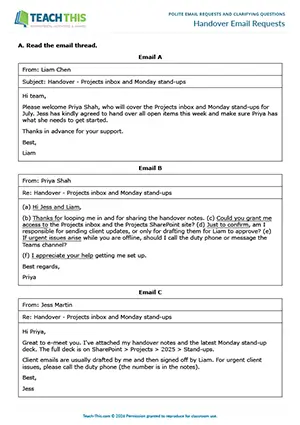
Business English Email Requests Worksheet - Reading, Vocabulary and Writing Exercises: Ordering, Sentence Completion, Writing Emails - Pair Work
In this business email requests worksheet, students practice writing polite handover emails to request access, clarify responsibilities and ask...
Polite Alternatives
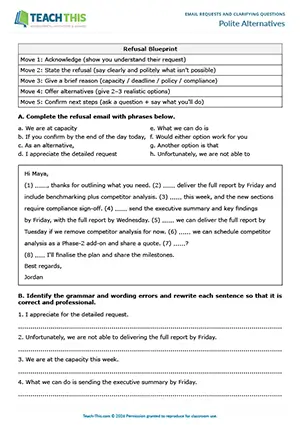
Business English Email Requests Worksheet - Reading and Writing Exercises: Gap-fill, Error Correction, Generating Options, Email Writing, Peer Feedback
In this responding to requests email worksheet, students learn and practice how to politely refuse a customer request and offer alternatives. First, read the...
The Question Funnel
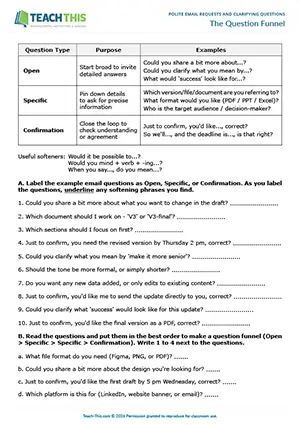
Business English Email Clarifying Questions Worksheet - Reading and Writing Exercises: Ordering, Writing and Rewriting Questions - Speaking - Discussion - Pair Work
In this email clarifying questions worksheet, students identify, soften, and sequence follow-up questions using a question funnel framework. First, students...
Business Email Requests and Clarifying Questions
Business email requests ask a reader to take action, while clarifying questions check information needed to understand a situation or proceed with a task. Students need to make both specific and appropriately polite so the recipient knows what to answer or do next.
This page contains nine worksheets across A2, B1 and B2, including one free worksheet, covering enquiries, invitations, requests, clarification and responses.
The table shows communication purposes with hypothetical examples that can be adapted to the recipient and situation.
| Communication purpose | Use | Example language |
|---|---|---|
| Give context | Identify the message, order or task being discussed. | 'I'm writing about the revised training schedule.' |
| Request an action | Tell the reader what you need them to do. | 'Could you send the updated schedule by Thursday?' |
| Ask for a missing detail | Replace vague information with a specific question. | 'What time should the first session finish?' |
| Check your understanding | Confirm an interpretation before acting on it. | 'Could you confirm whether the workshop is online?' |
| Explain why you are asking | Connect the request with a relevant purpose. | 'This will help us arrange the room and equipment.' |
| Offer an alternative | Respond constructively when the original request cannot be met. | 'We cannot provide a morning session, but we can offer an afternoon appointment.' |
How to Make Requests and Clarify Details by Email
Identify the information gap: Check what the existing message already tells you before asking questions. Name the specific detail you need, such as a date, quantity or responsibility, rather than asking generally for more information.
Balance politeness with precision: Choose wording suited to the relationship without burying the request in unnecessary phrases. If a deadline matters, state it and explain its purpose rather than relying on 'as soon as possible'.
Make the response easy to organise: Keep related questions together and separate distinct requests when needed. When replying, address each relevant point and distinguish confirmed information from details that still need checking.
3-Step Framework for Teaching Email Requests and Clarifying Questions
This B2 sequence develops tactful wording, question organisation and complete request emails through separate scenarios. It can be used across lessons.
1. Make Questions Tactful and Specific: Students rewrite direct sentences using supplied language, then examine workshop case notes and identify details to clarify. They write questions and an email to the client before exchanging feedback. This connects tone choices with an actual need for information.
2. Organise Follow-Up Questions: Students distinguish open, specific and confirmation questions, identify softening phrases and arrange questions into a funnel. They then write four clarification questions for scenarios and compare their final confirming questions. The framework provides a practice structure, not a requirement to include four questions in every email.
3. Apply the Language in a Handover: Students order an email thread, identify the functions of phrases and complete requests and questions. After rewriting direct requests, they produce a follow-up handover email based on the thread. Partner feedback and revision check whether the message clearly requests access, clarifies responsibilities and addresses urgent issues.
Common Mistakes with Email Requests and Clarifying Questions
Using the wrong verb form after would you mind: Follow this expression with an -ing form when requesting an action. Incorrect: 'Would you mind to send the updated file?' Correct: 'Would you mind sending the updated file?'
Leaving the clarification question too broad: A general request may not tell the reader which detail is missing. Vague: 'Could you clarify the arrangements?' More specific: 'Could you confirm the start time and whether the session will be online?'
Common Questions About Teaching Email Requests and Clarifying Questions
What worksheet helps teach polite email requests?
The worksheet Polite Replacement Requests uses a returns policy and an order problem to develop polite request emails. Students identify relevant policy details, complete useful phrases and order a model email before writing their own replacement or refund request with a clarifying question. Partner feedback then helps them improve the message.
What worksheet helps teach clarifying questions in emails?
The worksheet From Vague to Clear helps students identify missing information before asking for clarification. They distinguish clear and vague lines in a brief, write specific questions and connect email phrases with their functions. Rewriting blunt lines and a complete email then gives students practice combining a polite tone with precise questions.
What free worksheet helps teach saying no politely in emails?
The worksheet Polite Alternatives introduces a structure for refusing a customer request while offering alternatives. Students complete a model email, correct wording and grammar, and develop possible solutions for scenarios. They then write a refusal email and discuss it with a partner, checking whether the response follows the structure and sounds professional.
Become a Teach This Member
Get unlimited access to the full library, plus new resources added every week.
Unlimited Resource Access
Download from 3000+ worksheets, activities, and games.
Save 5+ Hours Weekly
Cut lesson prep time with ready-to-use resources, plus teacher notes and answer keys.
Trusted Professional Quality
Classroom-tested, editable resources created by experienced ESL professionals.
Fresh Content Weekly
Get 5 new resources added to the library each week.
Here's what our members are saying...


