
The Natural World ESL Worksheets, Games & Activities
Naturally Clever
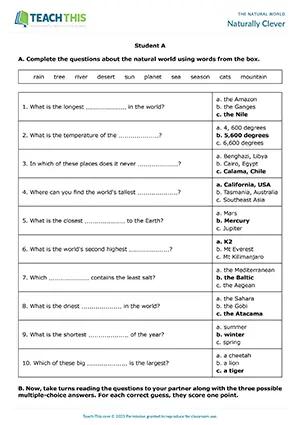
ESL Natural World Activity - Vocabulary: Gap-fill, Multiple-Choice Questions, Guessing - Pair Work
This interesting natural world trivia quiz helps students practice vocabulary related to nature. First, in two groups, students complete natural-world trivia questions using words from a box. Next, students...
Nature Pair-Up

ESL Natural World Games - Vocabulary and Speaking: Snap, Matching, Pelmanism, Forming Sentences - Pair Work
Here are two enjoyable natural world vocabulary games to help students practice words related to nature. Students begin by playing a game of snap. In pairs, students turn over a card from their pile at...
A Natural Match
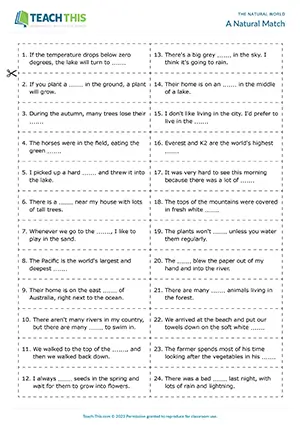
ESL Natural World Games - Vocabulary and Speaking: Matching, Describing, Guessing, Freer Practice - Group and Pair Work
These two fun natural world games help students practice vocabulary related to the natural world. First, students play a gap-fill pelmanism game to practice the natural world vocabulary. In groups of four...
Naturally Speaking

ESL Natural World Board Game - Vocabulary and Speaking: Multiple-Choice Questions, Guessing, Impromptu Speech, Communicative Practice - Group Work
In this engaging natural world board game, students practice nature vocabulary and talk about nature-related topics. In groups, players take turns rolling the dice...
Geo-Trivia Challenge

ESL Geographical Feature Games - Reading and Vocabulary: Unscrambling, Matching, True or False, Guessing - Pair Work
Here are two useful geographical feature games to help students practice or review vocabulary related to geographical features. First, students play an unscrambling and matching game in pairs...
Water Vocabulary
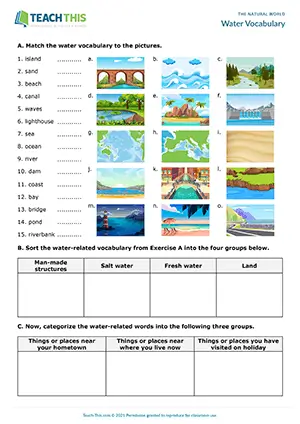
ESL Water Worksheet - Vocabulary Exercises: Matching, Categorising, Crossword, Question Completion - Speaking Activity: Freer Practice - Pair Work
This free water vocabulary worksheet helps students learn and practice water-related words that appear in nature as well as some water words that are...
At the Beach

ESL At the Beach Worksheet - Vocabulary Exercises: Matching, Gap-fill, Short Answer Questions - Listening and Speaking: Drawing and Describing - Pair Work
In this productive beach vocabulary worksheet, students learn nature words related to beaches. To begin, students match beach vocabulary to pictures...
Countryside Vocabulary
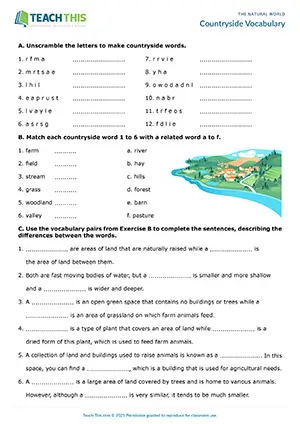
ESL Countryside Worksheet - Vocabulary Exercises: Unscrambling, Matching, Gap-fill - Speaking: Asking and Answering Questions, Freer Practice - Pair Work
In this detailed countryside vocabulary worksheet, students learn words related to the countryside and review the differences between similar words. First...
Natural Disasters
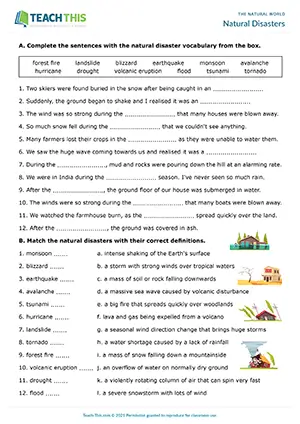
ESL Natural Disasters Worksheet - Vocabulary Exercises: Gap-fill, Matching - Speaking Activity: Discussion, Multiple Choice - Pair Work
In this insightful natural disasters worksheet, students learn and practice the names of natural disasters and related vocabulary. Students begin by completing...
The Poles
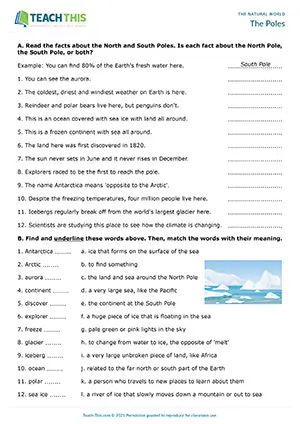
ESL The Poles Worksheet - Reading and Vocabulary Exercises: Short Answer Questions, Identifying, Matching, Table Completion
In this comprehensive North and South Poles worksheet, students learn and practice vocabulary related to the Poles. First, students read facts about the North...
Climate Change
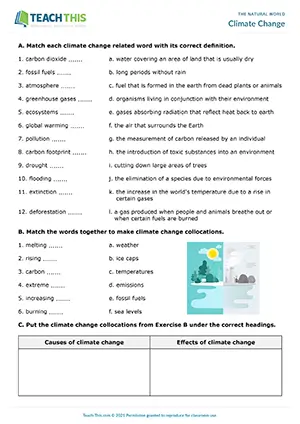
ESL Climate Change Worksheet - Reading and Vocabulary Exercises: Matching, Categorising, Gap-fill - Speaking Activity: Discussion, Freer Practice - Pair Work
In this compelling climate change worksheet, students learn essential terms and collocations associated with the topic of climate change. To start...
Using Natural World Vocabulary
Natural world vocabulary describes landscapes, water features, plants and natural processes. Using these words accurately helps students describe places, compare environments and explain their experiences of nature.
This page contains 11 resources from elementary (A1-A2) to advanced (C1), including one free download. Topics include geographical features, water, beaches, the countryside, natural disasters, polar regions and climate change.
Connect each word with a clear meaning and a sentence students could use about a place.
| Purpose | Useful language | Example |
|---|---|---|
| Describe landforms | mountain, hill, valley | 'The village is in a valley between two mountains.' |
| Identify water features | river, lake, waterfall | 'A river flows through the forest.' |
| Describe the coast | beach, cliff, bay | 'There is a sandy beach beside the cliffs.' |
| Describe vegetation | tree, bush, grass | 'Tall grass grows beside the path.' |
| Discuss natural events | flood, drought, earthquake | 'The drought lasted several months.' |
| Discuss environmental change | climate change, habitat loss | 'Habitat loss can affect wildlife.' |
How to Use Natural World Vocabulary
Clarify similar words with pictures: Show contrasting examples, such as a river and a lake, and ask students to explain what distinguishes them. Include both a meaning and a useful phrase when recording each new word.
Connect vocabulary with familiar places: Invite students to describe somewhere nearby, somewhere they have visited or a place in a photograph. Offer the photograph option so the task does not depend on travel experience.
Build descriptions with relationships: Move beyond lists of landscape words by adding location and action phrases, such as 'beside the river' or 'flows through the valley'. Ask partners to identify a picture from the description to give precise wording a purpose.
3-Step Framework for Teaching Natural World Vocabulary
For elementary to pre-intermediate students, move from recognising nature words to interpreting them in questions and developing short spoken answers.
1. Link words with pictures: Students play snap with nature words and pictures, then match pairs in a memory game. Making a sentence with a matched word earns an extra point. This extends visual recognition into using the word in context.
2. Interpret words in questions: Students complete nature trivia questions with supplied vocabulary, then read their questions and answer options to a partner. This shifts practice from single-word recognition to understanding the role of a word in a complete question.
3. Develop a spoken response: Use a board game with nature topics that students discuss for 20 seconds, alongside multiple-choice questions. Encourage them to support an answer with a description or example, building from the shorter sentence work in the first stage.
Common Mistakes with Natural World Vocabulary
Confusing 'nature' and 'natural': 'Nature' is a noun; 'natural' is an adjective describing something that exists or happens without being made by people. Incorrect: 'This is a nature lake.' Correct: 'This is a natural lake.' The noun is appropriate in a phrase such as 'I enjoy spending time in nature.'
Confusing 'scenery' and 'view': 'Scenery' is normally uncountable and describes the natural features of a landscape. A 'view' is what you can see from a particular place. Incorrect: 'There is a beautiful scenery from the window.' Correct: 'There is a beautiful view from the window.' You can also say 'The scenery is beautiful.'
Common Questions About Teaching Natural World Vocabulary
What free worksheet can I use for teaching nature vocabulary?
The free worksheet Water Vocabulary introduces words for natural water features and related structures through pictures and categories. Students connect the words with places they know, complete a vocabulary crossword, then ask a partner about places they have visited. This links word meanings with familiar locations and personal experiences.
What game helps students practice nature vocabulary?
The resource A Natural Match combines sentence matching with a team describing game. Students first match nature words to sentences and read them aloud. They then describe the words for a teammate to guess within ten seconds, moving from recognising vocabulary in context to explaining meanings in their own words.
What speaking activity helps students describe natural places?
The worksheet At the Beach finishes with a picture dictation activity. After matching beach words to pictures and using them in sentences, students draw a beach scene and describe it for a partner to reproduce. The drawing task gives students a reason to make their descriptions clear and specific.
Become a Teach This Member
Get unlimited access to the full library, plus new resources added every week.
Unlimited Resource Access
Download from 3000+ worksheets, activities, and games.
Save 5+ Hours Weekly
Cut lesson prep time with ready-to-use resources, plus teacher notes and answer keys.
Trusted Professional Quality
Classroom-tested, editable resources created by experienced ESL professionals.
Fresh Content Weekly
Get 5 new resources added to the library each week.
Here's what our members are saying...


